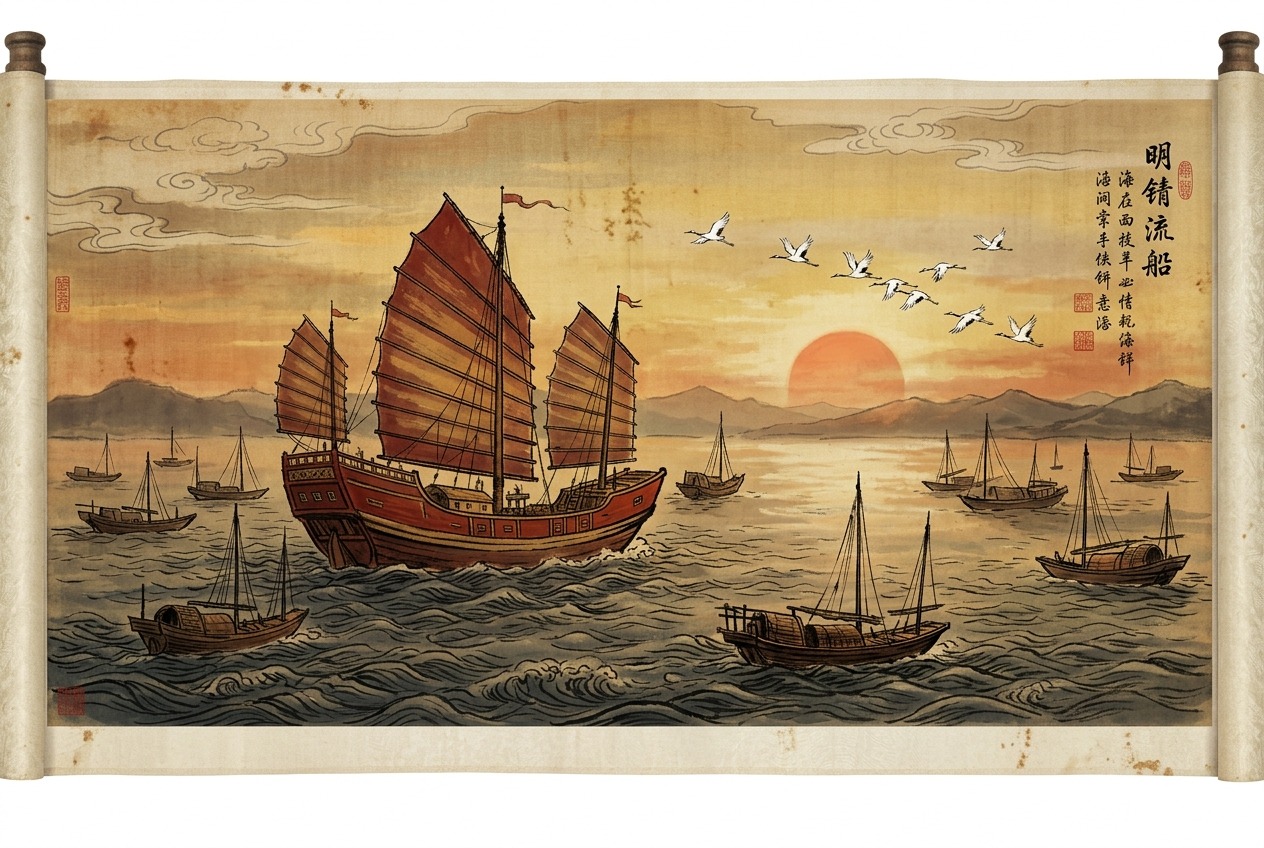
In 1414, a giraffe walked through the gates of the Forbidden City in Beijing. The animal, a gift from the Sultan of Bengal (who had received it from Malindi in East Africa), was paraded before the Yongle Emperor as a qilin—a mythical creature whose appearance signaled Heaven’s approval of a virtuous ruler. The giraffe had crossed the Indian Ocean aboard one of the largest wooden ships ever constructed, part of a fleet that dwarfed anything Europe would launch for centuries. This was the age of Zheng He, and for three remarkable decades, China ruled the seas.
The Unlikely Admiral
Zheng He’s path to command was anything but conventional. Born around 1371 as Ma He to a Muslim family in Yunnan province, he was captured as a boy when Ming forces conquered the region. Castrated and pressed into service as a court eunuch, he was assigned to the household of Zhu Di, a prince who would later seize the imperial throne in a civil war and rule as the Yongle Emperor.
Ma He proved himself an able soldier and loyal confidant during the prince’s rebellion. As a reward, the new emperor granted him the surname Zheng and, in 1405, appointed him commander of the most ambitious naval expedition in history. That a Muslim eunuch of humble origins would lead Confucian China’s greatest maritime venture is one of history’s great ironies—and perhaps one of its shrewdest appointments, given that the fleet would sail into the Islamic trading world of the Indian Ocean.
Ships That Defied Belief
The scale of the treasure fleets still astonishes historians. The flagship vessels, known as baochuan or “treasure ships”, were reported to be over 400 feet long with nine masts—though modern scholars debate whether wooden ships could structurally reach such dimensions, with more conservative estimates placing them around 200 to 250 feet. Even at the lower figure, they were giants. Columbus’s Santa María, launched decades later, measured a mere 85 feet.
A single expedition typically included:
- 60 or more treasure ships carrying silk, porcelain, and precious goods
- Supply ships stocked with food and fresh water for months at sea
- Horse transports and troop carriers
- Water tankers and specialized repair vessels
- Up to 27,000 personnel—sailors, soldiers, diplomats, doctors, astrologers, and translators
The fleets even grew fresh vegetables in tubs on deck and carried live animals for food, allowing them to stay at sea far longer than any European vessel of the era. Chinese innovations like watertight bulkhead compartments, the sternpost rudder, and the magnetic compass made these voyages possible.
The Seven Voyages
Between 1405 and 1433, Zheng He led seven expeditions across the Indian Ocean, each pushing further than the last.
The first three voyages (1405–1411) focused on Southeast Asia and India, visiting Champa (modern Vietnam), Java, Sumatra, Ceylon, and the great pepper port of Calicut on India’s Malabar Coast. These were not entirely peaceful cruises. On the first voyage, Zheng He destroyed the fleet of the pirate Chen Zuyi at Palembang, capturing him and sending him to Beijing for execution. On the third voyage, when the king of Ceylon proved hostile, Chinese forces captured him and installed a more cooperative ruler.
The fourth voyage (1413–1415) reached Hormuz at the mouth of the Persian Gulf, and detached squadrons pressed on to Arabia. The fifth, sixth, and seventh voyages ventured to the Swahili Coast of East Africa, calling at Mogadishu, Malindi, and other ports in modern Somalia and Kenya. From these shores came the famous giraffes, along with zebras, ostriches, and lions—exotic tribute that dazzled the Ming court.
On the final voyage in 1431–1433, Zheng He, now in his sixties, likely died at sea. Fittingly for a sailor, he may have been buried in the ocean he had mastered.
Diplomacy, Not Conquest
Here lies the crucial difference between Zheng He’s voyages and the European expeditions that followed. The treasure fleets established no colonies, seized no territory for settlement, and built no permanent overseas empire. Their purpose was to project Chinese power and prestige, extend the tributary system, and draw distant kingdoms into acknowledging the Ming emperor as the Son of Heaven.
The economics were deliberately lopsided. Foreign rulers who sent tribute missions to Beijing received gifts often worth far more than what they gave—silk, porcelain, and lacquerware of unmatched quality. The point was not profit but political theater: a demonstration that all the world’s rulers recognized China’s centrality. Trade flourished along the way, and Chinese communities took root across Southeast Asia, but the voyages were fundamentally instruments of statecraft.
This is not to say the fleets were pacifist. With tens of thousands of soldiers aboard, they engaged in at least three major military actions. But conquest was never the goal. As one inscription erected by Zheng He himself put it, the fleets sailed “to manifest the transforming power of imperial virtue.”
The Great Withdrawal
And then, abruptly, it ended. After the seventh voyage, China never launched another treasure fleet. Within decades, the shipyards fell silent, records of the voyages were reportedly destroyed or suppressed by court officials, and by 1500 it became a capital offense to build seagoing ships with more than two masts. The greatest navy on Earth was allowed to rot.
Why? Several forces converged:
- Politics: The voyages were the pet project of the Yongle Emperor and the eunuch faction at court. Confucian scholar-officials, longtime rivals of the eunuchs, viewed the expeditions as wasteful extravagance and moved to kill the program once their influence recovered.
- Money: The fleets were staggeringly expensive, and the treasury was strained by the construction of Beijing, the Grand Canal’s renovation, and costly wars in Vietnam.
- The Mongol threat: Renewed pressure from the steppe pulled resources northward. Rebuilding the Great Wall seemed more urgent than sailing to Africa.
- Ideology: Confucian orthodoxy prized agriculture and stability over commerce and adventure. To many officials, there was simply nothing the outside world offered that China needed.
The Road Not Taken
The what-ifs are irresistible. When Vasco da Gama rounded Africa and reached Calicut in 1498—arriving at ports Zheng He had visited sixty years earlier with a fleet a fraction of the size—there was no Chinese navy to meet him. The Indian Ocean, once dotted with Ming sails, lay open to Portuguese cannon. Some historians argue China’s withdrawal from the seas was among the most consequential decisions in world history, ceding the coming maritime age to Europe.
Yet we should be careful with hindsight. Ming China made a rational choice by its own logic: it faced real threats on land and saw little to gain from distant oceans. The tragedy, if there is one, lies in how completely the achievement was erased—so thoroughly that when Chinese officials centuries later confronted European gunboats, few remembered that their ancestors had once commanded the waves.
Today, Zheng He has been rediscovered as a symbol of peaceful maritime engagement, invoked from Nanjing to Nairobi. His treasure fleets remain a monument to what China achieved on the ocean—and a haunting reminder of how quickly even the greatest ventures can vanish when a civilization turns its back on the sea.