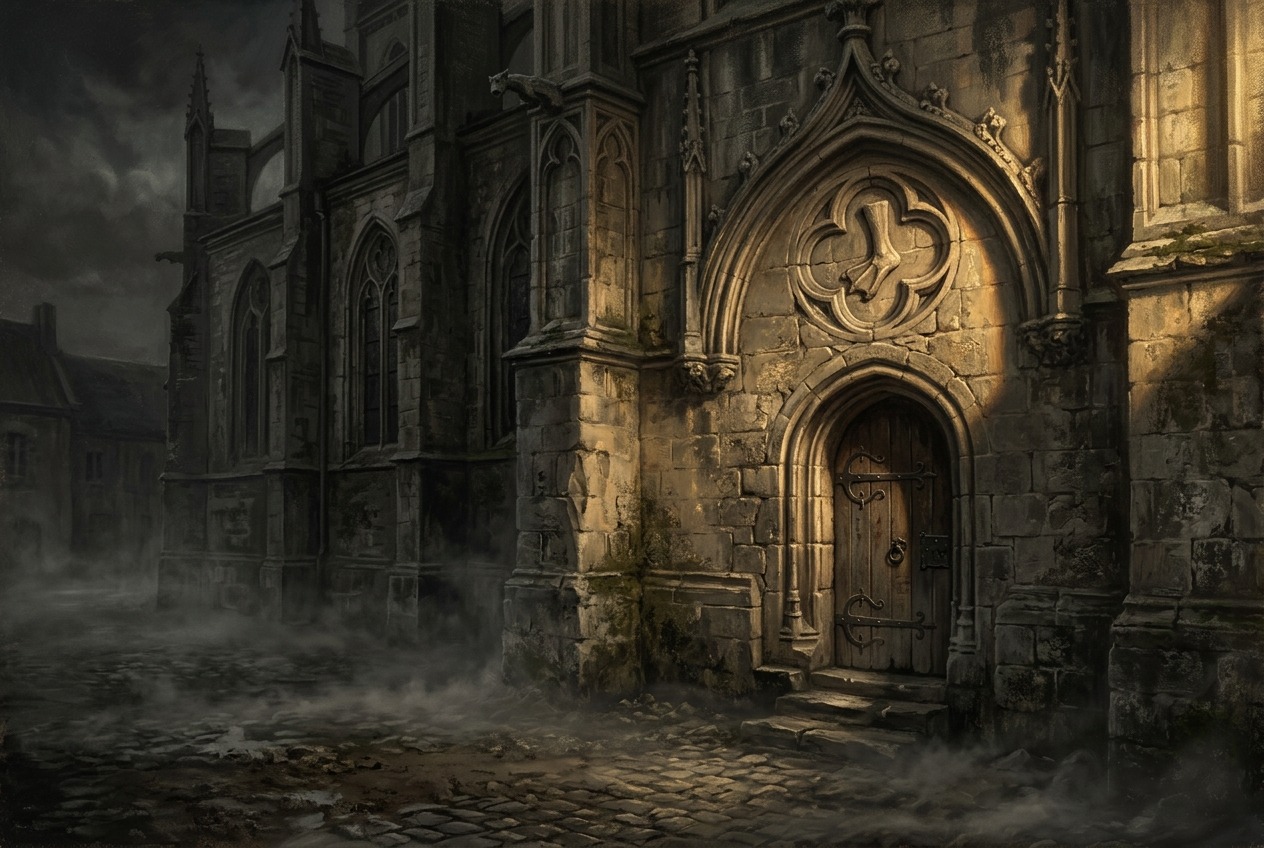
Imagine being forced to enter your church through a special low door, drink holy water from a separate font, and receive communion at the end of a long stick. Imagine being forbidden to walk barefoot in public, touch the parapet of a bridge, or handle food at the market. Now imagine that neither you—nor anyone else—could explain why. This was the reality for the Cagots, a mysterious pariah caste that endured centuries of persecution in southwestern France and northern Spain, despite being physically, linguistically, and religiously indistinguishable from their neighbors.
The story of the Cagots is one of history’s most baffling episodes of discrimination: a caste system without a caste, an untouchable class with no discernible difference from the people who shunned them. Their story raises uncomfortable questions about how prejudice sustains itself—and how completely it can vanish.
Who Were the Cagots?
The Cagots (pronounced “ka-GOH”) were a population scattered across the Pyrenees region, particularly in Gascony, Béarn, Navarre, and the Basque Country. Historical records mention them as early as the year 1000, and they persisted as a distinct outcast group well into the 19th century—a span of roughly 800 years.
What makes the Cagots so extraordinary is what they were not. They were not a religious minority; they were devout Catholics. They did not speak a different language; they spoke the same Gascon, Béarnais, or Basque dialects as everyone around them. They did not look different; contemporary observers repeatedly noted that Cagots were physically identical to their neighbors. They did not practice a foreign culture or maintain separate customs by choice. And yet, they were treated as fundamentally unclean.
A Catalog of Humiliations
The restrictions placed on the Cagots were remarkably specific and remarkably cruel. Consider the scope of their exclusion:
- Separate church entrances: Many churches in the region still bear the small, low “Cagot doors” through which they were required to enter. Some of these can still be seen today in villages across the Pyrenees.
- Segregated worship: Cagots had their own holy water fonts—touching the common font was strictly forbidden. In some parishes, priests handed them communion wafers on the end of a wooden spoon or long-handled implement to avoid contact.
- The goose-foot badge: Cagots were often required to wear a distinguishing mark sewn onto their clothing, most famously a red fabric emblem shaped like a goose or duck’s foot.
- Economic restrictions: They were forbidden from farming, owning livestock beyond what they needed, or selling food and drink. At markets, they could not touch produce—they had to point at what they wanted and have it handed to them.
- Physical segregation: Cagots lived in separate hamlets, called cagoteries, typically on the outskirts of towns, often near the water or in marshy, undesirable land.
- Social prohibitions: Marriage between Cagots and non-Cagots was taboo and sometimes legally forbidden. Cagots could not bear arms, and in some places they were even required to be buried in separate cemeteries.
The violence backing these rules was real. In one grim account from the 18th century, a prosperous Cagot in the town of Moumour who dared to use the main holy water font had his hand cut off and nailed to the church door as a warning.
The Mystery of Their Origins
The most confounding aspect of the Cagot phenomenon is that no one—not the persecutors, not the persecuted, and not modern historians—has ever definitively established why this group was ostracized in the first place. Over the centuries, numerous theories emerged, each with significant flaws:
The Leprosy Theory
One popular explanation held that the Cagots were descendants of lepers, or people believed to carry a hereditary, non-visible form of the disease. This might explain the obsessive avoidance of physical contact and the belief that Cagot touch could contaminate food. Medical examinations, however, consistently found Cagots to be perfectly healthy—a fact acknowledged even in their own time. One medieval theory held they were “white lepers”, carrying disease without symptoms, an unfalsifiable claim that conveniently justified endless discrimination.
The Defeated Peoples Theories
Other theories cast the Cagots as descendants of some defeated or disgraced group: Visigoths who remained after their kingdom fell to the Franks in the 6th century (the word “Cagot” was sometimes fancifully derived from caas Goth, “dog of a Goth”); Saracen soldiers left behind after the Battle of Tours in 732; or Cathar heretics fleeing the Albigensian Crusade. Each theory suffers from the same problem: the Cagots showed no cultural, linguistic, or genetic traces of any of these origins, and records of their persecution predate or postdate the proposed events in inconvenient ways.
The Guild Theory
Perhaps the most plausible modern hypothesis is more mundane: the Cagots may have originated as a medieval guild of carpenters and woodworkers—trades they were, notably, permitted and often required to practice. Some historians suggest that economic rivalry or an early association with a stigmatized trade hardened over generations into hereditary caste status. Once the stigma existed, it became self-perpetuating: people were Cagots because their parents were Cagots, and that was reason enough.
Resistance and the Long Road to Emancipation
The Cagots did not accept their status passively. In 1514, they petitioned Pope Leo X, who issued a bull declaring they should be treated “with kindness, in the same way as the other believers.” Local authorities largely ignored it. Cagots repeatedly brought lawsuits demanding equal treatment, and occasionally won on paper—only to find that village custom proved stronger than any legal ruling.
The French Revolution of 1789 formally abolished all such distinctions, declaring the equality of all citizens. In a symbolic act of liberation, some Cagots reportedly stormed local archives and burned the records documenting their ancestry, deliberately erasing the paper trail of their stigma.
Yet prejudice outlived the law. Discrimination against people of known Cagot descent persisted in rural Pyrenean communities throughout the 19th century, and folklorists recorded lingering awareness of “Cagot families” even into the 20th. Gradually, though, migration, urbanization, and intermarriage dissolved the caste. Today, the Cagots have effectively disappeared—not through violence, but through absorption. Few if any people now identify as Cagot descendants, and the very memory of the group has faded from popular consciousness.
What the Cagots Teach Us
The story of the Cagots is more than a historical curiosity. It is a case study in the anatomy of prejudice. Discrimination, it turns out, does not require real difference—it only requires the belief in difference, transmitted from generation to generation until the original cause, if there ever was one, is forgotten entirely. For 800 years, communities enforced elaborate rituals of exclusion against neighbors who were, by every measurable standard, exactly like themselves.
The Cagots also offer a rare, cautiously hopeful ending: proof that even the most entrenched caste systems can dissolve. Their persecution seemed eternal to those who lived under it, yet today it survives only in stone—in the small, low doorways still visible in the churches of the Pyrenees, silent monuments to a cruelty no one could ever quite explain.