When Spanish conquistadors first laid eyes on Tenochtitlan in 1519, they thought they were dreaming. Bernal Díaz del Castillo, a soldier in Hernán Cortés’s expedition, wrote that the city seemed like “an enchanted vision” rising from the water. The Aztec capital, home to an estimated 200,000 people, sat in the middle of Lake Texcoco—larger than most European cities of the era. But the real marvel wasn’t just the city itself. It was the answer to a question that puzzled the Spaniards: how did a metropolis built on a lake feed so many mouths?
The answer lay in the chinampas—ingenious artificial islands that transformed shallow lakebeds into some of the most productive farmland in human history. Often romantically called “floating gardens”, these agricultural platforms didn’t actually float, but they did something arguably more impressive: they yielded up to seven harvests a year, centuries before modern fertilizers or irrigation technology existed.
Engineering an Island Garden
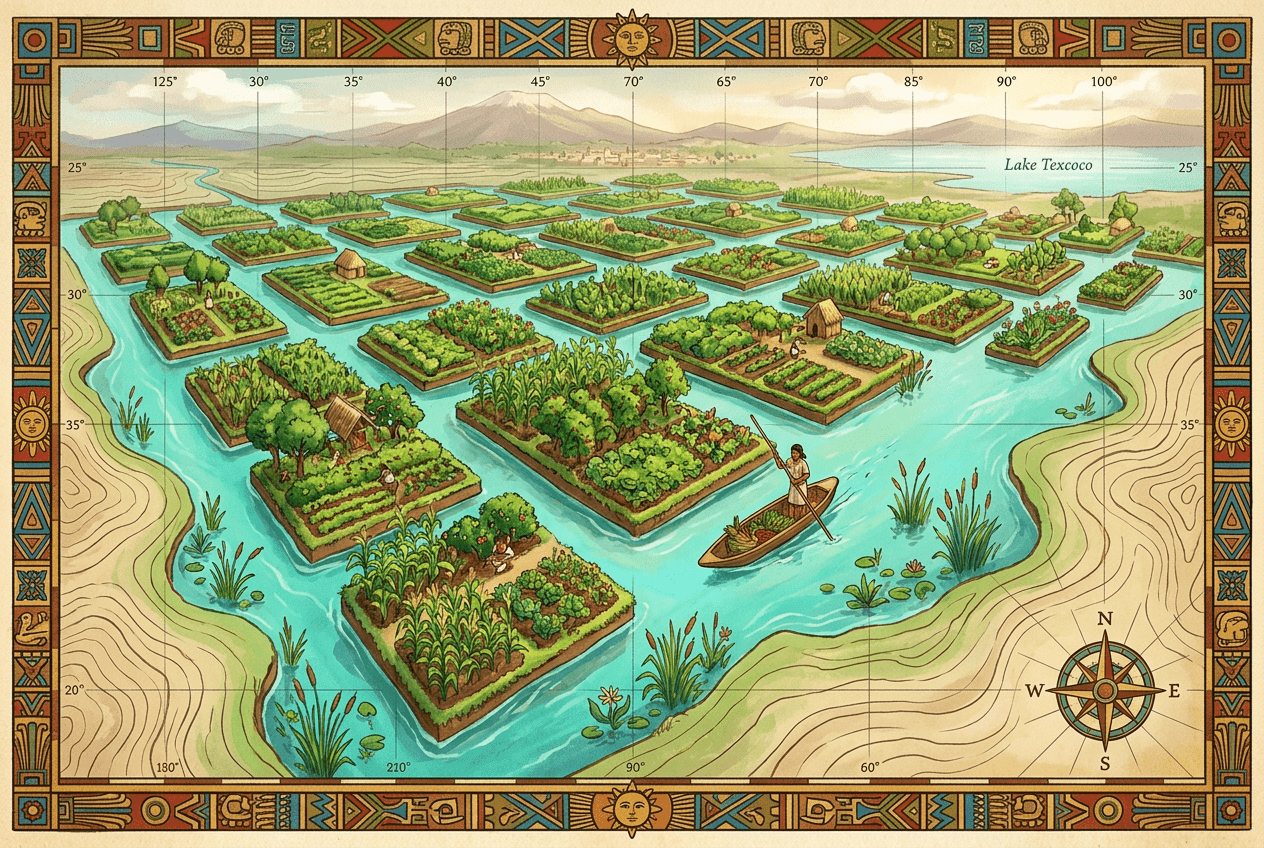
Building a chinampa was a masterclass in low-tech engineering. Aztec farmers began by marking out a rectangular plot in the shallow waters of the lake—typically about 30 meters long and 2.5 meters wide. The construction process followed a remarkably systematic approach:
- Staking the perimeter: Farmers drove wooden posts into the lakebed to define the plot’s boundaries.
- Weaving the walls: Reeds and branches were woven between the stakes, creating a fence-like enclosure that would hold the island together.
- Layering the foundation: The enclosure was filled with alternating layers of lake mud, decaying vegetation, and sediment dredged from the lake bottom—each layer adding nutrients and stability.
- Planting the anchors: Perhaps most cleverly, farmers planted willow trees (known as ahuejotes) along the edges. As these trees grew, their roots knitted through the soil and down into the lakebed, permanently anchoring the island in place.
The result was a raised garden bed sitting just above the waterline, surrounded on all sides by canals. These canals weren’t merely byproducts of construction—they were integral to the entire system, serving as irrigation channels, transportation routes for canoes, and habitats for fish and aquatic plants that fed both the soil and the people.
Why Chinampas Were So Astonishingly Productive
Modern agronomists studying chinampas have found that these pre-industrial farms rivaled—and in some measures exceeded—the productivity of contemporary intensive agriculture. Several factors combined to make this possible.
Self-Renewing Fertility
The lake mud that farmers regularly scooped from the canal bottoms was extraordinarily rich in organic matter and nutrients. Every time a farmer dredged the canals to keep them navigable, they were simultaneously harvesting fresh fertilizer. This mud, along with aquatic plants and household compost, was spread across the chinampa surface between plantings. The system essentially recycled its own nutrients in a closed loop—a concept that modern sustainable agriculture advocates would recognize immediately.
Constant Moisture Without Flooding
Because chinampas sat only slightly above the water level, moisture wicked up through the soil continuously. Crops enjoyed steady hydration without farmers ever needing to haul water. During dry seasons that devastated rain-fed fields elsewhere in Mesoamerica, chinampas kept producing.
Microclimate Protection
The surrounding water moderated temperatures, protecting crops from frost—a serious threat in the high-altitude Valley of Mexico, which sits over 2,200 meters above sea level. This thermal buffering extended the growing season significantly.
The Seedbed Innovation
Aztec farmers developed a sophisticated seedling system called chapines. They cut blocks of nutrient-rich mud, planted seeds in each block, and nurtured the seedlings in nurseries before transplanting them to the chinampa. This meant that as soon as one crop was harvested, mature seedlings were ready to go into the ground immediately. No time was wasted on germination in the field—a key reason chinampas could produce up to seven harvests annually.
Feeding an Empire
By the height of the Aztec Empire in the late 15th century, chinampas covered an estimated 9,000 hectares in the southern lakes of Xochimilco and Chalco. Scholars calculate that this network could feed well over 100,000 people, supplying Tenochtitlan with maize, beans, squash, amaranth, chili peppers, tomatoes, and flowers—the last of which held deep religious significance in Aztec culture.
The system was so vital that Aztec rulers made it a matter of state policy. Emperor Itzcoatl and his successors organized massive hydraulic engineering projects, including a 16-kilometer dike built under Nezahualcoyotl of Texcoco that separated the salty waters of the northern lake from the fresh water needed by the southern chinampa zones. Aqueducts, causeways, and sluice gates regulated water levels with impressive precision. This wasn’t casual gardening—it was landscape engineering on an imperial scale.
Fresh produce traveled by canoe through the canal network to the great market at Tlatelolco, where, according to Spanish accounts, some 60,000 people gathered daily to trade. The Spaniards marveled that vegetables harvested at dawn could be sold in the city center by mid-morning—a farm-to-table supply chain that many modern cities would envy.
Decline, Survival, and the Lessons of Xochimilco
The Spanish conquest dealt the chinampa system a devastating blow, though not an immediate one. Colonial authorities, plagued by flooding in Mexico City (built atop the ruins of Tenochtitlan), spent centuries draining Lake Texcoco. As the water disappeared, so did most of the chinampas. Urbanization in the 20th century consumed much of what remained.
Yet the system never entirely died. In Xochimilco, a borough in southern Mexico City, roughly 2,000 hectares of chinampas and canals survive. UNESCO designated the area a World Heritage Site in 1987, and in 2018 the FAO recognized it as a Globally Important Agricultural Heritage System. Today, a community of chinamperos still farms these ancient plots using techniques their ancestors would recognize, growing vegetables, herbs, and the flowers for which Xochimilco—”the place of the flower fields” in Nahuatl—is named.
The survival is precarious. Urban sprawl, water pollution, groundwater extraction, and invasive species threaten the remaining chinampas. The endangered axolotl, a salamander found nowhere else on Earth, clings to existence in these same canals. But a new generation of farmers, chefs, and scientists is fighting back, with restoration projects supplying organic produce to Mexico City restaurants and researchers studying chinampas as a model for sustainable urban agriculture worldwide.
An Ancient Answer to Modern Questions
As cities today grapple with food security, climate resilience, and sustainable farming, the chinampa offers a provocative lesson: some of the most sophisticated agricultural technology in history required no fossil fuels, no synthetic chemicals, and no machinery—only a deep understanding of ecology and generations of accumulated knowledge. The Aztecs didn’t fight their watery environment; they collaborated with it, turning a lake into a breadbasket.
Five centuries after Cortés’s soldiers gazed in wonder at the gardens of Tenochtitlan, the chinampas of Xochimilco still bloom—living proof that the “enchanted vision” was never a dream at all, but one of humanity’s greatest agricultural achievements.