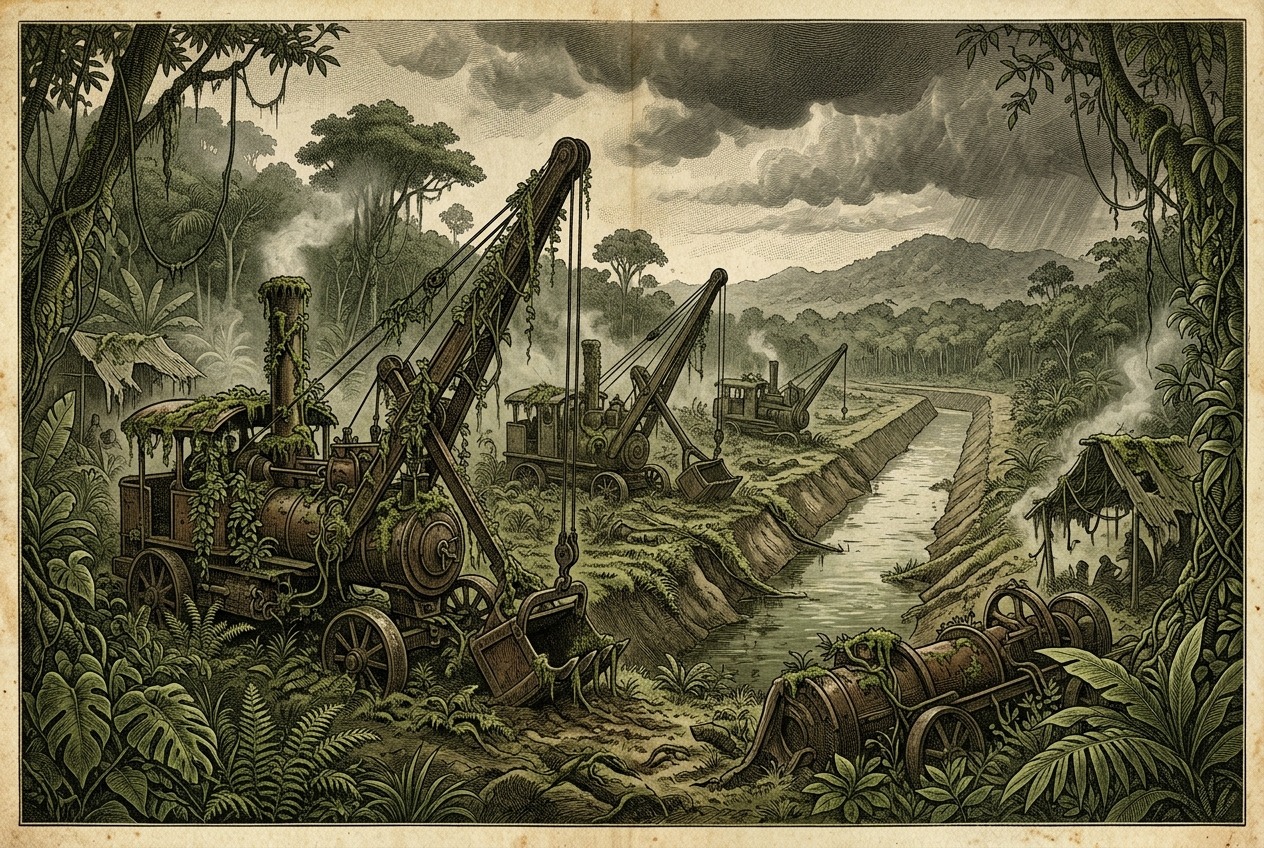
In 1879, Ferdinand de Lesseps stood before an adoring French public as perhaps the most celebrated man in Europe. He had just completed the Suez Canal—a feat many had declared impossible—and now, at age 74, he announced his next triumph: a canal across the Isthmus of Panama. Within a decade, that dream would collapse into history’s most catastrophic engineering failure, leaving 22,000 workers dead, 800,000 investors ruined, and the French Third Republic shaken to its foundations.
The story of the French Panama disaster is more than a tale of failed engineering. It is a cautionary epic about hubris, the limits of reputation, and what happens when national pride overrides scientific reality.
The Hero of Suez and His Fatal Confidence
Ferdinand de Lesseps was not an engineer. He was a diplomat, a promoter, and above all, a man of extraordinary charisma. His success at Suez—completed in 1869 after a decade of construction—had made him a living legend, dubbed “Le Grand Français” (The Great Frenchman). When he turned his attention to Panama, few dared question him.
But Panama was not Suez. The Egyptian canal had been dug through flat, dry desert at sea level. Panama presented a nightmarish contrast: dense tropical jungle, torrential rains, the unpredictable Chagres River, and the Culebra Cut—a mountain ridge of unstable geological composition that would need to be carved through at enormous depth.
At the 1879 International Congress in Paris, engineers presented compelling evidence that a sea-level canal was impossible in Panama. They advocated for a lock-based canal instead. De Lesseps dismissed them. He had heard identical objections about Suez, he reminded everyone, and he had proven the doubters wrong. The congress, packed with de Lesseps loyalists and attended by few engineers with tropical experience, voted for the sea-level plan. Notably, most of the actual engineers present voted against it or abstained.
Raising Millions on Reputation Alone
De Lesseps launched the Compagnie Universelle du Canal Interocéanique in 1880, raising capital not from banks but from ordinary French citizens—shopkeepers, farmers, widows, and pensioners who trusted the hero of Suez with their life savings. His projections were fantasy from the start:
- He estimated the cost at 658 million francs; his own technical commission had suggested nearly double that.
- He promised completion in eight years, roughly the same timeframe as Suez, despite vastly more difficult conditions.
- He calculated excavation volumes that proved to be less than half of what the project actually required.
To generate enthusiasm, de Lesseps embarked on publicity tours, brought his family to Panama during the dry season (concealing the horrors of the wet season), and paid journalists handsomely for favorable coverage—a practice that would later prove central to the scandal.
Death in the Jungle
Construction began in 1881, and the isthmus began exacting its terrible toll almost immediately. The two great killers were yellow fever and malaria, diseases whose transmission mechanism—the mosquito—was not yet understood. Medical wisdom of the era blamed “miasmas”, or bad air rising from swamps.
This ignorance produced deadly ironies. The French hospitals in Panama, among the finest in the tropics, placed the legs of patient beds in small pans of water to keep ants away. These water pans became perfect breeding grounds for mosquitoes, turning hospitals into death traps. Being admitted for a minor injury often meant contracting yellow fever and dying within days.
The statistics were staggering:
- An estimated 22,000 workers died over the course of the project—the majority of them laborers from Jamaica, Barbados, and other Caribbean islands.
- During the worst periods, disease killed more than 200 workers per month.
- Of the young French engineers who arrived full of ambition, many were dead within months. Entire arriving cohorts were sometimes wiped out.
Meanwhile, the engineering challenges proved as intractable as the critics had warned. The Culebra Cut suffered constant landslides—excavated earth simply slid back into the cut during the rainy season. The Chagres River flooded catastrophically, at times rising more than 10 meters and destroying months of work in hours. Machinery rusted, rotted, and sank into the mud.
Too Little, Too Late
By 1887, even de Lesseps could no longer deny reality. He belatedly accepted the lock-canal design and hired Gustave Eiffel—fresh from designing his famous tower—to build the locks. But the company was already hemorrhaging money. It had spent over a billion francs, more than twice the original estimate, with the canal perhaps two-fifths complete at best.
Desperate for funds, the company sought government authorization for a lottery bond issue. To secure it, company officials bribed politicians, ministers, and newspaper editors on a breathtaking scale. When the lottery loan finally launched in 1888, it failed to attract enough subscribers. On February 4, 1889, the Compagnie Universelle was formally dissolved. The savings of some 800,000 French investors—many of modest means—evaporated.
The Scandal That Shook a Republic
The financial collapse might have been remembered as mere business failure, but investigations beginning in 1892 revealed systematic corruption. Over 100 members of the French Parliament had allegedly taken bribes to support the company. The affair became known as the “Panama Scandal”, and the word panamiste entered the French language as a synonym for a corrupt politician.
The fallout was severe:
- Ferdinand de Lesseps and his son Charles were convicted of fraud and maladministration in 1893, though the elder de Lesseps—by then 88 and mentally deteriorating—never served his sentence.
- Gustave Eiffel was convicted alongside them, a stain later removed on appeal, but one that effectively ended his engineering career.
- Public trust in the Third Republic’s political class collapsed, fueling both radical and reactionary movements. The scandal’s antisemitic exploitation—two financiers involved were Jewish—helped poison the atmosphere that would soon produce the Dreyfus Affair.
The American Sequel—and the Lessons Learned
The story has a second act. In 1904, the United States purchased the French assets and rights for $40 million and succeeded where France had failed. Crucially, the Americans succeeded not primarily through superior engineering, but through medicine. Dr. William Gorgas, applying the recently proven mosquito theory of disease transmission, waged systematic war on mosquito breeding grounds, virtually eliminating yellow fever from the Canal Zone. The Americans also adopted the lock design the French experts had recommended back in 1879—and made extensive use of French excavation work and surveys.
The French Panama disaster endures as a masterclass in how projects fail. De Lesseps possessed vision, courage, and proven success—but he mistook past triumph for universal competence, dismissed expert warnings as timidity, and let sunk costs drive escalating commitment to a doomed plan. His story reminds us that nature does not negotiate with reputation, and that the confidence which conquers one challenge can become the blindness that dooms the next.
Today, ships glide through the Panama Canal in hours, passing the Culebra Cut where thousands of forgotten Caribbean laborers lie buried. Their graves are the true monument to the price of hubris.