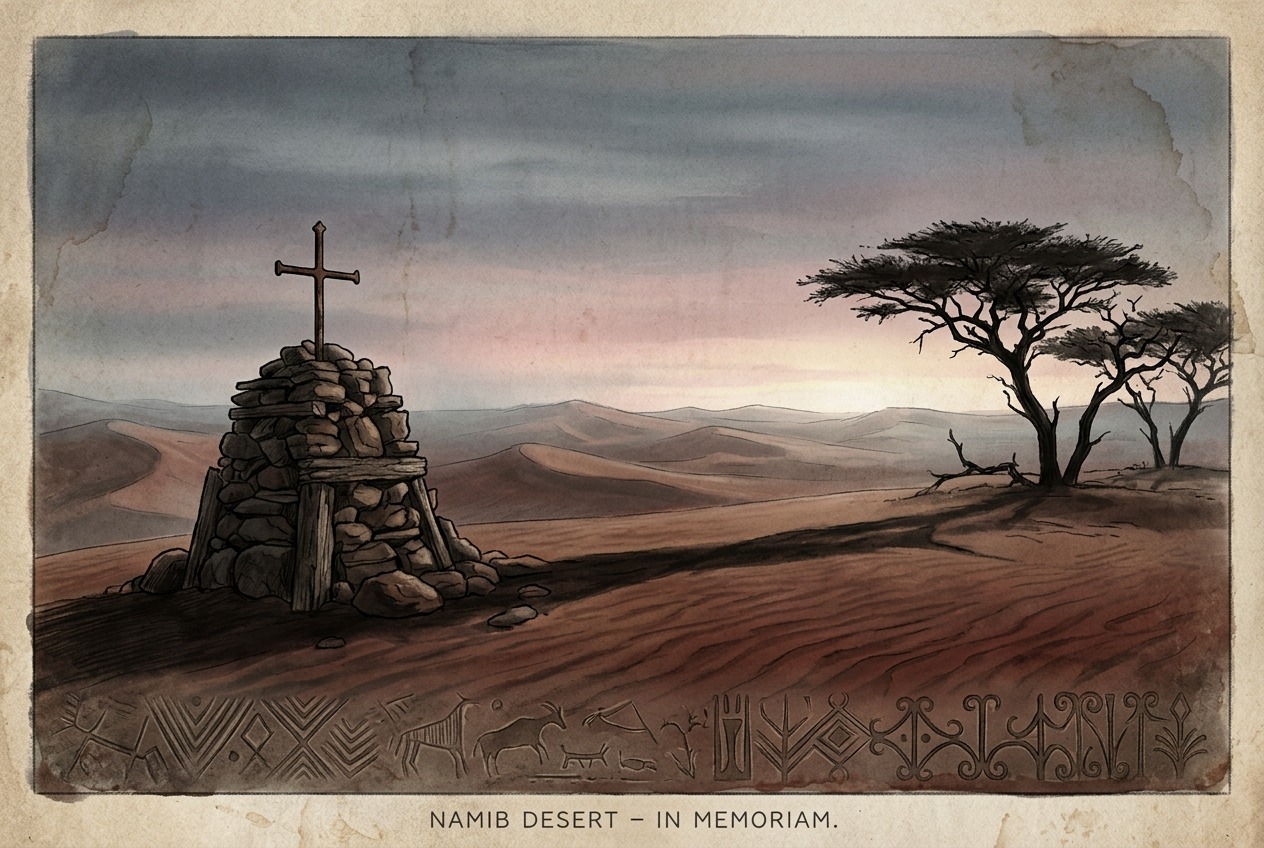
German South-West Africa: A Colony Built on Dispossession
Germany arrived late to the European scramble for Africa, but it pursued colonial ambitions with characteristic thoroughness. In 1884, the territory known as German South-West Africa (present-day Namibia) came under German control. The land was home to several peoples, most prominently the Herero, cattle-herding pastoralists whose wealth and identity were bound to their herds, and the Nama, skilled fighters and traders in the south.
Over the following two decades, German settlers steadily encroached on indigenous land and livestock. Colonial authorities imposed exploitative credit systems that stripped Herero families of their cattle, while a devastating rinderpest epidemic in 1897 destroyed much of the remaining herds. German settlers routinely abused indigenous people with impunity, and colonial courts rarely punished violence against Africans. By 1904, the Herero had lost more than a quarter of their land and faced the prospect of losing everything.
The Uprising and the Extermination Order
In January 1904, Herero forces under Chief Samuel Maharero rose against German rule, attacking military outposts and settler farms. Notably, Maharero issued orders sparing women, children, missionaries, and non-German Europeans—a restraint his enemies would not reciprocate.
Berlin’s response was to dispatch Lieutenant General Lothar von Trotha, a commander with a brutal reputation earned suppressing uprisings in German East Africa and China. Von Trotha made his intentions explicit, writing that he would “annihilate the revolting tribes with streams of blood.”
The decisive confrontation came at the Battle of Waterberg in August 1904. German forces deliberately left one escape route open—into the Omaheke Desert, an extension of the Kalahari. As tens of thousands of Herero men, women, and children fled into the waterless expanse, German troops sealed the perimeter and poisoned or guarded the few water holes.
On October 2, 1904, von Trotha issued his infamous Vernichtungsbefehl—the extermination order:
“The Herero people must leave this land… Within the German borders every Herero, with or without a gun, with or without cattle, will be shot. I will no longer accept women and children.”
This document stands as one of the earliest written orders for genocide in modern history. Survivors later described the desert littered with the bodies of those who died of thirst, and holes dug twenty-five feet deep by desperate people searching for water.
Concentration Camps and Forced Labor
When international and domestic criticism—including from German missionaries—forced Berlin to rescind the extermination order in December 1904, the killing did not stop; it changed form. Surviving Herero, and later Nama who had launched their own resistance under leaders like Hendrik Witbooi and Jakob Morenga, were rounded up into Konzentrationslager—concentration camps. The term itself, borrowed from British camps in the Boer War, would echo chillingly through the century.
The most notorious was Shark Island, off the coast of Lüderitz, often described by historians as a death camp. Prisoners there faced:
- Lethal forced labor: Prisoners built railways and harbor infrastructure under conditions designed to work them to death. Mortality rates at Shark Island approached 80 percent.
- Starvation rations and exposure: Inadequate food, no shelter from the cold Atlantic winds, and rampant disease killed thousands.
- Sexual violence: Women in the camps were subjected to systematic abuse by guards and soldiers.
- Pseudo-scientific exploitation: In one of the most disturbing chapters, prisoners—including women forced to clean the skulls of the dead—prepared human remains that were shipped to German universities for “racial science” research. Eugen Fischer, who conducted race studies in the colony, later influenced Nazi racial ideology and taught doctors who would serve the Third Reich.
By the time the camps closed in 1908, the demographic toll was staggering. Historians estimate that approximately 80 percent of the Herero people—perhaps 65,000 of 80,000—and roughly 50 percent of the Nama, around 10,000 people, had perished.
A Precedent for the Holocaust?
Historians continue to debate the degree of continuity between German South-West Africa and Nazi Germany, but the connections are difficult to ignore. The genocide normalized concepts of racial hierarchy, “living space”, and annihilation as policy within German military and political culture. Some colonial personnel and their intellectual heirs later served the Nazi regime. Hermann Göring’s father, Heinrich Göring, had been the first colonial commissioner of German South-West Africa. Whether one views the Herero genocide as a direct rehearsal for the Holocaust or a parallel expression of the same ideological currents, it demonstrates that the machinery of twentieth-century genocide was assembled decades before 1933.
The Long Road to Recognition
For most of the twentieth century, the genocide was effectively erased. Germany lost its colonies after World War I, and South Africa administered Namibia under apartheid until independence in 1990. Herero and Nama communities, meanwhile, lived with the consequences: landlessness, poverty, and marginalization that persist today, as much of Namibia’s commercial farmland remains in the hands of German-descended settlers.
The fight for acknowledgment gained momentum in stages:
- 1985: A United Nations report classified the events as genocide.
- 2004: On the centenary of Waterberg, German development minister Heidemarie Wieczorek-Zeul offered an apology at a commemoration in Namibia—though Berlin avoided the legal term “genocide.”
- 2011 and 2018: Germany repatriated skulls and human remains that had been held in German museums and universities for over a century.
- 2021: After years of negotiations, Germany formally recognized the atrocities as genocide and pledged €1.1 billion in development aid over thirty years.
An Unfinished Reckoning
The 2021 agreement, however, satisfied few. Many Herero and Nama leaders rejected it, arguing they were excluded from negotiations conducted between the German and Namibian governments. Critics noted that Germany carefully framed its payments as development assistance rather than legal reparations, avoiding any admission of liability that might set precedents for other former colonial powers. Descendant communities continue to demand direct compensation and the return of ancestral lands.
The story of the Herero and Nama genocide is ultimately about more than one colony’s brutality. It raises enduring questions about how nations confront historical crimes, who has the right to negotiate justice, and how long the shadows of colonialism stretch into the present. As monuments to von Trotha’s soldiers are dismantled and street names are changed in both Namibia and Germany, the descendants of survivors insist on a simple truth: recognition delayed by a century is only the beginning of repair, not its conclusion.