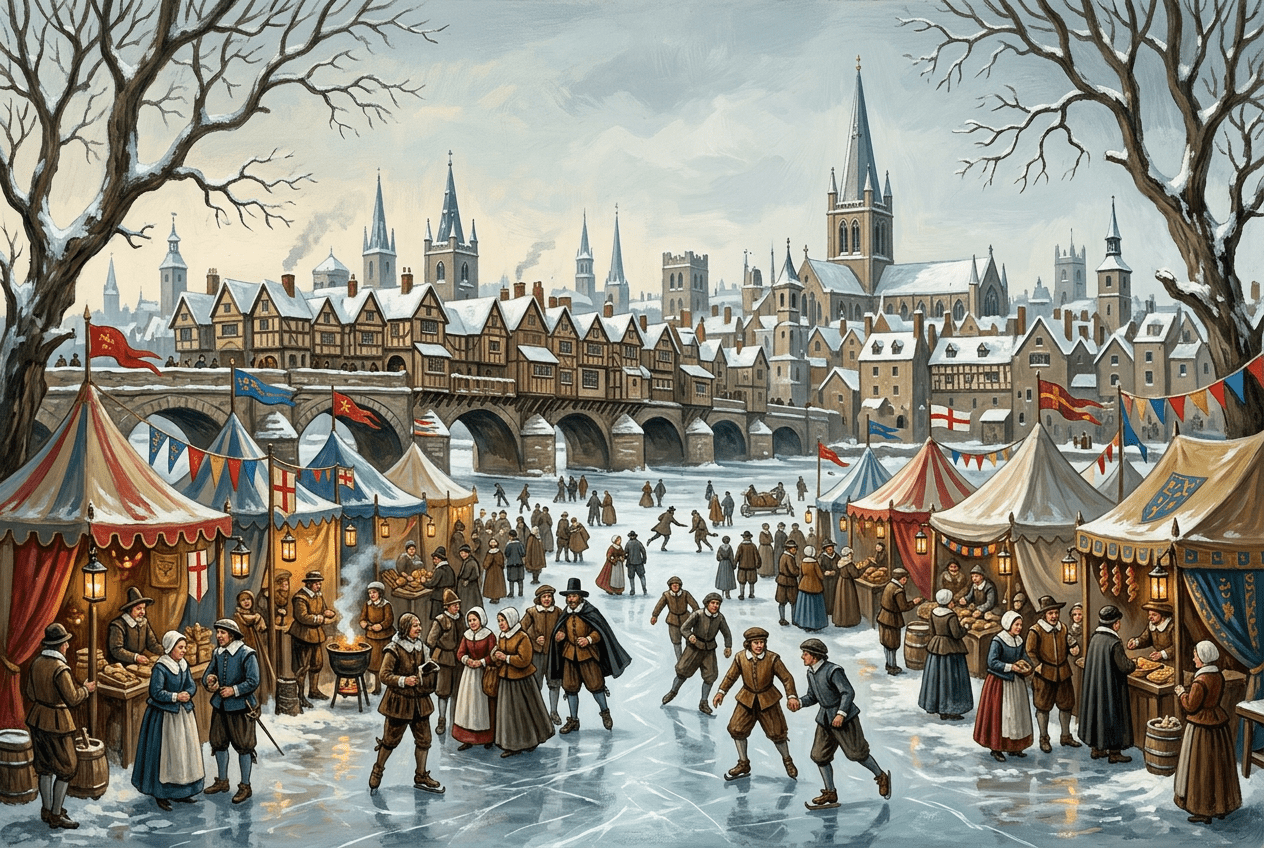
Imagine walking out onto the River Thames—not across a bridge, but directly onto the water itself, frozen solid enough to support taverns, ox roasts, horse races, and thousands of revelers. For roughly two centuries, this wasn’t fantasy but a recurring reality. Between 1608 and 1814, Londoners periodically transformed their frozen river into a sprawling carnival known as a “frost fair”, creating one of history’s most extraordinary examples of a city adapting to—and celebrating—extreme weather.
These weren’t modest gatherings. At their peak, frost fairs featured entire streets of shops built on ice, printing presses churning out souvenirs, puppet shows, gambling dens, and in one famous instance, an elephant led across the river near Blackfriars Bridge. The story of the frost fairs is a tale of climate, commerce, human ingenuity, and a river that will never freeze the same way again.
The Little Ice Age: Why the Thames Froze
The frost fairs owe their existence to a climatic period known as the Little Ice Age, which lasted roughly from the 14th to the 19th centuries. During this era, average temperatures in Europe dropped by about 1 to 2 degrees Celsius—a seemingly small shift that produced dramatically colder winters. Glaciers advanced in the Alps, harvests failed across the continent, and rivers that rarely froze became reliable sheets of ice.
But climate alone doesn’t explain why the Thames froze so completely. The river itself was physically different in those centuries. Old London Bridge, completed in 1209, stood on nineteen closely spaced piers surrounded by protective structures called starlings. These acted almost like a dam, slowing the river’s flow dramatically upstream. Slow-moving water freezes far more easily than fast currents, and the Thames above the bridge was also wider and shallower than it is today, before the Victorian embankments narrowed and deepened the channel.
When a hard frost set in—and during the Little Ice Age, they came often—chunks of ice would jam against the bridge’s starlings, backing up until the river froze into a solid, walkable surface sometimes a foot thick or more.
The Great Frost Fair of 1683–84
While the Thames froze many times, the winter of 1683–84 produced the most famous and elaborate frost fair of them all. The freeze lasted for two months, with ice reportedly eleven inches thick. Diarist John Evelyn left a vivid account of what he witnessed:
“Coaches plied from Westminster to the Temple, and from several other stairs to and fro, as in the streets; sleds, sliding with skates, a bull-baiting, horse and coach races, puppet plays and interludes, cooks, tippling and other lewd places, so that it seemed to be a bacchanalian triumph, or carnival on the water.”
A formal street of booths, nicknamed “Temple Street” or “Blanket Street”, ran across the river, lined with shops selling everything from roasted meat to gingerbread to gin. Entire oxen were roasted on the ice. Perhaps the most ingenious entrepreneurs were the printers who hauled their presses onto the frozen river and sold personalized souvenir cards commemorating the event. Even King Charles II and members of the royal family visited the fair and purchased a printed keepsake bearing their names—a document that survives to this day.
A Carnival Economy on Ice
Frost fairs were not simply spontaneous celebrations; they were driven partly by economic necessity. When the Thames froze, it paralyzed London’s economy. Watermen who ferried passengers across the river lost their livelihoods overnight, as did dockworkers, fishermen, and merchants dependent on river trade. Many of these workers pivoted quickly, charging tolls for access to the ice, cutting channels for pathways, or setting up entertainment and refreshment stalls.
The fairs developed a remarkable range of attractions over the decades:
- Food and drink: Roasted ox, hot pies, gingerbread, mulled wine, and copious amounts of gin sold from makeshift taverns called “fuddling tents”
- Entertainment: Puppet shows, merry-go-rounds, nine-pin bowling, football matches, and bear-baiting
- Sports: Ice skating, sledding, and horse-drawn coach races along the frozen river
- Novelties: Souvenir printing, fortune tellers, and exotic animal displays
The atmosphere was raucous, democratic, and slightly lawless. Because the frozen river existed in a kind of legal grey zone—neither land governed by city authorities nor navigable water—the fairs took on the character of a temporary free-for-all where ordinary rules seemed suspended.
The Final Fair of 1814
The last great frost fair took place in early February 1814, and Londoners seemed to sense it might be special. The freeze lasted only about four days, but in that brief window the city threw one final, spectacular party on the ice. Swings, bowling alleys, and drinking tents sprang up between Blackfriars and London Bridge. Vendors sold a hot spiced gin concoction and slices of roasted mutton advertised, with cheeky exaggeration, as “Lapland mutton.”
The most famous moment of the 1814 fair was the elephant. In a stunt that captured the public imagination, an elephant was led across the frozen Thames just below Blackfriars Bridge—a striking demonstration of the ice’s thickness and perhaps the ultimate frost fair spectacle. Printers were once again on the ice, producing souvenirs, including an entire book, titled Frostiana, typeset and printed on the frozen river itself.
The fair ended as they always did: with a thaw, and with danger. Rising temperatures broke the ice apart, and several people drowned when floes gave way beneath them. Tragedy was a recurring feature of the fairs—the same ice that hosted carnivals could crack without warning, swallowing tents, stalls, and unlucky revelers.
Why the Thames Will Never Freeze Again
No frost fair has been held since 1814, and none ever will be—at least not on the tidal Thames in central London. Three major changes made the fairs impossible:
- The demolition of Old London Bridge in 1831. Its replacement had far fewer, wider arches, allowing the river to flow freely. Without the old bridge acting as a partial dam, the water moved too quickly to freeze.
- The Victorian embankments. Built in the 1860s under engineer Joseph Bazalgette, the embankments narrowed the Thames and deepened its channel, further accelerating the current.
- The end of the Little Ice Age. By the mid-19th century, the climate was warming, and the brutal winters that once gripped Europe became increasingly rare. Modern climate change has only pushed temperatures further from the conditions that once froze the river solid.
A Frozen Moment in History
The frost fairs occupy a unique place in London’s story—a recurring festival born from hardship, opportunism, and a river that no longer exists in the same form. They remind us that climate has always shaped human culture in unexpected ways, and that people have an irrepressible instinct to turn even the harshest conditions into an occasion for celebration. Today, a series of engraved slabs in a pedestrian tunnel beneath Southwark Bridge commemorates the fairs, quietly marking the spot where Londoners once danced, drank, and roasted oxen on the frozen heart of their city.