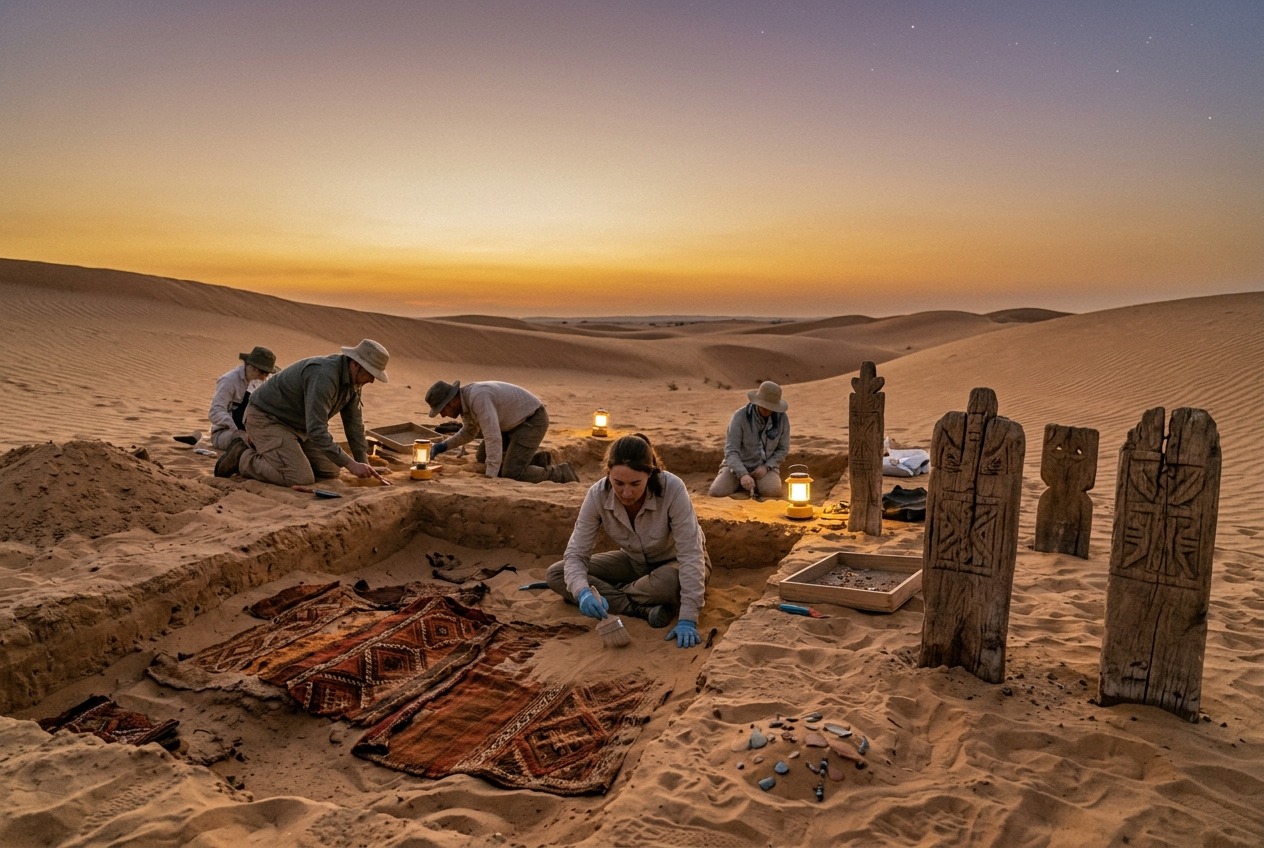
In the scorching sands of the Tarim Basin, in what is now China’s Xinjiang region, archaeologists made a discovery that would ignite one of the most contentious debates in modern archaeology. Buried beneath the desert floor lay hundreds of mummies—some over 4,000 years old—preserved so perfectly that their eyelashes remained intact, their clothing still vibrant, and their features hauntingly lifelike. But what stunned researchers most was their appearance: many had fair or reddish hair, tall statures, and wore woven woolen textiles with tartan-like plaid patterns strikingly similar to those found in Bronze Age Europe.
Were these ancient people European migrants who had traveled thousands of miles into the heart of Asia millennia before the Silk Road? For decades, that question fueled scientific debate, political tension, and popular fascination. Then, in 2021, DNA analysis delivered an answer nobody expected.
An Accidental Discovery in the Desert
The story of the Tarim mummies begins in the early 20th century, when explorers like Sven Hedin and Aurel Stein ventured into the forbidding Taklamakan Desert—a name often (though loosely) translated as “the place of no return.” They reported finding desiccated bodies with distinctly non-East Asian features, but systematic excavation wouldn’t begin until decades later.
In the 1970s and 1980s, Chinese archaeologists, led in part by Wang Binghua, began uncovering cemetery after cemetery across the basin. The extreme aridity, salty soil, and freezing winters had created a natural mummification chamber. Unlike Egyptian mummies, these bodies were not deliberately embalmed—the desert did all the work, preserving skin, hair, clothing, and even the contents of burial goods with astonishing fidelity.
Among the most famous discoveries:
- The Beauty of Loulan — Discovered in 1980, this woman died around 1800 BCE. Her auburn hair, delicate features, and serene expression made her an instant icon. She was buried in a woolen cloak with a felt hood adorned with a goose feather.
- Chärchän Man — A tall man (nearly six feet) who died around 1000 BCE, buried in a burgundy wool tunic and striking striped leggings, with traces of yellow ochre face paint still visible.
- The Beauty of Xiaohe — Perhaps the most photographed of all, this woman from the Xiaohe cemetery (c. 1800 BCE) retains her eyelashes and a faint, enigmatic smile beneath her pointed felt hat.
The Case for European Origins
The physical evidence seemed, on its surface, to point westward. The mummies’ clothing included twill weaves and plaid patterns remarkably similar to textiles associated with Celtic and other European Bronze Age cultures. Textile expert Elizabeth Wayland Barber famously analyzed these fabrics and noted their kinship with cloth found in prehistoric European sites, suggesting a shared textile tradition.
Scholars like Victor Mair of the University of Pennsylvania championed the theory that the mummies descended from Indo-European speakers—possibly related to the Tocharians, whose later-attested language in the Tarim Basin belonged to the Indo-European family. Under this hypothesis, migrating herders from the Eurasian steppe, perhaps connected to the Afanasievo or Yamnaya cultures, had swept eastward and settled the desert oases.
The debate carried political weight, too. Xinjiang is home to the Uyghur people, and questions about who inhabited the region first became entangled in modern disputes over identity and territorial claims—making the mummies far more than an academic curiosity.
The 2021 DNA Bombshell
For years, genetic studies offered only fragmentary clues. Then, in October 2021, a landmark study published in Nature analyzed the genomes of thirteen of the earliest Tarim Basin mummies, dating to between roughly 2100 and 1700 BCE, alongside individuals from the neighboring Dzungarian Basin.
The results overturned nearly everyone’s expectations. The mummies were not European migrants. Nor were they descendants of steppe pastoralists from the west, nor arrivals from Central Asian farming cultures. Instead, they were the direct descendants of Ancient North Eurasians (ANE)—a once-widespread Ice Age population that had largely vanished elsewhere by the end of the Pleistocene.
In other words, the Tarim mummies represented a genetically isolated, indigenous population—a living relic of deep prehistory that had persisted in the basin for thousands of years. Their “European-looking” features weren’t evidence of migration at all. Ancient North Eurasians contributed ancestry to both Europeans and Native Americans, which explains the superficial resemblance without requiring any Bronze Age trek across Asia.
Isolated Genes, Cosmopolitan Culture
Here lies the most fascinating paradox of the discovery. While the Tarim people were genetically insular—showing no evidence of intermarriage with neighboring groups—they were culturally anything but isolated. Their lifestyle reveals a people plugged into a web of ideas and technologies flowing across Bronze Age Eurasia:
- Dairy farming: Proteins recovered from dental calculus show they consumed milk products, and lumps found on mummies at Xiaohe turned out to be the world’s oldest known cheese—a kefir-style fermented product dating back nearly 3,600 years.
- Wheat and millet: They cultivated wheat (a western crop) alongside broomcorn millet (an eastern one), blending agricultural traditions from opposite ends of the continent.
- Livestock: Cattle, sheep, and goats—all domesticated far from the Tarim Basin—formed the backbone of their economy.
- Distinctive burials: At Xiaohe, the dead were interred in boat-shaped wooden coffins wrapped in cattle hides, marked by tall wooden posts—an eerie fleet of vessels sailing a sea of sand, in a region hundreds of miles from any major waterway.
This combination paints a picture of a resourceful oasis society: people who adopted useful innovations from their neighbors while maintaining their own bloodlines, beliefs, and identity across countless generations.
What About the Tartan?
If not carried by European migrants, how do we explain the plaid textiles? The likely answer is that weaving technologies and wool-working traditions spread across Eurasia through cultural transmission—trade, contact, and imitation—rather than mass migration. Ideas can travel even when people stay put. The Tarim weavers took incoming techniques and made them their own, producing textiles of remarkable sophistication for their era.
Lessons from a Lost Civilization
The Tarim mummies teach us several profound lessons about how we interpret the past:
- Appearances deceive. Physical features are an unreliable guide to ancestry and origins, and assumptions based on them led researchers astray for decades.
- Genes and culture travel separately. A population can be genetically isolated yet culturally cosmopolitan—a nuance that upends simple migration narratives.
- Prehistory was interconnected. Long before the Silk Road formally existed, crops, animals, and technologies were already crisscrossing Eurasia.
The people of the ancient Tarim Basin were not Europeans in China, nor early Chinese, nor steppe invaders. They were something rarer and, in many ways, more remarkable: the last heirs of an Ice Age lineage who built a thriving culture in one of Earth’s harshest landscapes. Their serene faces, preserved against all odds for four millennia, remind us that history’s greatest mysteries often have answers stranger than any theory we could invent.