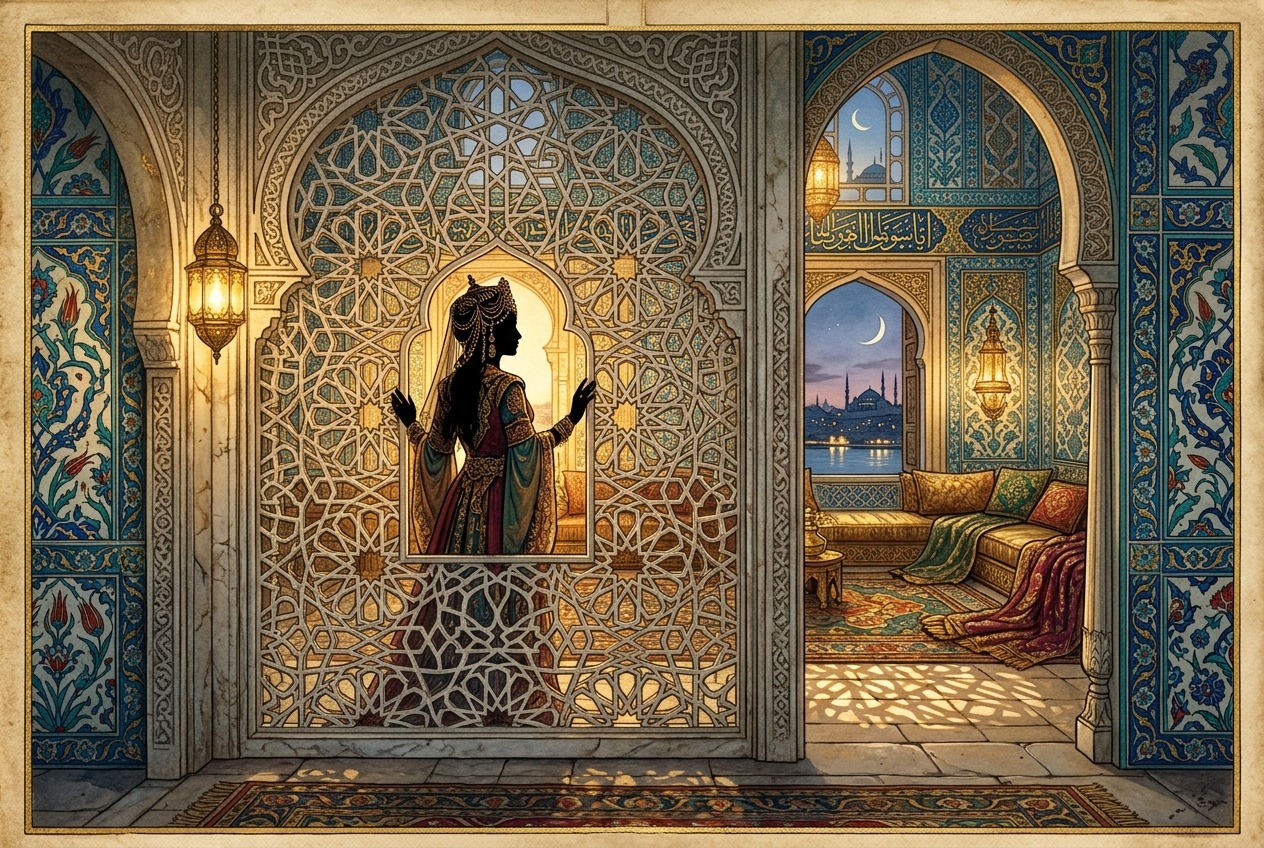
In 1656, as the Ottoman Empire teetered on the brink of collapse, an elderly woman was strangled in the Topkapi Palace by order of her own grandson’s faction. Her name was Kösem Sultan, and for nearly half a century she had been arguably the most powerful person in an empire stretching from Budapest to Baghdad. Her death marked the end of an extraordinary era that Ottoman historians would later call the Kadınlar Saltanatı—the Sultanate of Women.
For roughly 130 years, from the mid-sixteenth to the mid-seventeenth century, a succession of remarkable women—consorts, concubines, and queen mothers—exercised genuine political authority over one of history’s greatest empires. They negotiated with foreign powers, appointed and dismissed grand viziers, commanded vast fortunes, and in some cases ruled outright as regents. Yet for centuries, historians dismissed their era as one of decadence and decline. The real story is far more compelling.
The Structure of Power Behind the Veil
To understand how women gained such influence, we must first understand the imperial harem itself. Far from the exoticized fantasy of Western imagination, the harem was a sophisticated political institution—part royal household, part administrative training ground, part dynastic nerve center.
The Ottoman succession system created unique opportunities for maternal power. Sultans did not marry into rival noble families; instead, they reproduced through enslaved concubines, typically of Christian European origin. Each mother’s fortunes were bound entirely to her son’s. If he became sultan, she became valide sultan—queen mother—the highest-ranking woman in the empire, with her own income, staff, and stamp of authority.
Several factors converged in the sixteenth century to amplify this potential:
- Sedentary sultans: After Süleyman the Magnificent, sultans increasingly stayed in Istanbul rather than leading armies on campaign, making the palace—and the harem within it—the true center of power.
- Child sultans: A string of minors and mentally unstable rulers ascended the throne, creating power vacuums that queen mothers were uniquely positioned to fill.
- The end of fratricide: When the practice of executing a new sultan’s brothers gave way to confining them in the palace (the infamous kafes, or “cage”), the harem became the arena where succession politics played out.
Hürrem Sultan: The Concubine Who Rewrote the Rules
The era conventionally begins with Hürrem Sultan, known in Europe as Roxelana. Captured as a girl in what is now Ukraine and sold into the imperial harem, she accomplished something unprecedented: Süleyman the Magnificent fell so deeply in love with her that he broke centuries of tradition, freeing and legally marrying her around 1533–1534. No sultan had married a concubine in living memory.
Hürrem’s power went far beyond romance. She corresponded directly with foreign rulers, including the King of Poland and the sister of the Persian Shah, functioning as an informal diplomatic channel. She endowed monumental charitable complexes—mosques, soup kitchens, hospitals, and bathhouses—in Istanbul, Mecca, and Jerusalem, using architectural patronage to project legitimacy in ways previously reserved for sultans and their mothers.
She was also a ruthless political operator. Contemporary observers implicated her in the downfall of the grand vizier Ibrahim Pasha, executed in 1536, and in the tragic execution of Prince Mustafa, Süleyman’s eldest son by another consort, in 1553—clearing the path for her own sons. Whether or not she orchestrated these events, the perception of her influence transformed how everyone understood harem politics.
Nurbanu and Safiye: Diplomats in Their Own Right
Hürrem’s successors institutionalized what she had improvised. Nurbanu Sultan, the Venetian-born consort of Selim II and mother of Murad III, maintained a famously pro-Venetian foreign policy and corresponded with Catherine de’ Medici of France. Venetian diplomats openly acknowledged that access to the queen mother was often more valuable than access to the grand vizier.
Her successor, Safiye Sultan, took harem diplomacy even further. She exchanged letters and lavish gifts with Queen Elizabeth I of England—two of the most powerful women on earth conducting statecraft directly with one another. Elizabeth sent Safiye a jeweled portrait and an ornate carriage; Safiye reciprocated with robes of gold cloth and support for English commercial interests in the Ottoman market. This relationship helped cement the Anglo-Ottoman trade alliance at a moment when both powers opposed Habsburg Spain.
Kösem Sultan: The Empire’s De Facto Ruler
No figure embodies the Sultanate of Women more completely than Kösem Sultan. Greek by origin, she became the favorite of Sultan Ahmed I and, after his death in 1617, navigated decades of dynastic chaos with astonishing skill.
Her résumé of power is staggering:
- She served as official regent for her son Murad IV, who took the throne at age eleven in 1623—the first time a valide sultan was formally recognized as regent of the empire.
- When her second son, the unstable Ibrahim, was deposed and executed in 1648, she again became regent for her grandson, the six-year-old Mehmed IV.
- She managed relationships with the janissary corps, brokered alliances with viziers, and effectively directed state policy during periods of crisis, rebellion, and war.
Kösem’s downfall came from within the harem itself. Her daughter-in-law, Turhan Hatice Sultan—mother of the young Mehmed IV—built a rival faction among the palace eunuchs. In 1651, Kösem was assassinated in a palace coup. Turhan then ruled as regent herself before eventually transferring power to the capable Köprülü family of grand viziers in 1656, an act many historians see as closing the era.
Why Historians Got It Wrong
For centuries, both Ottoman chroniclers and Western historians treated the Sultanate of Women as a symptom of imperial decay—a “petticoat government” that corrupted the sultanate. This interpretation reflected deep-seated assumptions: that women’s political activity was inherently illegitimate, that influence exercised through households rather than battlefields didn’t count as “real” power, and that the empire’s seventeenth-century troubles needed a scapegoat.
Modern scholarship, pioneered by historians like Leslie Peirce in her landmark study The Imperial Harem, has demolished this narrative. Peirce demonstrated that women’s power was not a corruption of the Ottoman system but a logical extension of it—a dynasty ruling through the royal household naturally empowered the women who managed that household. Queen mothers provided crucial continuity during minority reigns and succession crises. Far from causing decline, they often held the state together.
A Legacy Reclaimed
The women of the Sultanate era left tangible marks that endure today. Istanbul’s skyline still features their architectural patronage: the Atik Valide Mosque complex built by Nurbanu, and the magnificent Yeni Cami (New Mosque) on the Golden Horn, begun by Safiye and completed by Turhan Hatice. Their charitable foundations fed the poor, funded pilgrims, and endowed hospitals for generations.
More broadly, their story challenges us to rethink what political power looks like. Hürrem, Kösem, and their peers wielded authority through letters rather than armies, through patronage networks rather than parliaments, through the strategic management of a dynasty rather than public office. That their power operated behind palace walls made it no less real—and recognizing it makes our understanding of world history immeasurably richer.