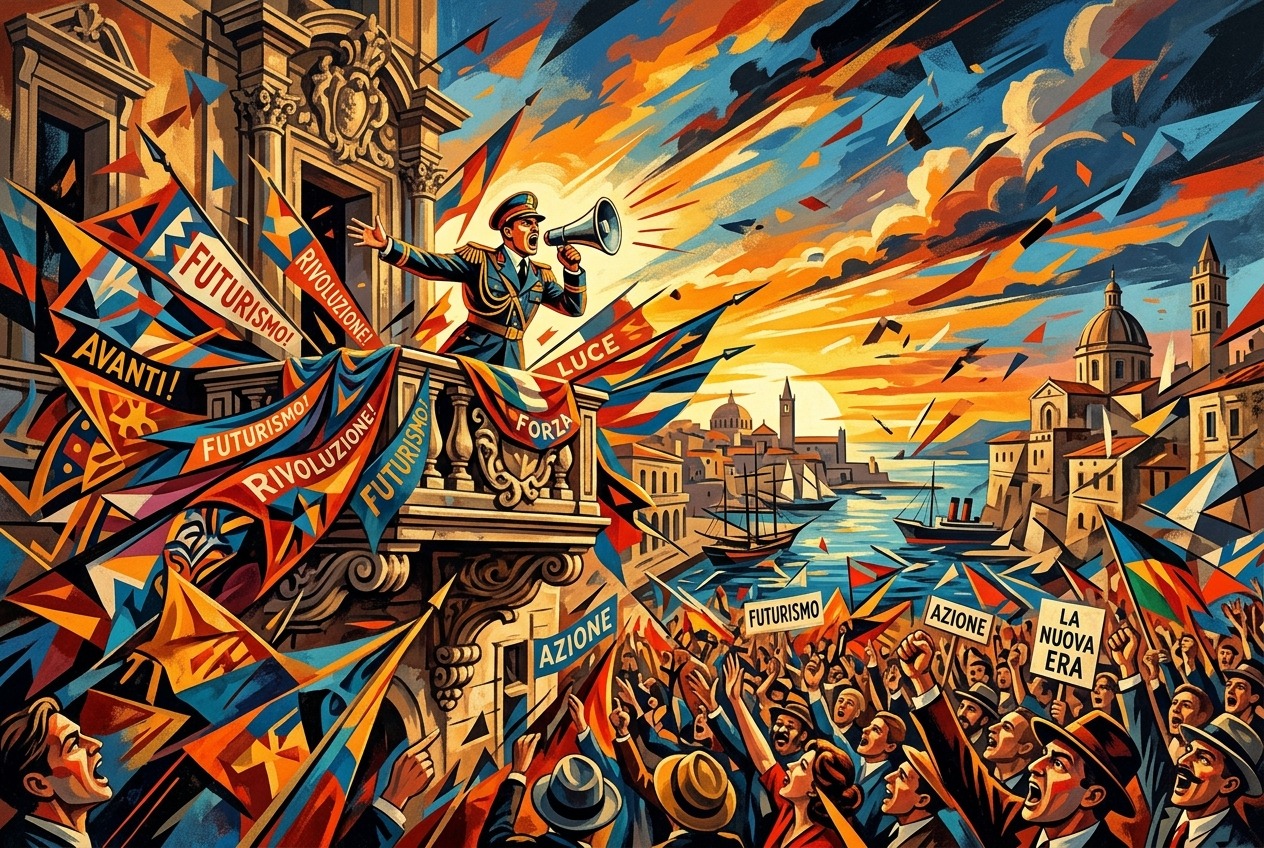
In September 1919, a 56-year-old poet with a shaved head, a monocle, and a flair for the theatrical marched into the disputed Adriatic city of Fiume at the head of roughly 2,000 mutinous soldiers. Within hours, Gabriele D’Annunzio had declared himself ruler of what would become one of history’s strangest political experiments: a city-state governed by poetry, sustained by piracy, and animated by nightly spectacles that blurred the line between government and performance art. For fifteen months, the Republic of Fiume—later styled the Italian Regency of Carnaro—existed as a fever dream on the map of postwar Europe. Its legacy, however, would prove anything but whimsical.
The Poet Who Would Be Prince
To understand Fiume, you must first understand Gabriele D’Annunzio. By 1919, he was arguably the most famous man in Italy—a decadent novelist, playwright, and poet whose scandalous love affairs (most famously with the actress Eleonora Duse) and extravagant debts were tabloid staples. But D’Annunzio was more than a literary celebrity. During World War I, he had reinvented himself as a war hero, flying daring propaganda missions over Vienna and leading torpedo boat raids against the Austrian navy. He lost an eye in a plane crash and kept fighting.
When the war ended, D’Annunzio became the loudest voice denouncing what he called the vittoria mutilata—the “mutilated victory.” Italy had been promised territorial gains in secret wartime treaties, but at the Paris Peace Conference, President Woodrow Wilson and the other Allied leaders balked at handing over the multiethnic port city of Fiume (modern-day Rijeka, Croatia). The city’s population was a contested mix of Italians and Croats, and Wilson envisioned it as a free city or part of the new Yugoslav state.
For Italian nationalists, this was an unbearable insult. And D’Annunzio decided to do something about it.
The March of Ronchi
On September 12, 1919, D’Annunzio set out from Ronchi with a few hundred army deserters and veterans. By the time his convoy reached Fiume, his force had swelled to around 2,000 men as soldiers abandoned their posts to join him. The Allied garrison, unwilling to fire on a war hero, simply stood aside. D’Annunzio entered the city to rapturous crowds and proclaimed its annexation to Italy.
There was just one problem: Italy didn’t want it. The Italian government, terrified of provoking an international crisis, refused to accept the annexation and blockaded the city instead. D’Annunzio, undeterred, decided that if Italy wouldn’t have Fiume, Fiume would become something entirely new.
Life in the Pirate Utopia
What followed was fifteen months of governance unlike anything Europe had seen. Fiume under D’Annunzio was part military dictatorship, part avant-garde commune, part endless carnival. Consider some of its more remarkable features:
- Daily poetry from the balcony: D’Annunzio addressed crowds nearly every day from the balcony of the governor’s palace, delivering intoxicating orations that functioned as both political theater and civic ritual. He perfected the call-and-response style of crowd manipulation—posing rhetorical questions and drawing roars of approval from the masses below.
- State-sponsored piracy: With the city blockaded and starving, D’Annunzio’s followers—dubbed the Uscocchi after 16th-century Adriatic pirates—raided ships and warehouses to keep Fiume supplied. In one famous episode, they hijacked the Italian cargo ship Persia, loaded with arms bound for anti-Bolshevik forces in Russia, and diverted it to Fiume.
- A magnet for radicals and dreamers: The city attracted an astonishing cast of characters: anarchists, syndicalists, futurist artists, war veterans, adventurers, and free-love advocates. Cocaine flowed freely, divorce was legalized, and the atmosphere was one of permanent revolutionary festivity. The poet’s inner circle even flirted with plans to launch a “League of Fiume” to unite oppressed peoples against the imperialist League of Nations.
A Constitution Written in Music
Perhaps Fiume’s most extraordinary artifact was its constitution, the Charter of Carnaro, drafted in 1920 by the anarcho-syndicalist Alceste De Ambris and rewritten in lyrical prose by D’Annunzio himself. It remains one of the strangest founding documents ever produced.
The Charter organized society into nine corporations representing different sectors of labor—workers, seafarers, professionals, and so on—with a mysterious tenth corporation reserved for the “superior individuals” of the future: heroes, prophets, and geniuses. It guaranteed remarkably progressive rights for its era, including gender equality, freedom of religion, universal suffrage, and generous social insurance.
And then there was Article 64, which declared music to be a “religious and social institution” and a fundamental principle of the state. Every commune was required to maintain a choir and orchestra, and the Charter called for the construction of a massive concert amphitheater with free admission for 10,000 citizens. No other constitution in history has enshrined music as a pillar of governance.
The Laboratory of Fascism
For all its bohemian charm, Fiume had a darker significance. Watching from Milan, an ambitious journalist named Benito Mussolini took careful notes. Nearly the entire aesthetic vocabulary of Italian Fascism was pioneered in Fiume:
- The black shirts worn by D’Annunzio’s legionnaires
- The straight-armed Roman salute
- The balcony speeches and choreographed dialogues with the crowd
- The war cry “Eia, eia, alalà!” that Fascists would later adopt
- The cult of the charismatic leader, whom followers called il Duce—a title Mussolini would famously appropriate
Historians have called D’Annunzio the “John the Baptist of Fascism”, though the comparison is imperfect. D’Annunzio himself never joined the Fascist Party and privately disdained Mussolini as a vulgar imitator. Fiume’s politics were genuinely eclectic, blending left-wing syndicalism with nationalist theater. But Mussolini stripped away the anarchist experimentation and kept the stagecraft—the uniforms, the rituals, the intoxicating fusion of politics and spectacle. Fiume proved that a modern crowd could be governed through aesthetics and emotion, a lesson totalitarians would apply with devastating effect.
Bloody Christmas and the Aftermath
The adventure ended in December 1920. Italy and Yugoslavia signed the Treaty of Rapallo, establishing Fiume as an independent free state—without D’Annunzio. When the poet refused to leave, the Italian navy shelled the city in what became known as Natale di Sangue, or “Bloody Christmas.” A shell struck the governor’s palace, narrowly missing D’Annunzio himself. Declaring that Italy was not worth dying for, he surrendered and withdrew.
D’Annunzio retired to a lavish villa on Lake Garda, where Mussolini—wary of his rival’s lingering charisma—kept him comfortable, subsidized, and politically neutralized until his death in 1938. Fiume itself was annexed by Fascist Italy in 1924 and passed to Yugoslavia after World War II. Today, as Rijeka, Croatia, it bears few traces of its brief career as a pirate republic of poets.
Why Fiume Still Matters
The Republic of Fiume endures as a cautionary tale and a curiosity in equal measure. It demonstrated how quickly the machinery of the state can be captured by charisma, how art and politics can fuse into something intoxicating and dangerous, and how the carnival can curdle into the dictatorship. It was utopia and dystopia sharing the same balcony—a fifteen-month performance whose final act played out across Europe for decades to come.