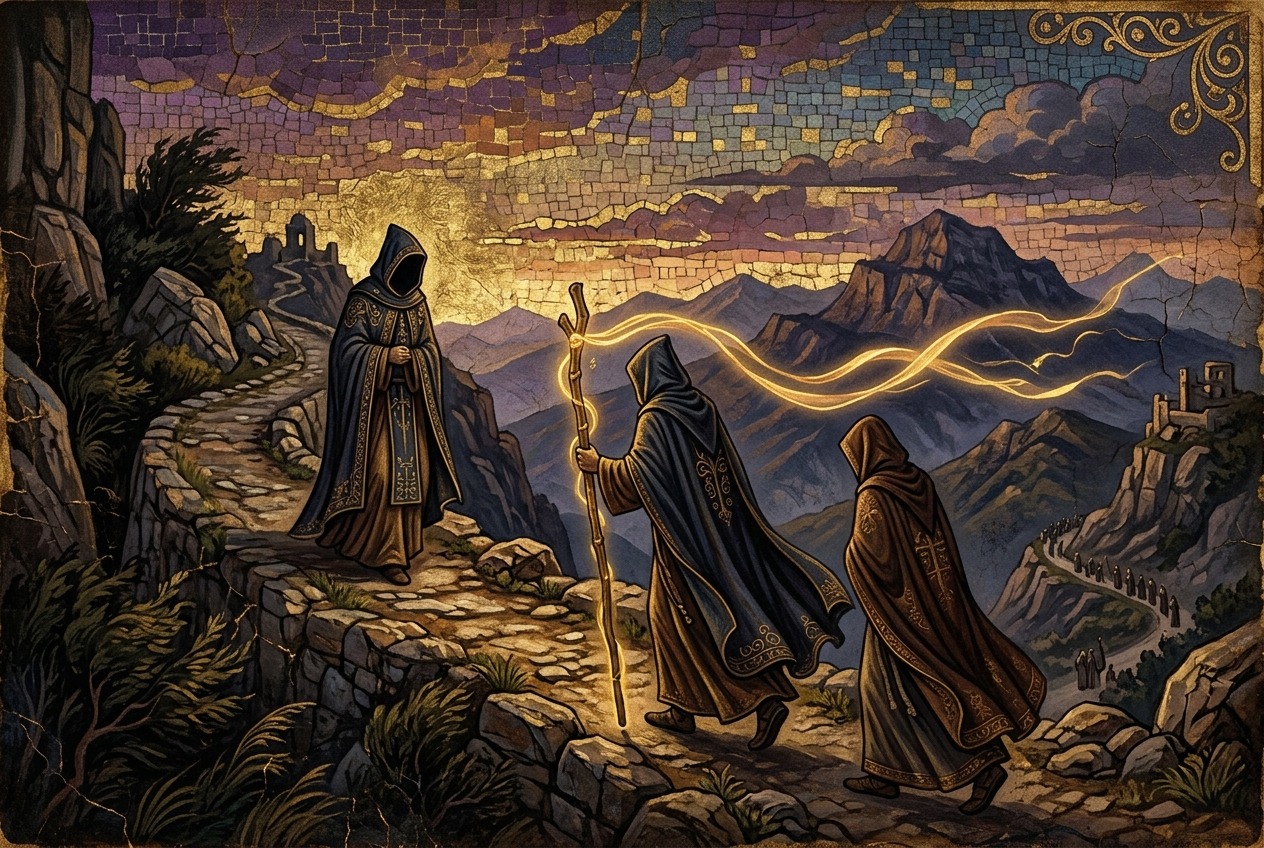
In the annals of espionage, few operations can match the audacity, patience, and world-changing consequences of a mission carried out around 552 CE. Two monks, armed with nothing more than hollow bamboo canes and extraordinary nerve, walked out of Asia carrying the seeds of an empire’s economic salvation—and the destruction of another’s most jealously guarded secret. Their cargo? Silkworm eggs. Their achievement? Breaking a monopoly that China had maintained for over a thousand years.
This is the story of history’s greatest act of industrial espionage, a tale that reshaped global trade, enriched the Byzantine Empire, and demonstrates that in the ancient world, as today, knowledge was the most valuable commodity of all.
The Secret Worth More Than Gold
To understand why two monks would risk their lives smuggling insect eggs across thousands of miles, we must first appreciate just how valuable silk was in the ancient world. For centuries, silk was quite literally worth its weight in gold—and sometimes more. Roman senators draped themselves in it, Byzantine emperors reserved certain shades for royalty alone, and the fabric served as currency, diplomatic gift, and status symbol across three continents.
China had discovered the art of sericulture—the cultivation of silkworms and production of silk—as early as 2700 BCE, according to Chinese tradition. Legend credits Empress Leizu with the discovery when a silkworm cocoon fell into her tea and began to unravel into a shimmering thread. Whatever the true origins, the Chinese understood immediately that they possessed something extraordinary.
The imperial government guarded the secret with ferocious determination. Revealing the methods of silk production or exporting silkworm eggs was punishable by death. For over a millennium, this policy worked remarkably well. Outsiders spun wild theories about silk’s origins—the Roman naturalist Pliny the Elder believed silk was combed from the leaves of trees, while others thought it grew like cotton or was produced by giant beetles.
The Silk Road: A River of Wealth Flowing East
The famous Silk Road, stretching over 4,000 miles from China to the Mediterranean, was named for its most precious cargo. But this trade route was as much a drain on Western economies as it was a source of luxury. Consider these staggering realities:
- Rome hemorrhaged an estimated 100 million sesterces annually on silk and other Eastern luxuries, prompting complaints from moralists like Seneca about the “immodest” fabric bankrupting the empire
- By the time silk reached Constantinople, it had passed through numerous middlemen—Sogdian merchants, Persian traders—each adding their markup
- The Sasanian Persian Empire, sitting astride the trade routes, could effectively hold Byzantine silk supplies hostage during frequent wars
This last point proved critical. For Emperor Justinian I, who ruled Byzantium from 527 to 565 CE, dependence on Persian intermediaries wasn’t merely expensive—it was a strategic vulnerability. Silk wasn’t just fashion in Constantinople; it was essential to imperial ceremony, diplomacy, and the state’s prestige. Justinian had already attempted to bypass Persia by establishing alternate routes through Ethiopia and the Crimea, with limited success.
Enter the Monks
Our primary source for this remarkable tale is the Byzantine historian Procopius, writing in his work History of the Wars. According to Procopius, sometime around 552 CE, two monks approached Emperor Justinian with an extraordinary proposition. These monks—likely Nestorian Christians who had spent years living in “Serinda” (probably a region of Central Asia or China itself)—claimed they had learned the closely guarded secrets of silk production.
The monks explained the truth that had eluded the West for centuries: silk came not from trees or magical beetles, but from the cocoons of a particular caterpillar, the Bombyx mori, which fed exclusively on the leaves of mulberry trees. More importantly, they claimed they could obtain silkworm eggs and transport them back to Byzantine territory.
Justinian, recognizing the world-altering potential of this offer, promised the monks generous rewards and dispatched them on their mission.
The Journey: Bamboo Canes and Nerves of Steel
The details of the monks’ return journey read like an ancient thriller. According to the accounts, they concealed silkworm eggs inside hollow bamboo canes—possibly their walking staffs. This method was ingenious for several reasons:
- Concealment: A monk’s walking staff would attract no suspicion at border checkpoints
- Climate control: The bamboo may have helped insulate the eggs during the long journey
- Timing: Silkworm eggs can remain dormant for extended periods, unlike live silkworms, which would have died en route
The journey itself likely took one to two years, crossing deserts, mountains, and hostile territories. Had they been caught with their contraband in Chinese-controlled lands, execution would have been swift. Yet around 552-554 CE, the monks arrived in Constantinople with their precious cargo intact.
Byzantium Becomes a Silk Superpower
The eggs hatched. The caterpillars fed on mulberry leaves (which fortunately grew in Byzantine territory). The Byzantines learned to unravel the cocoons, spin the thread, and weave the fabric. Within decades, the empire had established a thriving silk industry centered in Constantinople, with later production centers in Greek cities like Thebes and Corinth.
The consequences were profound:
- Economic transformation: Silk production became a Byzantine state monopoly, with imperial workshops (the gynaecea) producing the finest grades. Revenue that once flowed to Persia and China now enriched Byzantine coffers.
- Diplomatic power: Byzantine silk became a tool of statecraft. Gifts of imperial purple silk could cement alliances, and restrictions on its export signaled displeasure.
- Strategic independence: Byzantium no longer needed to negotiate with Persian rivals for access to this critical commodity.
- Lasting legacy: The Byzantine silk industry thrived for centuries until Norman raiders carried weavers off to Sicily in 1147, spreading sericulture to Italy and eventually the rest of Europe.
Separating Fact from Legend
Historians urge some caution with this story. Procopius is our main source, and a slightly different version by the historian Theophanes of Byzantium credits a Persian rather than monks. The tale may be simplified or embellished—establishing a functioning silk industry required not just eggs but expertise in raising silkworms, cultivating mulberry trees, and processing thread, knowledge that likely arrived through multiple channels over time.
It’s also worth noting that China’s monopoly had already sprung leaks. Sericulture had reached Korea, Japan, India, and Central Asian kingdoms like Khotan (where legend tells of a Chinese princess smuggling eggs in her elaborate hairdo) before the monks made their famous journey. What the monks accomplished was bringing the secret to the Mediterranean world specifically.
Lessons from History’s Greatest Heist
The silkworm smuggling operation resonates today because it illustrates timeless truths about technology, secrecy, and economic power. No monopoly on knowledge lasts forever. China guarded sericulture successfully for perhaps 3,000 years—an astonishing achievement—but ultimately, valuable secrets find ways to travel.
The story also reveals how single acts of espionage can redirect the flow of history. Byzantium’s silk industry sustained the empire’s wealth and prestige for six centuries. The knowledge eventually seeded the silk industries of Italy and France, which in turn shaped European fashion, trade, and industrialization.
Two monks, two bamboo canes, and a handful of insect eggs: rarely has so much history hinged on so humble a cargo.