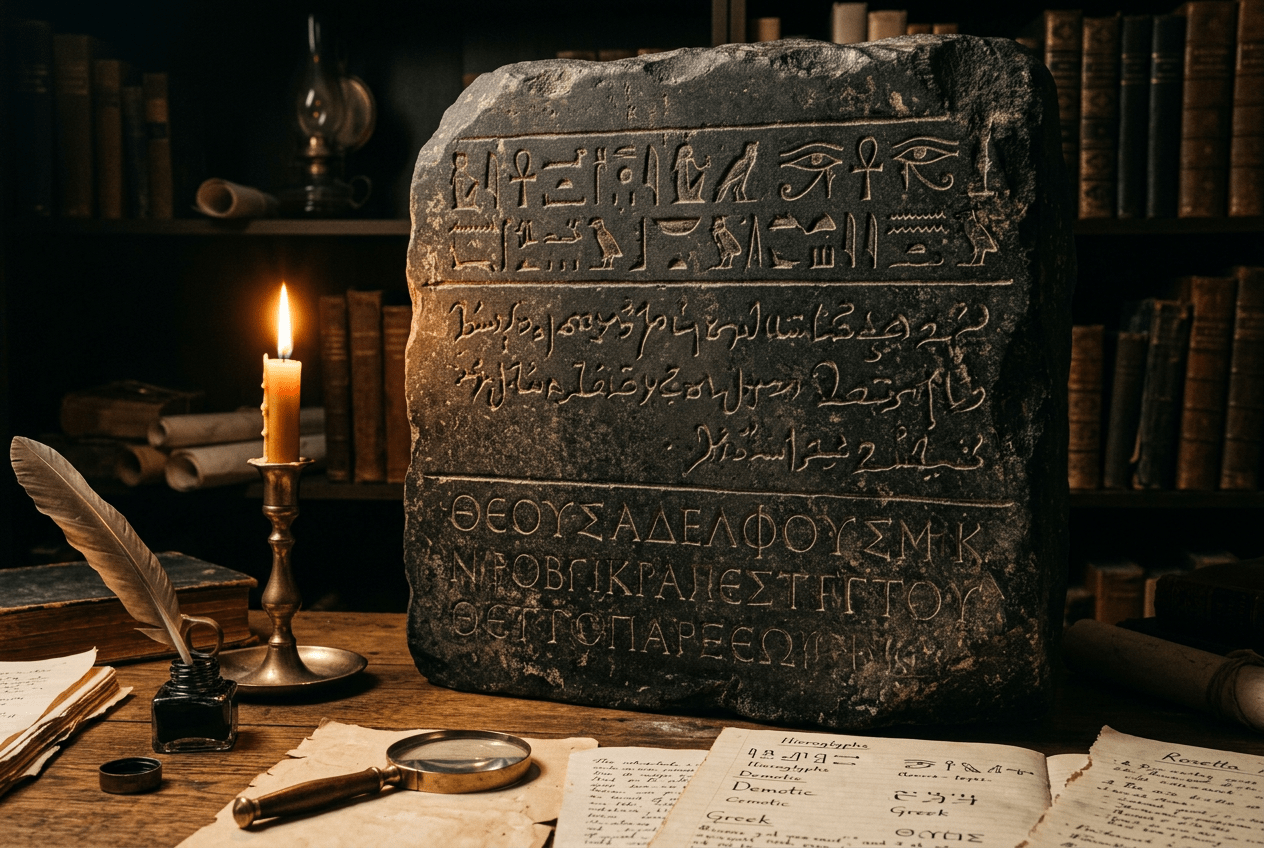
In July 1799, French soldiers digging fortifications near the Egyptian town of Rashid—known to Europeans as Rosetta—unearthed a slab of dark granodiorite covered in three bands of writing. They could not have known it, but they had just discovered the key that would unlock 3,000 years of silent history. What followed was one of the most gripping intellectual contests of the nineteenth century: a two-decade race between an English polymath and a French prodigy, played out against the backdrop of the Napoleonic Wars, to decipher Egyptian hieroglyphs and resurrect the voice of an ancient civilization.
A Stone Born of Empire
The Rosetta Stone owes its discovery to Napoleon Bonaparte’s ambitious 1798 invasion of Egypt. Alongside his army, Napoleon brought 167 scholars, engineers, and artists—the famous savants—tasked with documenting everything about the mysterious land of the pharaohs. When Lieutenant Pierre-François Bouchard’s men uncovered the inscribed stone, the savants immediately recognized its significance.
The stone bore a single decree, issued in 196 BCE on behalf of the boy-king Ptolemy V, written three times: in hieroglyphs (the sacred script of Egyptian priests), in Demotic (the everyday script of ordinary Egyptians), and in ancient Greek. Since scholars could read Greek fluently, the stone offered something extraordinary—a bilingual crib sheet for a writing system that had been dead for nearly 1,400 years.
But before the French could exploit their discovery, fortune intervened. British forces defeated Napoleon’s army in Egypt, and under the Treaty of Alexandria in 1801, the stone was surrendered as a spoil of war. It arrived in London in 1802 and has resided in the British Museum ever since. The French, however, had made copies—and the race was on.
The Problem That Defeated Everyone
Deciphering hieroglyphs proved far harder than anyone expected, largely because European scholars carried centuries of misconceptions. Since the Renaissance, the prevailing theory—rooted in the writings of the fifth-century philosopher Horapollo—held that hieroglyphs were purely symbolic. A picture of a hawk, the thinking went, represented an abstract idea like “swiftness” or “divinity”, not a sound or a word.
This assumption sent generations of would-be decipherers down blind alleys, producing translations that were pure fantasy. To crack the code, someone would have to abandon the symbolic theory entirely—and that required both genius and intellectual courage.
Thomas Young: The Man Who Knew Everything
Enter Thomas Young, an English physician and physicist so brilliant that contemporaries called him “the last man who knew everything.” Young had already demonstrated the wave nature of light, explained how the human eye focuses, and contributed to the theory of elasticity. By 1814, he turned his formidable mind to the Rosetta Stone.
Young made several genuine breakthroughs:
- He recognized that Demotic was not purely alphabetic, but a mixture of phonetic and symbolic signs—and that it was related to hieroglyphs, not a completely separate system.
- He focused on the cartouches—the oval rings that enclosed certain groups of hieroglyphs—correctly guessing they contained royal names.
- He partially deciphered the name “Ptolemy”, assigning sound values to several hieroglyphic signs, some of them correctly.
Yet Young stopped short of the full breakthrough. He believed phonetic spelling was a late, foreign innovation used only for non-Egyptian names like Ptolemy’s. The rest of the script, he assumed, remained symbolic. In 1819, he published his findings in a supplement to the Encyclopaedia Britannica—a substantial achievement, but not the solution.
Champollion: A Life Devoted to One Obsession
Meanwhile, in France, a very different kind of scholar was preparing. Jean-François Champollion was no gentleman dabbler. Born in 1790 in the town of Figeac, he was a prodigy consumed by a single obsession: Egypt. By his teens, he had mastered Latin, Greek, Hebrew, Arabic, Syriac, Chaldean, and—crucially—Coptic, the liturgical language of Egyptian Christians, which he correctly suspected was a descendant of ancient Egyptian.
Legend has it that at age eleven, Champollion vowed to be the one to decipher hieroglyphs. Whether or not the story is true, his preparation was unmatched. While Young approached the puzzle as one intellectual challenge among many, Champollion had spent his entire life building the exact toolkit the problem demanded.
The Breakthrough of 1822
The decisive clue arrived from an unexpected source: an obelisk from Philae, brought to England by the collector William Bankes. It bore a bilingual inscription containing two royal names—Ptolemy and, scholars deduced, Cleopatra. When Champollion obtained a copy, he could cross-reference the signs. The letters shared by both names—P, T, O, L—appeared in exactly the right positions. Hieroglyphs, at least in these cases, spelled sounds.
But the true test came in September 1822, when Champollion received copies of inscriptions from the temple of Abu Simbel—inscriptions far older than the Greek-influenced Ptolemaic era. One cartouche contained a circle with a dot (which he knew from Coptic represented the sun, Ra), followed by signs he could now read phonetically as m-s-s. The name leapt out at him: Ra-mses. Ramesses. A pharaoh’s name from Egypt’s golden age, spelled with a combination of symbolic and phonetic signs.
The implication was staggering: the phonetic principle wasn’t a foreign afterthought. It ran through the entire hieroglyphic system, from its earliest ages. The script was a rich hybrid of sounds and symbols—and Champollion, with his Coptic, could read it.
On September 14, 1822, Champollion burst into his brother’s office at the Institut de France, cried out “Je tiens l’affaire!” (“I’ve got it!”)—and collapsed in a dead faint. He remained bedridden for days, overwhelmed by the magnitude of his discovery. On September 27, he formally announced his findings in his famous Lettre à M. Dacier, the founding document of Egyptology.
Rivalry, Resentment, and National Pride
The aftermath was anything but gracious. Young, who was in Paris and even attended Champollion’s presentation, initially congratulated the Frenchman. But he soon grew bitter, convinced that Champollion had built on his work without adequate credit. British scholars rallied behind Young; the French championed Champollion. The decipherment became a proxy battle in the long Anglo-French rivalry, with newspapers and learned societies on both sides of the Channel claiming national victory.
The fairest verdict acknowledges both men. Young made real, documented progress and may well have pointed Champollion toward the phonetic approach. But it was Champollion who grasped the system as a whole, who could actually read Egyptian rather than merely match names, and who went on to compile grammars and dictionaries of the ancient language. Young picked the lock partway; Champollion opened the door.
The Legacy: A Civilization Speaks Again
Champollion lived only a decade after his triumph, dying of a stroke in 1832 at just forty-one—but not before leading an expedition to Egypt, where he read inscriptions on temple walls that had been mute for millennia. Thanks to the decipherment, Egyptology transformed from treasure hunting into genuine scholarship. Medical papyri, love poems, legal contracts, religious texts, and royal chronicles poured forth, restoring one of humanity’s greatest civilizations to the historical record.
The Rosetta Stone itself has become a universal metaphor for any key that unlocks the unknown. But behind the metaphor lies a very human story: two brilliant rivals, driven by curiosity, ambition, and national pride, racing to hear the dead speak—and the moment when one of them finally did, and the shock of it knocked him off his feet.