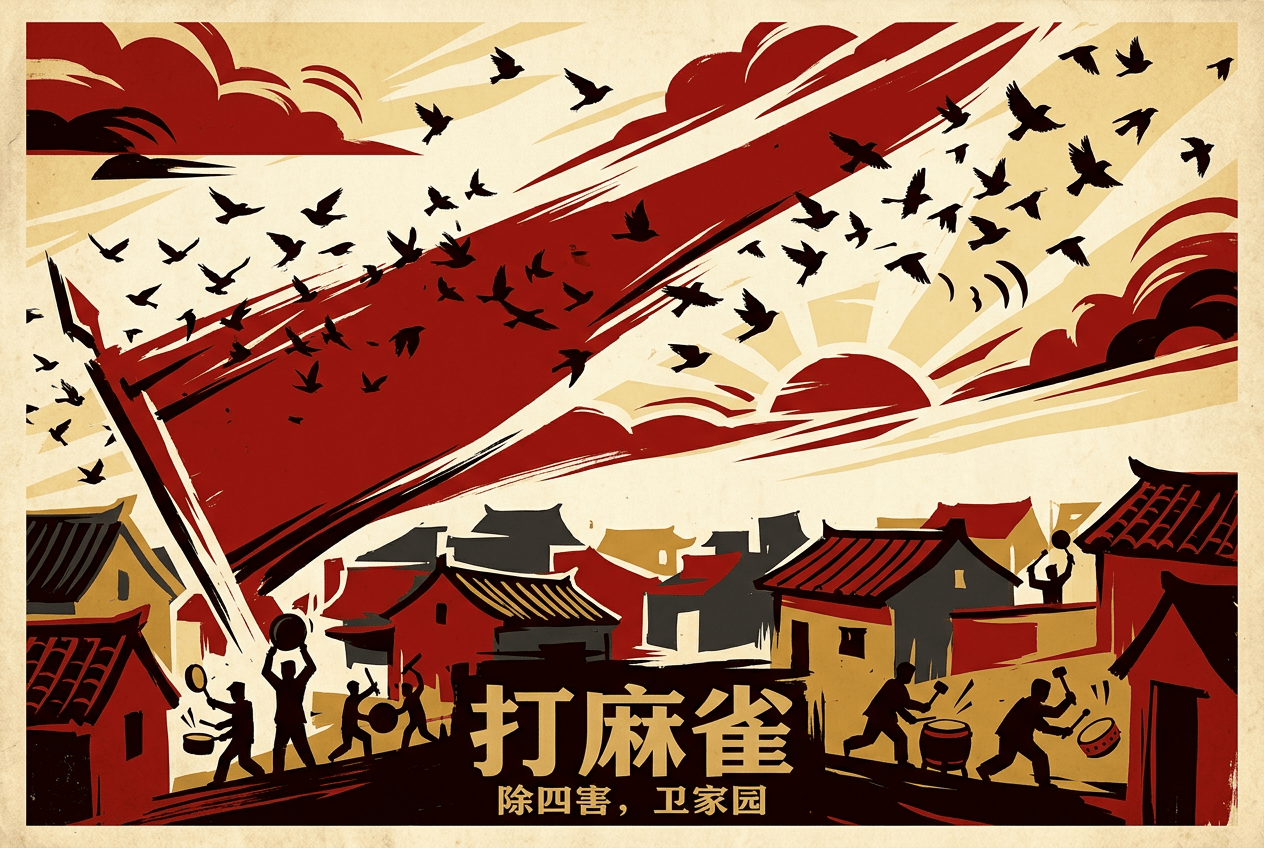
In the spring of 1958, an eerie cacophony rose across China. In cities and villages alike, millions of people stood on rooftops, in courtyards, and along country roads, banging pots, pans, gongs, and drums. Children waved flags and fired slingshots. The target of this nationwide assault was not an invading army or a political enemy—it was a small brown bird weighing barely an ounce: the Eurasian tree sparrow.
The Four Pests Campaign remains one of history’s most striking examples of how political zeal, combined with ecological ignorance, can spiral into catastrophe. What began as a public health initiative would help deepen the deadliest famine in human history.
The Great Leap Forward and the Birth of the Campaign
To understand the war on sparrows, one must understand the moment in which it was launched. In 1958, Mao Zedong initiated the Great Leap Forward, an audacious plan to transform China from an agrarian society into an industrial powerhouse within a few short years. Steel production quotas soared, farms were collectivized into massive communes, and the entire population was mobilized in service of rapid modernization.
Part of this vision involved cleansing China of disease and agricultural loss. The government identified four “pests” to be exterminated:
- Rats, which spread plague and consumed grain stores
- Flies, carriers of disease in homes and markets
- Mosquitoes, responsible for malaria transmission
- Sparrows, accused of eating grain from the fields
The first three targets were, by any reasonable measure, legitimate public health concerns. The fourth was a fatal miscalculation. Chinese scientists had estimated that a single sparrow consumed roughly 4.5 kilograms of grain per year. By that arithmetic, killing one million sparrows would theoretically save enough food to feed 60,000 people. The logic seemed unassailable—if you ignored everything else sparrows ate.
A Nation Mobilized Against a Bird
What followed was one of the most extraordinary mass mobilizations in history. The strategy exploited a simple biological fact: sparrows cannot stay airborne indefinitely. If denied a place to land and rest, they will eventually drop from the sky, dead from exhaustion.
So China made sure the sparrows could never rest. Entire communities coordinated their efforts, creating relentless walls of noise. People banged pots and pans in shifts. Scarecrows were erected in fields. Nests were torn down, eggs smashed, and chicks killed. Schoolchildren were organized into shooting brigades and rewarded for the number of birds they brought in. Some schools and work units held competitions, with quotas and prizes for the most sparrows killed.
Contemporary accounts describe surreal scenes. In Beijing, an estimated three million people participated in a coordinated assault in December 1958. The Polish embassy in Beijing, which refused to participate, reportedly became a refuge for fleeing sparrows—until Chinese citizens surrounded the compound with drums, and after two days of continuous noise, embassy staff had to clear the grounds of dead birds with shovels.
The results were staggering. By some estimates, hundreds of millions of sparrows were killed within the campaign’s first year, along with roughly 1.5 billion rats, 100 million kilograms of flies, and 11 million kilograms of mosquitoes. The sparrow was driven to near-extinction within China’s borders.
The Ecological Reckoning
The campaign’s fatal flaw lay in a fact that ornithologists understood well: sparrows do eat grain, but they also eat enormous quantities of insects—particularly locusts and other crop-destroying pests. During breeding season, sparrows feed their young almost exclusively on insects. A single sparrow family could consume thousands of insects in a season.
The ecologist Tso-hsin Cheng, China’s most prominent ornithologist, had warned that sparrows were vital for pest control. His concerns, like those of other scientists, were dismissed—and worse. During later political campaigns, scientists who had spoken against the sparrow extermination were denounced. Cheng himself was persecuted during the Cultural Revolution, forced to clean bird cages at the very institute he had once led.
With their primary predator gone, insect populations exploded. Locusts, in particular, swarmed across the countryside in devastating numbers, devouring crops with an efficiency no sparrow could ever match. The birds accused of stealing grain had, in fact, been protecting it.
Compounding a Catastrophe
The locust plagues struck at the worst possible moment. The Great Leap Forward had already destabilized Chinese agriculture through a series of disastrous policies:
- Backyard steel furnaces pulled millions of farmers away from fields to smelt scrap metal—much of it useless
- Lysenkoist farming techniques, imported from Soviet pseudoscience, promoted deep plowing and dense planting that damaged crops
- Inflated harvest reports from local officials, eager to please superiors, led the state to requisition grain that didn’t exist
- Poor weather in 1959–1961 further stressed the agricultural system
Into this fragile situation came the insect swarms. Crop yields collapsed. The resulting Great Chinese Famine, lasting roughly from 1959 to 1961, killed an estimated 15 to 45 million people—the deadliest famine in recorded history. While the sparrow campaign was not the famine’s sole cause, historians widely agree that the ecological imbalance it created significantly worsened the agricultural collapse.
A Quiet Reversal
By 1960, even the leadership could not ignore the evidence. On the advice of scientists at the Chinese Academy of Sciences, Mao ordered the campaign redirected: sparrows were quietly removed from the list of four pests and replaced with bed bugs. There was no public acknowledgment of error—the change simply happened.
But ecosystems do not recover by decree. Sparrow populations had been so devastated that China eventually had to import sparrows from the Soviet Union to help restore the balance. It would take years for insect predation to return to natural levels.
Lessons from the War on Sparrows
The Four Pests Campaign endures as a cautionary tale with lessons far beyond China’s borders:
- Ecosystems are interconnected. Removing a single species—even one that seems harmful—can trigger cascading consequences that dwarf the original problem.
- Expertise matters. Scientists who understood sparrow ecology were ignored or silenced. When political ideology overrides empirical knowledge, the results can be measured in human lives.
- Mass mobilization is a double-edged sword. The same organizational capacity that can build dams and eradicate diseases can also execute catastrophic errors with terrifying efficiency.
- Simple arithmetic can mislead. The calculation that killing sparrows would save grain was technically accurate but catastrophically incomplete—a reminder that narrow metrics can obscure larger truths.
Today, as humanity grapples with biodiversity loss, climate intervention proposals, and other large-scale environmental decisions, the sparrows of 1958 offer a sobering reminder. Nature’s balance, built over millennia, can be shattered in a season of banging pots—and no amount of political will can order it restored.
The humble sparrow, once declared an enemy of the people, ultimately proved to be one of agriculture’s quiet guardians. Its near-extermination stands as a monument to what happens when we act on nature before we understand it.