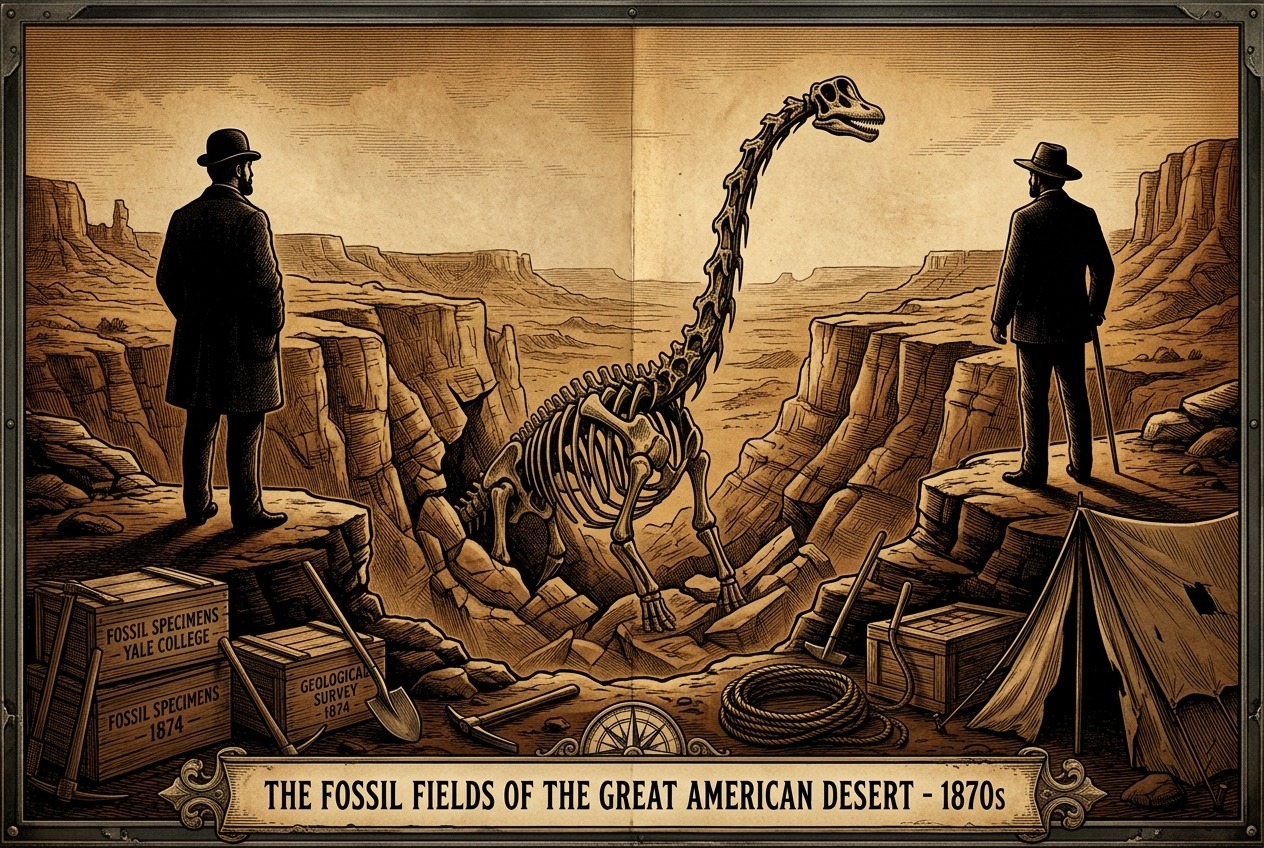
In the summer of 1877, workers in the Wyoming Territory dynamited a fossil quarry—not to extract dinosaur bones, but to destroy them. The goal was simple and spiteful: if one paleontologist couldn’t have the fossils, then his hated rival certainly wouldn’t get them either. This act of scientific vandalism was just one skirmish in a decades-long war between two of America’s most brilliant and most flawed scientists: Edward Drinker Cope and Othniel Charles Marsh.
Their feud, now known as the “Bone Wars”, reads like a Gilded Age melodrama complete with espionage, bribery, character assassination, and financial ruin. Yet paradoxically, this poisonous rivalry produced one of the most productive eras in the history of paleontology. Between them, Cope and Marsh named over 130 new dinosaur species—including household names like Triceratops, Stegosaurus, Allosaurus, and Diplodocus—and transformed dinosaurs from obscure curiosities into icons of American science.
Two Men, One Obsession
Edward Drinker Cope was a prodigy. Born in 1840 to a wealthy Philadelphia Quaker family, he published his first scientific paper at age 19 and would go on to author an astonishing 1,400 papers in his lifetime. Brilliant, hot-tempered, and impulsive, Cope worked at a feverish pace that sometimes led to embarrassing errors.
Othniel Charles Marsh, nine years older, was Cope’s temperamental opposite: methodical, calculating, and politically savvy. Born into modest circumstances in New York, Marsh’s fortunes changed thanks to his fabulously wealthy uncle, the philanthropist George Peabody. Peabody’s money funded Marsh’s education and endowed the Peabody Museum of Natural History at Yale, where Marsh became America’s first professor of paleontology.
Remarkably, the two men began as friends. They met in Berlin in 1863, corresponded warmly, and even named species after one another. But friendship between two ambitious men chasing the same glory could not last.
The Elasmosaurus Incident
The exact origins of the feud are debated, but one humiliation looms large. In 1868, Cope reconstructed a marine reptile he named Elasmosaurus—a long-necked plesiosaur from Kansas. There was just one problem: Cope had placed the skull on the wrong end of the animal, mounting the head on the tail.
According to the popular version of the story, Marsh gleefully pointed out the error, and Cope, mortified, tried to buy up every copy of the journal containing his mistake. Whether Marsh actually discovered the error (the anatomist Joseph Leidy also identified it) matters less than the outcome: Cope never forgave the humiliation, and Marsh never let him forget it.
Around the same time, Marsh committed his own act of betrayal. After Cope generously showed him a productive marl pit in New Jersey, Marsh secretly paid the quarry operators to send future fossil finds to Yale instead of to Cope. The gloves were off.
Racing West: The Great Fossil Rush
The 1870s opened the American West to fossil hunters on an unprecedented scale. The transcontinental railroad, completed in 1869, made remote badlands accessible, and the exposed rock formations of Colorado, Wyoming, Montana, and Kansas proved to be treasure troves of Mesozoic life.
The rivalry reached fever pitch in 1877, when massive dinosaur bones were discovered at Como Bluff, Wyoming, and near Morrison and Cañon City, Colorado. Both men dispatched teams of collectors, and the competition descended into outright warfare:
- Espionage: Both men planted spies in each other’s camps and paid informants to report on rival discoveries.
- Bribery: Collectors were routinely bribed to switch sides, and railroad workers were paid to redirect shipments of fossils.
- Sabotage: Field crews destroyed fossils they couldn’t carry out, smashing bones or dynamiting quarries to keep them from the enemy.
- Deception: Teams used false names for fossil sites and shipped crates under misleading labels to throw off rivals.
The scientific consequences were mixed. The frantic pace led both men to publish hastily, sometimes describing the same species multiple times under different names—a taxonomic mess that took later scientists decades to untangle. Marsh’s most famous error came in 1879, when he mounted the wrong skull on an Apatosaurus skeleton and named the composite creature “Brontosaurus”, creating a confusion that persisted for over a century.
Politics, Ruin, and Public Scandal
As the fossil fields quieted in the 1880s, the war shifted to Washington. Marsh, ever the political operator, secured the position of chief paleontologist for the U.S. Geological Survey and became president of the National Academy of Sciences. He used his influence to choke off Cope’s access to federal funding and even attempted to seize Cope’s fossil collection, arguing that specimens collected on government-funded expeditions belonged to the government.
Cope, meanwhile, had squandered much of his inherited fortune on failed mining investments and self-funded expeditions. Nearly destitute, living amid crates of fossils in a cramped Philadelphia rowhouse, he decided to take his enemy down with him.
In January 1890, Cope handed the New York Herald a dossier of accusations he had been compiling for decades. The newspaper ran the story under a sensational headline accusing Marsh and the Geological Survey of corruption, plagiarism, and scientific incompetence. Marsh fired back in print with his own accusations. The public spectacle scandalized the scientific community and damaged both men’s reputations. Within two years, Congress slashed the Geological Survey’s budget, and Marsh was forced to resign his government post and, eventually, to ask Yale for a salary for the first time in his life.
A Rivalry to the Grave—and Beyond
Cope died in 1897, nearly penniless, surrounded by his beloved fossils. Even in death, he sought one last contest: he donated his skull to science, reportedly hoping that his brain would prove larger than Marsh’s—a challenge Marsh declined to accept. Marsh died two years later, having spent nearly all of his fortune on his collections.
The Legacy: Destruction and Discovery
How should history judge the Bone Wars? The costs were real. Fossils were destroyed, careers were wrecked, and the credibility of American science suffered. Both men cut corners that generations of paleontologists have had to correct.
Yet the achievements were staggering. When Cope and Marsh began their careers, only a handful of dinosaur species were known in North America. By the time they died, they had described more than 130 between them, along with hundreds of other fossil vertebrates. Marsh’s fossil horse sequence provided some of the most compelling early evidence for Darwinian evolution—Darwin himself praised it. Their collections, housed at Yale’s Peabody Museum and Philadelphia’s Academy of Natural Sciences, remain foundational research resources today.
Perhaps most importantly, the Bone Wars captured the public imagination. Newspaper coverage of giant bones and feuding scientists made dinosaurs famous, paving the way for the museum displays, books, and films that keep paleontology in the popular consciousness.
The Bone Wars stand as a cautionary tale about how ego can corrupt science—and a strange testament to how competition, even at its ugliest, can drive discovery. Cope and Marsh destroyed each other, but in doing so, they built American paleontology.