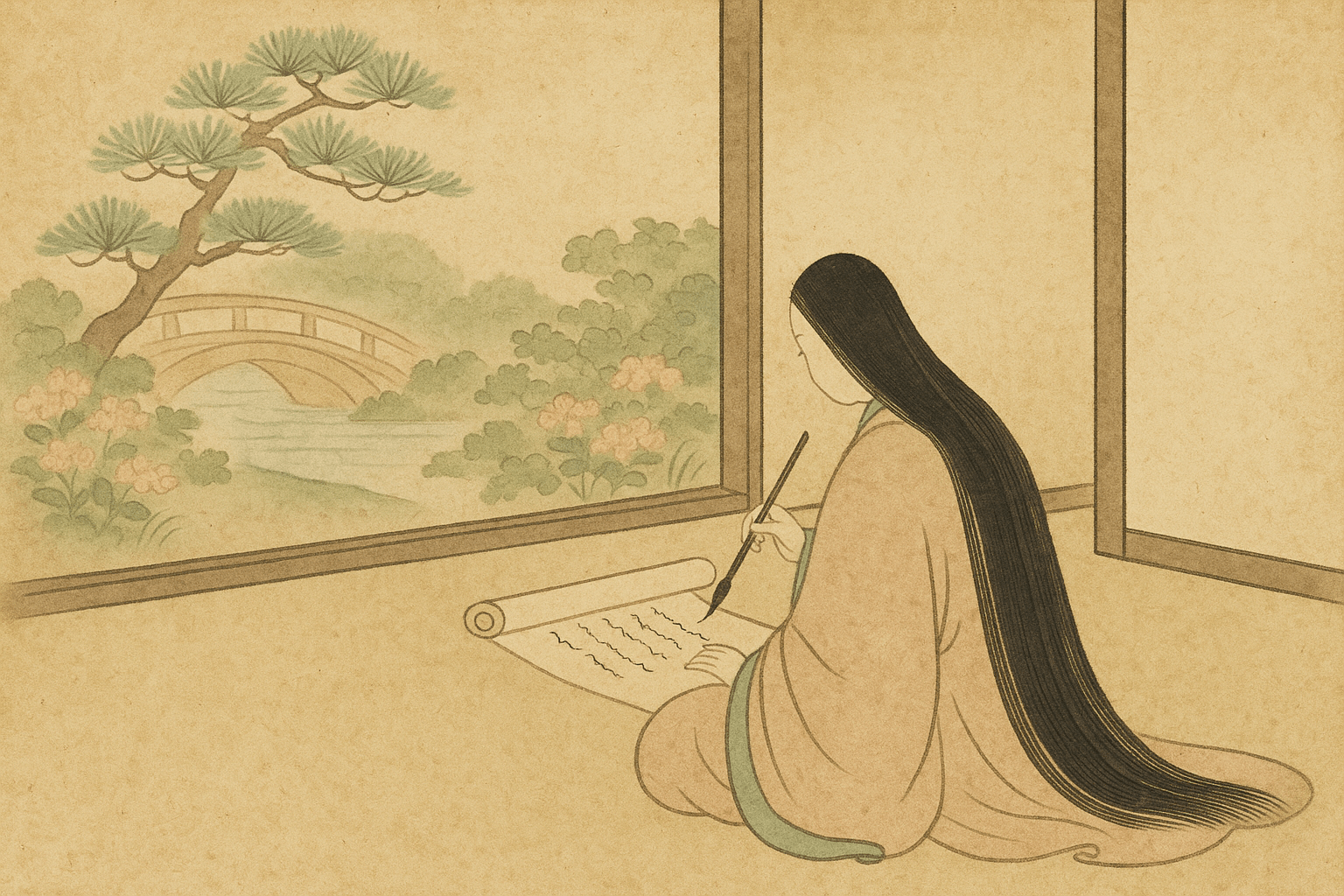
Imagine the world of Heian-kyō, the imperial capital of Japan in the 10th century. It’s a world of exquisite silk robes, intricate courtly rituals, and poetry competitions where a single misplaced syllable could mean social ruin. In this highly stratified society, governed by rigid rules of conduct, men and women occupied vastly different spheres. Men wrote the histories, the laws, and the “serious” literature in formal, scholarly Chinese. Women, largely confined to their own quarters, developed a culture of personal expression, writing diaries and poems in a new, phonetic Japanese script.
It is in this context that one of the most fascinating and revolutionary works of Japanese literature was born: the Tosa Nikki, or Tosa Diary. On the surface, it appears to be a travel journal written by a lady-in-waiting, chronicling a 55-day sea journey home to the capital. But behind this simple premise lies a radical secret: the author was no woman, but one of the most powerful and respected male literary figures of his day, Ki no Tsurayuki.
A World of Two Scripts: The Language of Heian Japan
To understand why the Tosa Nikki was so groundbreaking, we must first understand the linguistic landscape of Heian Japan. The written word was sharply divided along gender lines:
- Kanbun (Sino-Japanese): This was the official, prestigious language of the male elite. It used Chinese characters (kanji) and often adhered to Chinese grammar. It was the language of government documents, Buddhist scripture, historical chronicles, and poetry composed by men. It was considered the only medium for formal, public, and intellectually serious writing.
- Wabun (Vernacular Japanese): This was the native spoken language. To write it, the Japanese developed a phonetic script called kana, specifically hiragana. Because women were typically not educated in classical Chinese, hiragana became their primary mode of written expression. It was fluid, graceful, and perfectly suited to capturing the nuances of personal feeling and daily life. It was considered the “woman’s hand” (onnade), a private and informal script.
For a man to write in kanbun was expected. For him to write a major literary work entirely in hiragana, and to do so by adopting a female persona, was an act of profound creative rebellion.
The Master of Convention: Who Was Ki no Tsurayuki?
Ki no Tsurayuki (c. 872–945) was no outsider. He was a leading courtier, a celebrated poet, and an arbiter of literary taste. His most famous achievement, prior to the Tosa Nikki, was serving as the chief compiler of the Kokin Wakashū (Collection of Japanese Poems of Ancient and Modern Times), the first imperial anthology of waka poetry, completed around 905. In its preface—written in formal kanbun—he established the very foundations of Japanese poetics that would dominate for centuries.
He was, in short, the ultimate establishment figure. This makes his choice to write the Tosa Nikki all the more startling. Why would the master of the formal, male-dominated literary world choose to hide behind the guise of a woman and write in a “feminine” script?
“To See if a Woman Cannot Also Keep One”
The diary begins with a sentence that is both a disarming fib and a bold declaration of intent:
“Men are said to write diaries. Now I will see if a woman can also succeed in this.”
With this, Tsurayuki immediately establishes his female narrator and frames the entire work as an experiment. The diary chronicles his own journey from Tosa Province, where he had just finished a term as governor, back to the capital in 935. By casting himself as an anonymous lady-in-waiting in his own entourage, he gave himself a kind of freedom that his public persona as a high-ranking male official would never have allowed.
As a man writing in kanbun, he would have been expected to focus on logistics, place names, and official matters. As a woman writing in hiragana, he could explore a completely different landscape: the inner world of emotion. The diary is filled with witty observations, anxieties about pirates, complaints about seasickness, and impromptu poems. Most movingly, it is saturated with a deep and abiding grief. Tsurayuki’s narrator mourns the loss of a young child who died in Tosa, a thinly veiled reference to Tsurayuki’s own daughter who had passed away there. When the traveling party finally arrives home in the capital, the narrator observes the overgrown garden and feels the painful emptiness of the house, a sentiment a male governor would have been too stoic to express in a formal record.
The Diary that Changed Everything
The Tosa Nikki was a quiet revolution that sent shockwaves through Japanese literature. By proving that hiragana could be used for extended, sophisticated prose, Tsurayuki legitimized it as a powerful literary medium. He effectively invented a new genre: the literary diary (nikki bungaku).
His experiment opened the floodgates for the true masters of the form: the court women of the Heian period. Tsurayuki’s work created a space for women’s voices to be seen not just as private scribbles but as significant works of art. The decades and century following the Tosa Nikki produced some of the greatest works in the Japanese canon, all written by women using the prose style he had pioneered:
- The Kagerō Nikki (The Gossamer Years): A raw and painfully honest account of an unhappy marriage, written by a noblewoman known as “the mother of Michitsuna.”
- The Pillow Book (Makura no Sōshi): A collection of witty observations, lists, and anecdotes by the sharp-tongued lady-in-waiting Sei Shōnagon.
- The Tale of Genji (Genji Monogatari): Written by Murasaki Shikibu, this sprawling narrative is often called the world’s first novel and is a masterpiece of psychological depth, all written in flowing hiragana-based prose.
Without the precedent set by a man like Tsurayuki, it is debatable whether these incredible works by women would have been preserved and valued as highly as they were.
A Legacy Written in a Woman’s Hand
The Tosa Nikki remains a fascinating piece of historical and literary analysis. It is a work built on a clever paradox: a man, pretending to be a woman, broke free from the constraints of masculinity to create a more authentic and human form of expression. Ki no Tsurayuki, the master of the old rules, used his authority to break them, and in doing so, he didn’t just write a diary. He charted the course for a golden age of literature, proving that the most profound truths are often found by looking at the world through a different pair of eyes.