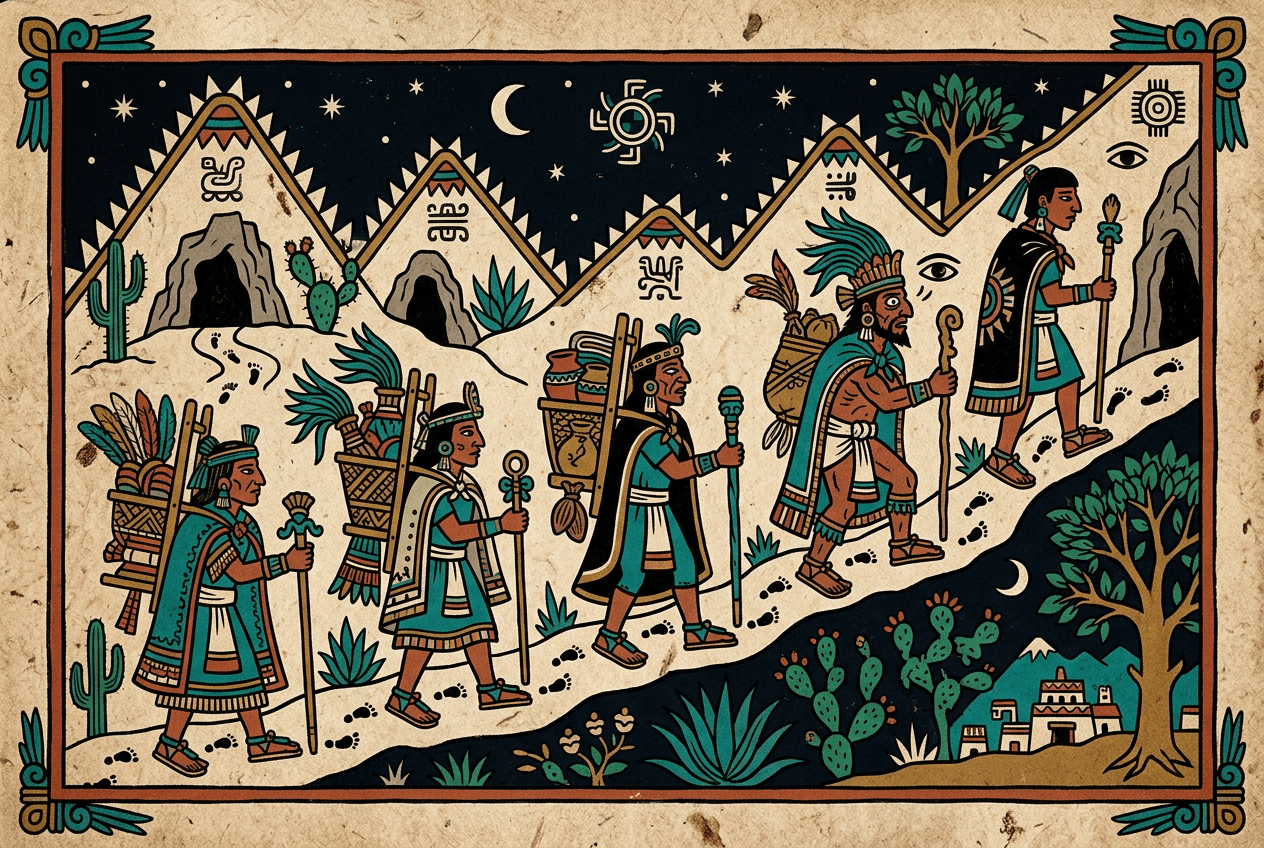
In the bustling marketplace of Tlatelolco, where as many as 60,000 people gathered daily to trade everything from obsidian blades to quetzal feathers, a select group of merchants moved with quiet authority. They were the pochteca—long-distance traders of the Aztec Empire whose caravans crossed hundreds of miles of hostile territory. But their cargo of luxury goods was only half the story. These merchants were also the empire’s eyes and ears: spies, scouts, and provocateurs whose intelligence work paved the way for Aztec armies. Few institutions in world history so completely fused commerce and espionage.
Who Were the Pochteca?
The pochteca (from the Nahuatl word pochtecatl, meaning “merchant”) were not ordinary market vendors. While local traders sold maize, beans, and pottery within the Valley of Mexico, the pochteca specialized in long-distance trade in luxury goods—the exotic commodities that fueled Aztec prestige culture. They organized grueling expeditions to distant regions like the Gulf Coast, Oaxaca, and the trading hub of Xicalango near the Maya lowlands, sometimes traveling for months or even years at a time.
Their trade goods reflected the appetites of the Aztec elite:
- Quetzal feathers from the cloud forests of Guatemala, prized for royal headdresses
- Jade and greenstone, considered more valuable than gold
- Cacao beans, which served as both a luxury beverage and a form of currency
- Jaguar pelts, seashells, gold, and amber from tropical lowlands
- Slaves, often destined for sacrifice or labor
In exchange, they carried out finely crafted goods from the imperial heartland: obsidian tools, embroidered textiles, rabbit-fur garments, and copper bells. Every expedition was both a commercial venture and, potentially, a mission of state.
A Guild Apart: The Secret Society of Merchants
What made the pochteca truly remarkable was their status as a hereditary, semi-secret guild. They lived in their own neighborhoods—twelve cities in the Valley of Mexico had recognized pochteca districts, with Tlatelolco’s being the most prestigious. Membership passed from parent to child, and outsiders could not simply join.
The guild operated with striking autonomy within the rigidly hierarchical Aztec state:
- Their own courts: Pochteca were judged by fellow merchants, not by the ordinary judicial system—a privilege shared by almost no other commoner group.
- Their own god: They worshipped Yacatecuhtli, “Lord of the Nose” or “He Who Goes Before”, the deity of travelers and commerce. Merchants carried staffs representing the god, bundling them together at night camps and offering blood sacrifices before them.
- Their own hierarchy: Senior merchants called pochtecatlatoque governed the guild, while specialized ranks included the oztomeca (vanguard merchants who ventured into enemy lands) and slave dealers known as tealtianime.
Curiously, the pochteca cultivated deliberate invisibility. Though many grew immensely wealthy, they entered the capital at night, hid their goods, and dressed in plain, even ragged clothing. Aztec society reserved ostentatious display for the warrior nobility, and a merchant who flaunted wealth risked the resentment of nobles—and possibly confiscation or worse. Humility was a survival strategy.
Merchants as Spies: The Intelligence Network of an Empire
The Aztec Empire was not a territorial state with fixed borders and garrisons everywhere. It was a tribute empire, held together by intimidation and periodic military campaigns. For such a system, information was as valuable as obsidian-edged swords—and the pochteca supplied it.
Traveling in Disguise
The most daring pochteca were the oztomeca, or “disguised merchants”, who penetrated regions openly hostile to the Aztecs. According to the Florentine Codex—the encyclopedic account compiled by Friar Bernardino de Sahagún from indigenous informants—these agents learned foreign languages, cut their hair in local styles, and adopted regional dress to pass as natives in places like the Zapotec and Maya-influenced coastal regions. Discovery meant death: hostile towns that identified Aztec merchant-spies killed them, sometimes ritually.
Scouting for Conquest
While trading, the pochteca gathered precisely the intelligence a pre-modern army needed: the location and strength of fortifications, the political loyalties of local rulers, the wealth available for tribute, road conditions, and sources of food and water along invasion routes. Emperor Ahuitzotl (reigned 1486–1502) reportedly relied heavily on merchant intelligence during his aggressive expansion toward the Pacific coast and the Isthmus of Tehuantepec.
Provocation and Pretext
Perhaps most cynically, the pochteca served as instruments of provocation. Because they traveled under the emperor’s protection, any attack on them was an attack on the Aztec state itself. When merchants were robbed or killed—as happened along routes to the Gulf Coast and in the region of Ayotlan—the emperor gained a legitimate casus belli. Some historians suspect the Aztecs occasionally sent merchants into volatile regions precisely hoping for an incident that would justify conquest. Commerce, in effect, manufactured wars.
Merchant Warriors
The pochteca could also fight. The most famous episode is the siege of Ayotlan, where a group of merchants, cut off in hostile territory, reportedly held out for four years against besieging forces—defeating their attackers before a relief army under the future emperor Moctezuma II even arrived. The victorious merchants earned insignia and honors normally reserved for elite warriors, a testament to how blurred the line between trader and soldier had become.
Ritual, Wealth, and the Price of Status
Success in trade brought obligations. Wealthy pochteca were expected to host lavish banquets and sponsor ceremonies, including the purchase of slaves for sacrifice during the festival of Panquetzaliztli honoring Huitzilopochtli. These ruinous displays of generosity redistributed merchant wealth and signaled loyalty to the state religion—another way the empire kept its rich commoners in check.
Departure and return were wrapped in ritual. Expeditions left only on auspicious calendar days, after speeches from elder merchants and offerings to Yacatecuhtli. A merchant who died on the road was not buried but bundled and placed on a mountain frame, believed to ascend to the heavens like a fallen warrior—an extraordinary honor revealing how the Aztecs viewed long-distance trade as a form of combat.
An Institution Without Parallel?
History offers other merchant-spies—Venetian traders reporting to the Council of Ten, or the intelligence-gathering of the British East India Company—but the pochteca stand out for how formally espionage was woven into their identity. They were simultaneously a commercial class, a religious brotherhood, a diplomatic corps, and a state intelligence service, all operating under a veneer of humble anonymity.
When Hernán Cortés arrived in 1519, the world the pochteca had helped build was nearing its end. Spanish conquest shattered the tribute empire, and the guild’s privileges dissolved along with it. Yet their story endures as a reminder that in the Aztec world, as in ours, information was power—and the people who carried goods across borders often carried secrets as well.
The next time you picture an Aztec marketplace, look past the feathers and jade. Somewhere in the crowd stands a plainly dressed traveler who has walked a thousand miles, speaks four languages, and knows exactly how thick the walls of your city are.