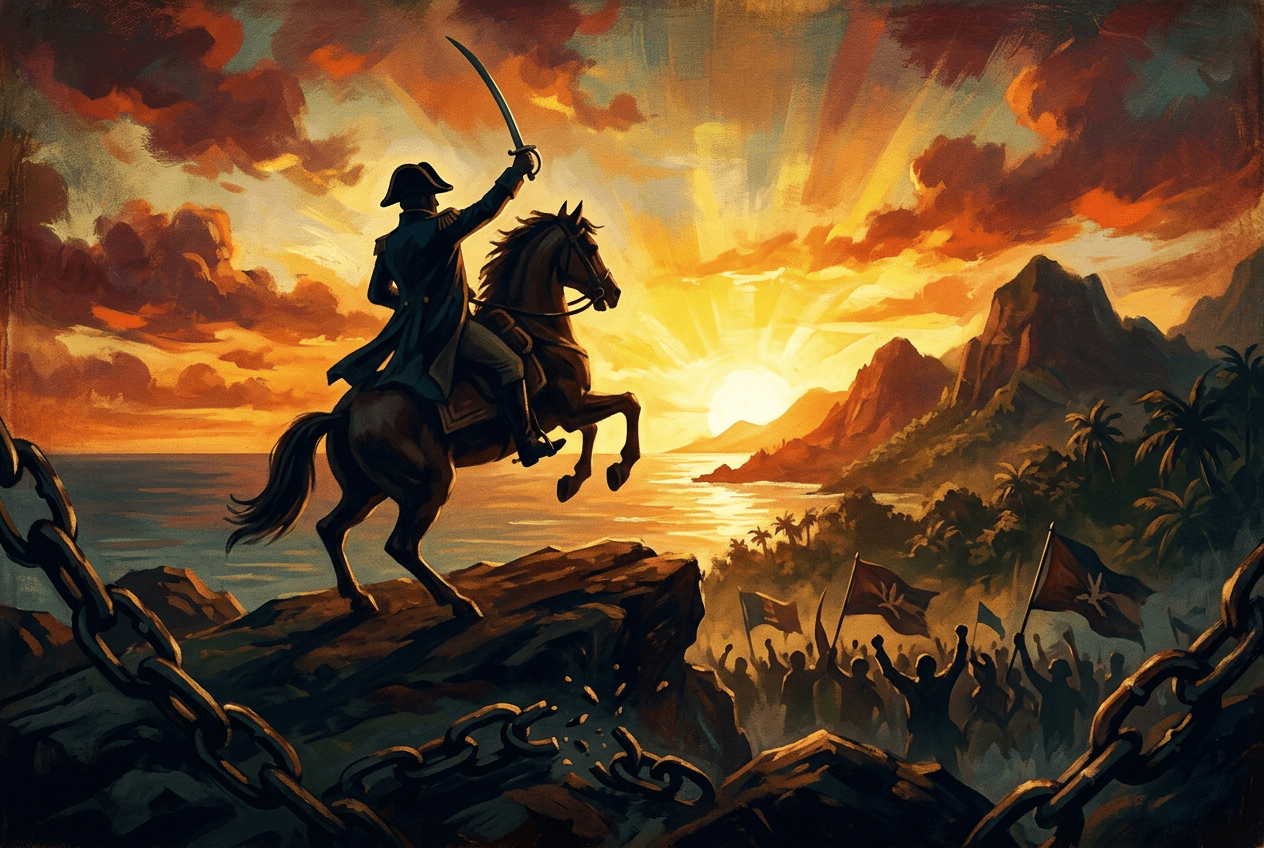
In August 1791, on the night of a secret ceremony at Bois Caïman, enslaved Africans in the French colony of Saint-Domingue lit the fuse on the most extraordinary revolution in modern history. Over the next thirteen years, people who had been bought, sold, branded, and worked to death would defeat the professional armies of three European empires—France, Britain, and Spain—and found Haiti, the world’s first Black republic. It remains the only successful large-scale slave revolt in recorded history, and its consequences still ripple through our world today.
The Richest Colony on Earth
To understand the revolution, you must first understand what Saint-Domingue was. By the late 18th century, this French colony occupying the western third of the island of Hispaniola was the single most profitable colony in the world. It produced roughly 40 percent of Europe’s sugar and 60 percent of its coffee. French merchants and planters grew fabulously wealthy—so wealthy that the phrase “rich as a Creole” entered the French vocabulary.
This wealth was built on almost unimaginable brutality. Around 500,000 enslaved Africans labored on the colony’s plantations, outnumbering the white population by more than ten to one. Conditions were so lethal that the enslaved population could not sustain itself—planters found it cheaper to work slaves to death and import replacements than to keep them alive. The average enslaved person survived just a few years after arrival. This meant that the majority of the enslaved population at the time of the revolution had been born free in Africa, and many had military experience from conflicts there.
Revolution Ignites
The French Revolution of 1789, with its ringing declarations about liberty and equality, created an ideological earthquake in the colonies. Free people of color in Saint-Domingue demanded citizenship rights. White planters resisted. Into this chaos, the enslaved masses launched their own revolution.
On the night of August 22, 1791, following the Vodou ceremony at Bois Caïman led by the priest Dutty Boukman, thousands of enslaved people rose up in the northern plain. Within weeks, they had destroyed hundreds of plantations and killed thousands of colonists. The rebellion that European planters had always feared—and insisted was impossible—had begun.
Toussaint Louverture: The Black Spartacus
From the chaos emerged one of history’s most remarkable figures. Toussaint Bréda, later known as Toussaint Louverture (“the opening”), was a former slave in his late forties—literate, a skilled horseman and herbalist, and a strategic genius of the first order. He would prove himself the equal of any general in Europe.
Louverture’s brilliance lay in his mastery of both war and politics:
- Military innovation: He transformed bands of insurgents into a disciplined army, combining European tactics with guerrilla warfare suited to Saint-Domingue’s mountains. His forces used the terrain, the climate, and yellow fever as weapons against European troops.
- Diplomatic agility: He allied with Spain when it served the cause of emancipation, then switched to France in 1794 when the French Republic abolished slavery—consistently maneuvering to protect Black freedom above all else.
- Statecraft: By 1801, he governed the entire island, issued a constitution abolishing slavery forever, and rebuilt the shattered economy—all while nominally remaining loyal to France.
Between 1793 and 1798, Louverture’s armies also faced a massive British invasion. Britain, hoping to seize the wealthy colony and prevent the contagion of slave revolt from spreading to Jamaica, committed tens of thousands of troops. The campaign ended in catastrophe: an estimated 15,000 British soldiers died, most from disease, in what one historian called Britain’s “Caribbean Vietnam.”
Napoleon’s Betrayal and the Final War
In 1802, Napoleon Bonaparte—determined to restore slavery and rebuild France’s American empire—dispatched his brother-in-law, General Charles Leclerc, with the largest expeditionary force France had ever sent overseas: some 30,000 troops, later reinforced to over 50,000.
Louverture was captured through treachery during negotiations and deported to France, where he died in a freezing prison cell in the Jura mountains in April 1803. His parting words proved prophetic: “In overthrowing me, you have cut down in Saint-Domingue only the trunk of the tree of liberty. It will spring back from the roots, for they are numerous and deep.”
He was right. When news arrived that Napoleon had restored slavery in Guadeloupe, the population of Saint-Domingue rose in a war of total resistance. Under Jean-Jacques Dessalines, Louverture’s fierce lieutenant, the revolutionary army fought the French to annihilation. Yellow fever devastated the European troops—Leclerc himself died of it—and at the Battle of Vertières in November 1803, Dessalines’s forces delivered the final blow. Of the roughly 50,000 French troops sent, fewer than 10,000 survived to evacuate.
On January 1, 1804, Dessalines declared independence, restoring the island’s indigenous Taíno name: Haiti.
Shockwaves Across the World
The Haitian Revolution transformed global history in ways rarely acknowledged:
- The Louisiana Purchase: Having lost Saint-Domingue, Napoleon abandoned his American ambitions and sold the vast Louisiana Territory to the United States in 1803—doubling the size of the young republic.
- Fear and inspiration: Slaveholding societies from Virginia to Brazil tightened their grip in terror, while enslaved people and abolitionists drew hope. Rebels from Denmark Vesey in South Carolina to insurgents across the Caribbean invoked Haiti’s example.
- Latin American independence: Haiti gave crucial aid—ships, weapons, and refuge—to Simón Bolívar, on the condition that he abolish slavery in the lands he liberated.
The Cruelest Price: The Independence Debt
Victory did not bring peace. The world’s slaveholding powers refused to recognize Haiti; the United States withheld recognition until 1862. Then, in 1825, France delivered its final blow. King Charles X sent warships to Haiti’s coast and demanded 150 million francs in “compensation”—not for the war, but for the property French planters had lost, including the formerly enslaved people themselves.
Facing invasion and re-enslavement, Haiti agreed. To pay, it took loans from French banks at punishing interest, creating a “double debt” that consumed the young nation’s finances for over a century—the final payments were not made until 1947. Modern estimates suggest this extraction cost Haiti the equivalent of tens of billions of dollars, strangling investment in schools, infrastructure, and institutions. It is a foundational reason why the nation that once produced staggering wealth became one of the hemisphere’s poorest.
Why the Haitian Revolution Still Matters
For generations, historians largely ignored the Haitian Revolution—the scholar Michel-Rolph Trouillot famously called it an event “unthinkable” to the Western imagination, silenced in the archives because it contradicted everything the age believed about race and civilization.
Yet the men and women of Saint-Domingue accomplished what neither the American nor French revolutions dared: they took the promise of universal human rights literally, and made it real for everyone. They proved that the enslaved could defeat empires, that liberty belonged to all humanity, and that the price of freedom—though staggering—was worth paying. Two centuries later, their revolution remains one of the most radical and consequential acts in human history.