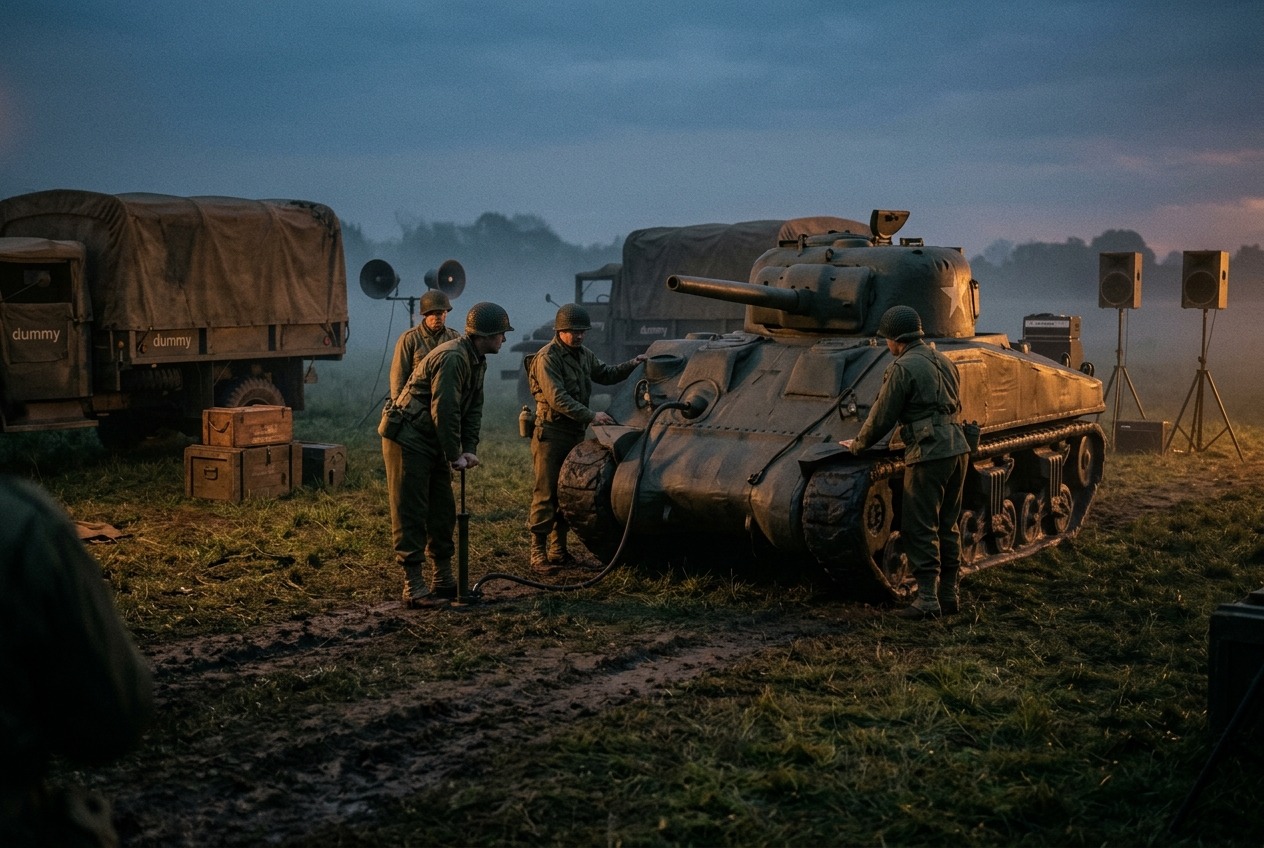
In the summer of 1944, German reconnaissance planes photographed what appeared to be a formidable American armored division massing near the front lines in France. Tanks lined the fields, artillery pieces stood ready, and radio chatter buzzed with the unmistakable rhythm of a unit preparing for battle. There was just one problem for the Germans: none of it was real. The tanks were inflatable rubber decoys. The radio traffic was scripted theater. The sounds of rumbling engines came from massive speakers mounted on trucks. The Germans had been fooled by one of the most unusual military units in history—the 23rd Headquarters Special Troops, better known today as the Ghost Army.
An Army of Artists
The Ghost Army was unlike any other unit in the United States military. Activated in January 1944, it consisted of roughly 1,100 men, many of whom were recruited not for their marksmanship or physical prowess, but for their creativity. The Army deliberately sought out artists, designers, sound engineers, actors, and advertising professionals—people who understood illusion, perception, and performance.
The unit’s ranks included men who would go on to remarkable postwar careers. Fashion designer Bill Blass served in the Ghost Army, as did painter Ellsworth Kelly, wildlife artist Arthur Singer, and photographer Art Kane. Many were plucked from art schools and design studios in New York and Philadelphia. In the evenings between operations, some of these soldier-artists sketched the French countryside and painted watercolors of liberated villages—a strange juxtaposition of fine art and battlefield deception.
Their mission was deceptively simple in concept and staggeringly complex in execution: impersonate other American units to mislead the German army about the location, size, and intentions of Allied forces.
The Three Pillars of Deception
The Ghost Army’s illusions rested on three complementary techniques, each handled by specialized sub-units. Together, they created what the soldiers called “atmosphere”—a complete multi-sensory impersonation of a real fighting force.
Visual Deception: The Inflatable Arsenal
The most famous tools of the Ghost Army were its inflatable decoys. The 603rd Camouflage Engineers deployed rubber tanks, trucks, jeeps, artillery pieces, and even aircraft that could be inflated in minutes using air compressors. From the ground, up close, the deception was obvious—soldiers joked about four men lifting a 40-ton “tank” and carrying it across a field. But from the air, where German reconnaissance planes photographed Allied positions, the decoys were remarkably convincing.
The artists didn’t stop at simply inflating dummies. They understood that authenticity lived in the details:
- They used bulldozers to create fake tank tracks leading to the decoys, since real tanks would leave visible trails.
- They deliberately made their camouflage netting slightly imperfect, because perfectly hidden equipment would arouse no suspicion—and the whole point was to be “accidentally” discovered.
- They hung laundry, built fake supply dumps, and positioned decoys with the spacing and layout a real armored unit would use.
Sonic Deception: The Sound of an Invisible Army
The 3132 Signal Service Company handled what may have been the most technologically innovative aspect of the operation. Working with engineers at Bell Labs and recording sounds at Fort Knox, the unit compiled a library of military audio: tanks maneuvering, trucks convoying, bridges being constructed, soldiers shouting orders.
These sounds were recorded on state-of-the-art wire recorders and mixed into custom “soundscapes” tailored to each mission. Powerful 500-pound speakers mounted on halftracks could project these sounds up to 15 miles, convincing German listening posts that entire battalions were moving through the night. A handful of trucks could sound like an armored division crossing a river under cover of darkness.
Radio Deception: Scripted Airwaves
The Germans monitored Allied radio traffic constantly, and their operators were skilled at identifying units by the distinctive “fist”—the personal style—of individual Morse code operators. The Ghost Army’s Signal Company countered this by training its radio men to mimic the transmission styles of operators in the units they were impersonating. They created entire fictional radio networks, transmitting fake orders, supply requests, and routine chatter that painted a convincing electronic portrait of a division that wasn’t there.
Method Acting on the Front Lines
Beyond technology, the Ghost Army practiced what they called “special effects”—essentially, theatrical performance. Soldiers sewed the shoulder patches of the units they impersonated onto their uniforms and painted fake unit markings on their vehicles. They drove trucks in loops through towns, with just two men visible in the back of each, creating the impression of endless convoys ferrying troops.
Officers even engaged in what they called “playing the part” in local cafés, deliberately dropping misleading information within earshot of suspected spies. A few Ghost Army officers impersonated generals, complete with fake insignia—a performance that carried serious risks if captured.
Operation Viersen: The Masterpiece
The Ghost Army conducted more than 20 deception operations between June 1944 and March 1945, from Normandy through the liberation of France and into Germany. Their crowning achievement came in March 1945 with Operation Viersen, staged along the Rhine River.
As the Allied Ninth Army prepared to cross the Rhine, the Ghost Army was tasked with convincing the Germans that the crossing would happen ten miles from the actual site. Deploying their full arsenal—hundreds of inflatable vehicles, elaborate sound programs simulating bridge construction, fake radio networks, and dummy artillery positions—the 1,100-man unit impersonated two full divisions of roughly 30,000 men.
The deception worked. German forces concentrated their defenses at the false crossing point, and the real assault met significantly lighter resistance than anticipated. Military analysts later credited the operation with saving potentially thousands of American lives. It was deception warfare executed at the highest level.
The Cost and the Silence
The Ghost Army’s work was far from safe. The unit operated close to the front lines—sometimes within a few hundred yards of German positions—armed with little more than rubber tanks and speakers. If their deception failed and the enemy attacked what they believed was an armored division, the Ghost Army had almost no capacity to fight back. Three of its soldiers were killed and dozens wounded during operations, including a dangerous mission near Brest where German artillery targeted their fake positions.
After the war, the unit’s existence remained classified for decades. Veterans were sworn to secrecy and could not tell even their families what they had done. The story only began to emerge publicly in the 1980s and was not fully declassified until 1996. In 2022, nearly 80 years after their service, the surviving members of the Ghost Army were finally awarded the Congressional Gold Medal—recognition that came too late for most of the men who had served.
The Legacy of Creative Warfare
The Ghost Army stands as a powerful reminder that wars are won not only with firepower but with imagination. These artists and engineers weaponized creativity itself, proving that perception can be as decisive as any physical force on the battlefield. Their techniques influenced modern military deception doctrine, and their story continues to captivate historians precisely because it upends our expectations of what a soldier—and a weapon—can be.
In an age of information warfare and digital deception, the lessons of the Ghost Army feel more relevant than ever: sometimes the most powerful weapon isn’t the one that destroys, but the one that deceives.