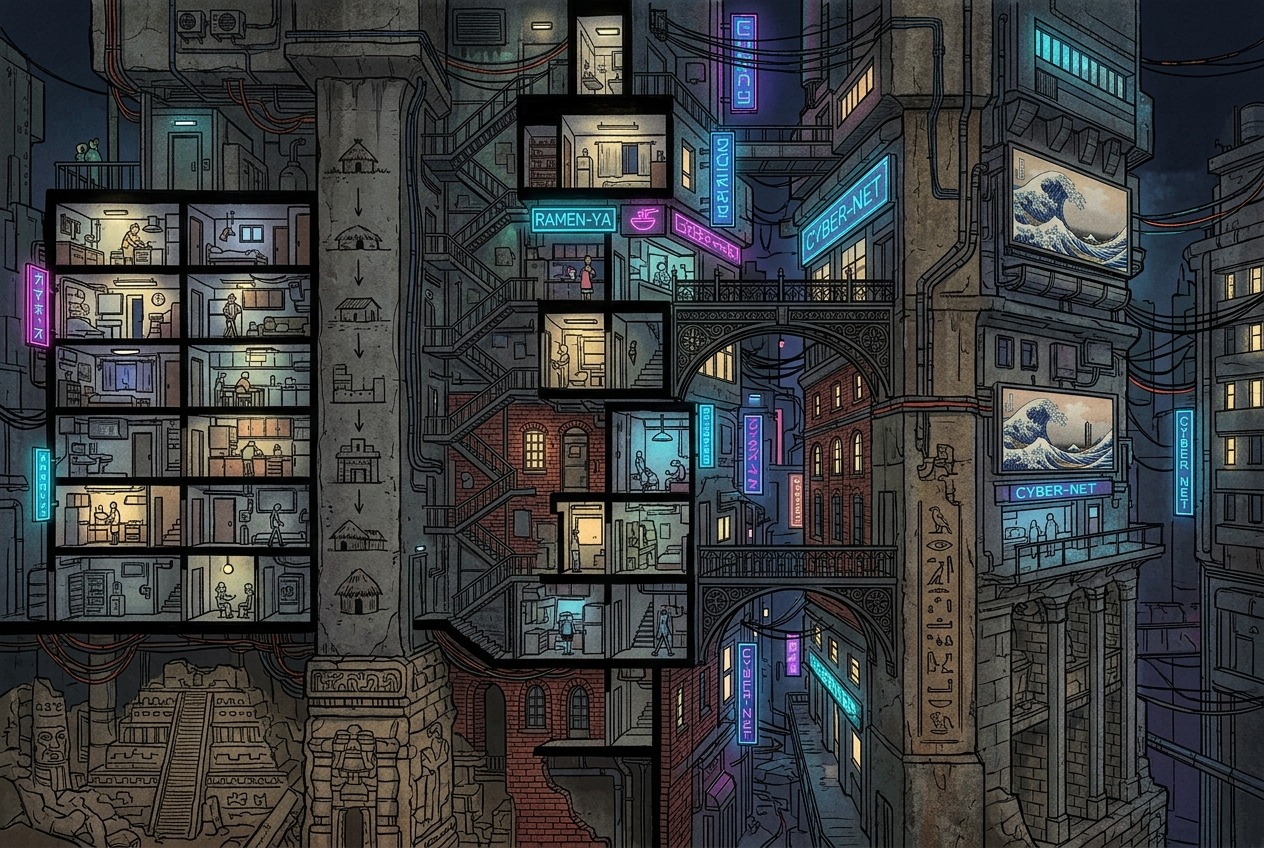
Imagine a single city block—roughly the size of four football fields—housing 33,000 people. Imagine that block rising fourteen stories high, its buildings fused into a single organic mass so dense that sunlight never reached the alleyways below. Imagine no police, no building codes, no health inspectors, no taxes. Now imagine that this place actually existed, in the heart of one of the world’s most modern cities, until 1994.
This was Kowloon Walled City: a diplomatic accident that became the most densely populated place in human history, and one of the most fascinating experiments in urban self-organization the world has ever seen.
A Fort Caught Between Empires
The story begins long before the towering slum. The site’s strategic value was recognized as early as the Song Dynasty, but the walled fort itself dates to 1847, when Qing Dynasty officials fortified the location to monitor British activity in newly ceded Hong Kong Island. Granite walls, cannons, and a garrison of soldiers made it a modest but genuine outpost of imperial Chinese authority.
The critical moment came in 1898, when Britain leased the New Territories from China for 99 years. Buried in the Convention for the Extension of Hong Kong Territory was a peculiar clause: China would retain jurisdiction over the Walled City, provided this didn’t interfere with British defense needs. The British almost immediately decided it did interfere, expelled the Chinese officials in 1899, and then—crucially—did almost nothing with the place afterward.
China never formally renounced its claim. Britain never formally asserted full control. The result was a jurisdictional black hole: a few acres of land that belonged, in practice, to no government at all.
The Vacuum Fills
For decades, the Walled City remained a sleepy curiosity—a cluster of old buildings, a school, a temple. The transformation began after World War II. Japanese occupiers had torn down the historic walls to extend the runway at nearby Kai Tak Airport, and when the war ended, waves of refugees fleeing the Chinese Civil War poured into Hong Kong. Thousands discovered that in the Walled City, no one would check papers, demand permits, or collect rent for a landlord’s license.
When British authorities attempted to evict squatters in 1948, China protested vigorously, and riots erupted. The colonial government backed down and adopted what became its permanent policy: hands off. The message was clear to everyone in Hong Kong—inside those few acres, the normal rules did not apply.
Building Without Blueprints
What happened next defied every principle of urban planning. Without building codes, structures rose story by story, added by different owners at different times, until roughly 350 buildings had merged into a single interconnected block. By the 1980s, the statistics were staggering:
- 33,000 residents (some estimates ran as high as 50,000) crammed into 2.6 hectares—a population density of roughly 1.25 million people per square kilometer, about 100 times denser than modern-day Manhattan
- Fourteen stories maximum height—not by law, but because aircraft descending into Kai Tak Airport passed directly overhead
- Only two functioning elevators in the entire complex
- Alleyways as narrow as one meter, perpetually dark, dripping with water from a jury-rigged maze of pipes overhead
Residents rarely used street-level passages to cross the City. Instead, they traveled through an informal network of interconnected corridors, staircases, and rooftops—a genuine three-dimensional city where the concept of “street address” barely applied.
An Economy Without Licenses
The absence of regulation created a shadow economy that served all of Hong Kong. The Walled City became famous for its unlicensed dentists and doctors—often genuinely trained practitioners from mainland China whose credentials weren’t recognized by colonial authorities. At its peak, over 100 dental clinics operated there, offering care at a fraction of licensed prices. Hong Kongers who couldn’t afford legitimate dentistry simply walked through the gates.
Food production thrived in conditions that would horrify any health inspector. Factories inside the City produced an enormous share of Hong Kong’s fish balls, noodles, and roast pork—foods that ended up in restaurants across the territory, their origins discreetly unmentioned. Small workshops manufactured everything from textiles to metal goods, operating around the clock in windowless rooms.
Order Without Government
For a time, the vacuum was filled by darker forces. From the 1950s through the early 1970s, triad organizations—particularly the 14K and Sun Yee On—controlled much of the City, running opium dens, gambling parlors, and brothels. The Walled City earned its reputation as a den of vice, a place where Hong Kong police would enter only in large raiding parties, if at all.
But the popular image of perpetual anarchy misses the more remarkable story. In 1973 and 1974, Hong Kong police conducted massive sweeps that broke triad power inside the City. What remained was something stranger: a community that largely governed itself. Residents formed the Kai Fong Association, a neighborhood committee that mediated disputes, organized cleaning of common areas, and coordinated with charities. Churches and missionaries operated schools and drug rehabilitation programs—most famously Jackie Pullinger, a British missionary who spent decades helping addicts inside the City’s walls.
Children attended rooftop kindergartens—the roofs being the only place with open air and sunlight. Elderly residents gathered there in the evenings, among the forest of television antennas, as jets thundered overhead close enough to read their markings. The City had mail delivery (postmen memorized the labyrinth), water access (though much of it came from illegally tapped municipal pipes and just eight legal standpipes for decades), and electricity (a patchwork of legitimate connections and dangerous improvisation).
The End of the Anomaly
The Walled City’s fate was sealed by the 1984 Sino-British Joint Declaration, which settled Hong Kong’s return to China in 1997. With the jurisdictional dispute resolving itself, neither government had reason to preserve the anomaly. In 1987, they jointly announced the City’s demolition.
The eviction process took years and cost the Hong Kong government approximately HK$2.7 billion in compensation to residents and business owners. Many residents, it turned out, didn’t want to leave—the City had been affordable, tight-knit, and, by the 1980s, safer than its reputation suggested. Demolition began in 1993 and concluded in April 1994.
Today, Kowloon Walled City Park occupies the site—a serene classical Chinese garden preserving the old yamen (administrative building) and remnants of the original South Gate, discovered during demolition. It is beautiful, peaceful, and almost surreally quiet.
What the Walled City Teaches Us
Kowloon Walled City endures as a legend—inspiring films, video games like Stranglehold and Call of Duty, the aesthetic of cyberpunk fiction, and endless academic study. But beyond the mythology, it poses genuine questions for historians and urbanists alike.
It demonstrated that tens of thousands of people could organize housing, commerce, education, and dispute resolution with virtually no state involvement. It also demonstrated the costs: fire hazards, exploitation, disease, darkness, and decades of criminal control before community institutions matured. The Walled City was neither the libertarian paradise nor the hellscape of caricature—it was something messier and more human: proof that when governments create a vacuum, ordinary people will fill it with something, for better and for worse.
A legal loophole between two empires built anarchy’s skyscraper. Its demolition ended a physical structure, but the questions it raised about order, community, and the necessity of the state still stand as tall as the City once did.