CONTENT:
Imagine a plant so precious that an entire city’s economy revolved around it, so valuable that it was stored in the Roman treasury alongside gold, and so beloved that Julius Caesar himself allegedly hoarded it. Now imagine that plant disappearing forever—harvested into oblivion by the very civilization that treasured it. This is the story of silphium, a mysterious herb from ancient North Africa that may hold the dubious distinction of being the first commercially valuable species driven to extinction by human demand.
A City Built on a Plant
Around 630 BCE, Greek colonists from the island of Thera founded the city of Cyrene on the coast of what is now Libya. According to legend, they were guided there by the Oracle of Delphi. What they found in the arid hills of Cyrenaica was botanical gold: a wild plant with a thick stalk, celery-like leaves, and clusters of yellow flowers that the local peoples already prized.
This was silphium, and it would transform Cyrene into one of the wealthiest cities of the ancient Mediterranean. The plant grew only in a narrow strip of territory—roughly 125 miles long and 35 miles wide—along the Cyrenaican coast. Despite countless attempts, it stubbornly refused cultivation. The Greeks tried transplanting it to Attica; the plant withered. It grew wild or not at all.
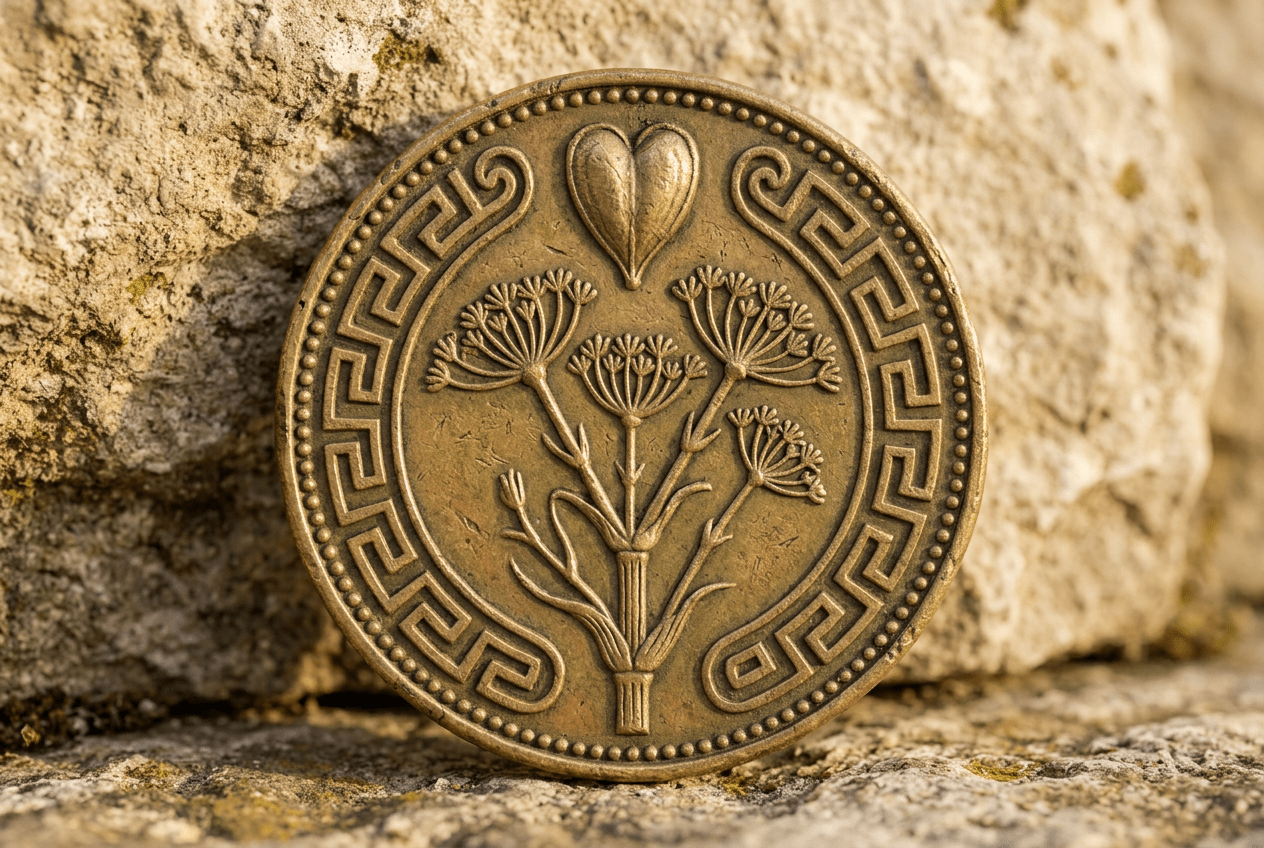
The proof of silphium’s importance to Cyrene is stamped in metal. For centuries, the city minted coins bearing the image of the silphium plant—its distinctive stalk, its heart-shaped seed pods, sometimes the entire plant rendered in careful detail. Few civilizations in history have so literally put a plant on their money. One famous coin even shows a seated woman touching the plant with one hand while pointing to her womb with the other—a clue to one of silphium’s most famous uses.
The Ancient World’s Wonder Drug
What made silphium so extraordinarily valuable? The answer is that it seemed to do almost everything.
A Culinary Sensation
The plant’s resin—called laser or laserpicium by the Romans—was the caviar of ancient seasonings. Cooks grated it over dishes the way we might use truffle or saffron today. The Roman gourmet Apicius, whose cookbook survives from antiquity, called for laser in dozens of recipes, from lentils to flamingo. Both the stalk and the root were eaten as vegetables, and even livestock that grazed on silphium were said to produce exceptionally delicious meat.
A Medicine Cabinet in a Single Plant
Ancient physicians prescribed silphium for a staggering range of ailments. Hippocrates recommended it for digestive troubles. Other sources describe its use for:
- Coughs, sore throats, and fevers
- Warts and growths
- Dog bites and scorpion stings
- Hair loss and toothaches
- Epilepsy and “growths of the anus” (per Pliny the Elder’s exhaustive catalog)
Whether silphium actually cured any of these conditions is impossible to verify, but the ancient world’s faith in it was absolute.
The Contraceptive Connection
Perhaps silphium’s most famous—and most historically significant—use was as a contraceptive and abortifacient. The physician Soranus of Ephesus, writing in the second century CE, recommended a monthly dose of silphium juice “about the size of a chickpea” to prevent pregnancy. In a world without reliable birth control, a plant that could regulate fertility would have been almost priceless.
Intriguingly, modern research lends some plausibility to these claims. Silphium’s surviving relatives in the Ferula genus contain compounds with demonstrated estrogenic and anti-fertility effects in laboratory studies. Some historians have even speculated—though the evidence is thin—that silphium’s heart-shaped seed pod inspired our modern symbol for love, linking the plant to rom