Before the Silk Road: A Proto-Urban Metropolis
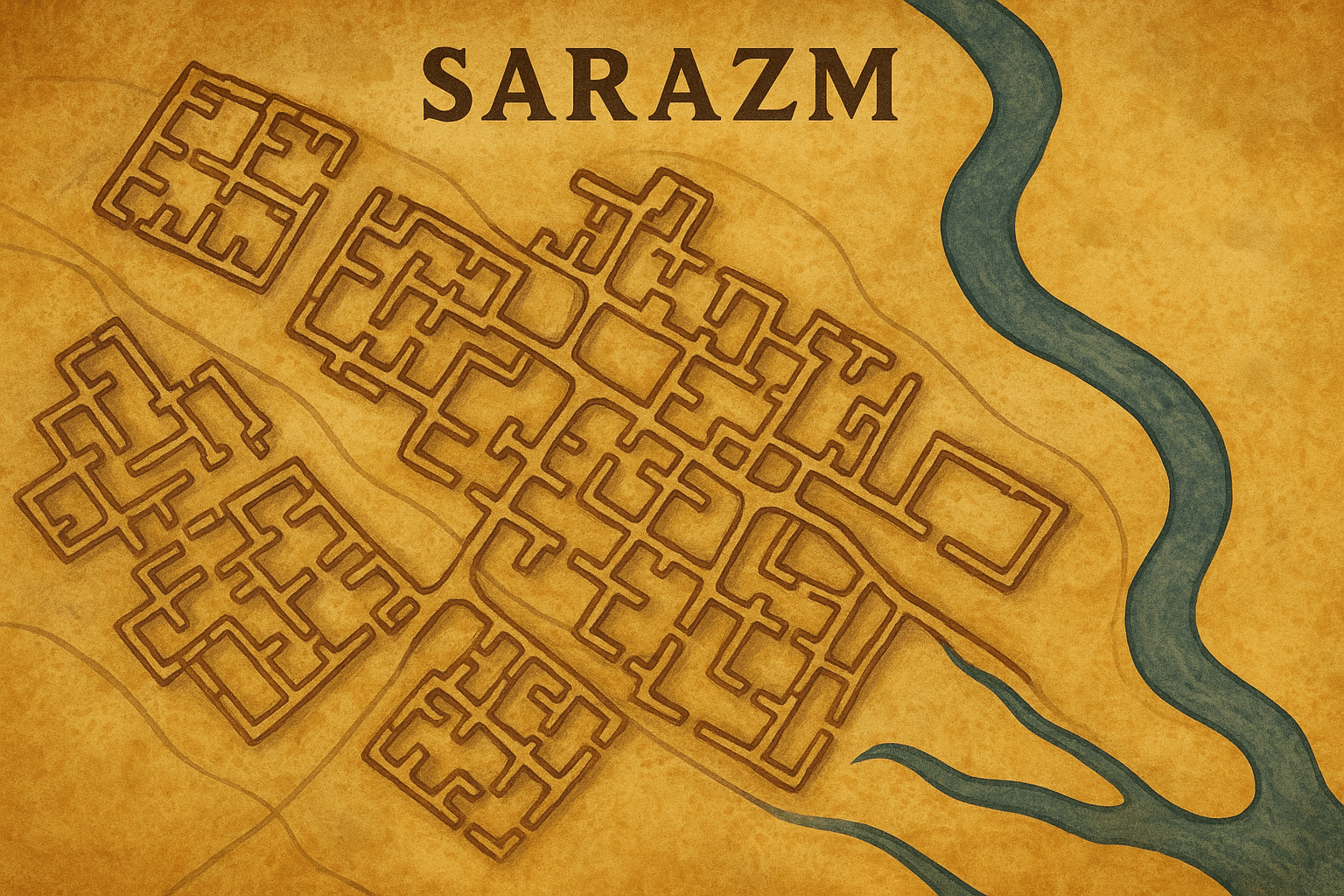
Nestled in the upper Zerafshan Valley of Tajikistan lies the archaeological site of Sarazm. The name itself, from the Tajik language, means “where the land begins”, a fitting title for a place that represents one of the earliest stages of settled, urban life in Central Asia. Flourishing from the 4th to the late 3rd millennium BCE, Sarazm was not just a village; it was a sprawling proto-urban center, a precursor to the great cities that would later define the region.
Designated a UNESCO World Heritage site in 2010, Sarazm is recognized as a remarkable center for agriculture, craft production, and trade that predates the more famous Bactria-Margiana Archaeological Complex (BMAC) to the south. For over a thousand years, this settlement was a beacon of innovation and a crucial node in a network that spanned thousands of kilometers. Its discovery in 1976 fundamentally rewrote the history of Central Asia, transforming it from a perceived periphery into a vibrant, interconnected hub of the ancient world.
The Crossroads of the Bronze Age
Sarazm’s most astonishing feature was its role as a great connector. Imagine a bustling hub where merchants and artisans from vastly different worlds met, exchanged goods, and shared knowledge. The evidence unearthed at Sarazm paints a vivid picture of this ancient globalization.
- The Connection to the East (Indus Valley): Archaeologists have found distinctive ceramics, beads made of carnelian and agate, and bracelets crafted from seashells that are stylistically identical to those from the Harappan Civilization of the Indus Valley (modern-day Pakistan and India). This suggests a well-established trade route, with Sarazm likely exporting its local metals and semi-precious stones in exchange for luxury goods from the subcontinent.
- The Connection to the West (Mesopotamia and Iran): The architectural techniques at Sarazm, such as the use of standardized mud bricks and building layouts, show strong parallels with sites on the Iranian Plateau and in Mesopotamia. Pottery and seals discovered at the site also mirror styles found thousands of kilometers to the west, pointing to a steady flow of goods, people, and, most importantly, ideas.
- The Connection to the North (Eurasian Steppe): Sarazm was not just a city of farmers and traders; it was also a vital link to the nomadic pastoralist cultures of the steppe, such as the Andronovo people. Steppe-style daggers and metalwork found at Sarazm indicate a dynamic relationship. The nomads likely provided animal products and served as guides or enforcers along trade routes, while Sarazm offered agricultural goods and served as a center for processing the metals mined in the nearby mountains—gold, silver, copper, lead, and tin.
Sarazm sat at the nexus of these three worlds, becoming a melting pot of culture and technology. It was here that raw materials from the mountains were transformed into valuable goods and traded across the known world.
A Glimpse into Life and Society in Sarazm
Excavations have revealed a complex, well-organized settlement. The site is characterized by large, multi-roomed residential complexes built around courtyards, workshops for pottery and metallurgy, and monumental public structures. Some of these buildings, featuring large hearths and altars, are believed to be temples or ceremonial centers, suggesting a sophisticated religious life, possibly centered around fire worship.
The craftsmanship of Sarazm’s inhabitants was exceptional. They were master metallurgists, capable of creating complex alloys like tin-bronze, a technology that was cutting-edge for its time. They produced tools, weapons, and intricate jewelry. Potters used wheels to create fine, painted ceramics that were both functional and beautiful. The discovery of looms points to a developed textile industry, likely using wool from the flocks of steppe nomads.
This level of organization and specialized craft production clearly indicates a stratified society. There were rulers who controlled trade, priests who oversaw rituals, artisans who created wealth, and farmers who sustained the population.
The “Princess of Sarazm”
Perhaps the most compelling evidence of Sarazm’s wealth and social hierarchy comes from a single burial. In one of the excavated structures, archaeologists uncovered the remains of a high-status woman, now famously known as the “Princess of Sarazm.”
She was not buried with gold or a crown, but her wealth was no less staggering. Her body was adorned with a magnificent gown or shroud decorated with thousands of beads made from lapis lazuli, carnelian, turquoise, and steatite. Her arms were decorated with massive bracelets made from seashells. This single burial is a microcosm of Sarazm’s world: the lapis lazuli came from the mountains of Afghanistan, the carnelian from India, the turquoise from the deserts of Central Asia, and the shells from the distant Indian Ocean. The “Princess” was a physical embodiment of Sarazm’s vast and powerful trade network.
An Enigmatic Decline
Around 2000 BCE, after more than a millennium of prosperity, Sarazm was abandoned. There are no signs of a violent destruction or a catastrophic fire. Instead, it seems the city simply faded away. Why did this vibrant civilization collapse?
Researchers propose several theories. A period of climate change may have led to aridification, making agriculture in the Zerafshan Valley more difficult. It’s also possible that regional trade routes shifted, bypassing Sarazm and undermining its economic foundation. Finally, increasing pressure from and conflict with mobile steppe groups may have destabilized the delicate balance that allowed the city to thrive. Whatever the reason, the city was deserted, its memory lost to time until its rediscovery in the 20th century.
A Lost Chapter, Rediscovered
The story of Sarazm is a powerful reminder that history is layered, and that celebrated eras like the Silk Road often stand on the foundations of even older, forgotten worlds. Sarazm was not just a stopover point; it was a creative and economic powerhouse in its own right, a true Bronze Age melting pot. It proves that Central Asia was a cradle of civilization, a place where people forged connections and built complex societies thousands of years before the rise of the great Persian and Hellenistic empires. As archaeologists continue to sift through its secrets, Sarazm reminds us that so much of our shared human story still lies buried, waiting to be told.