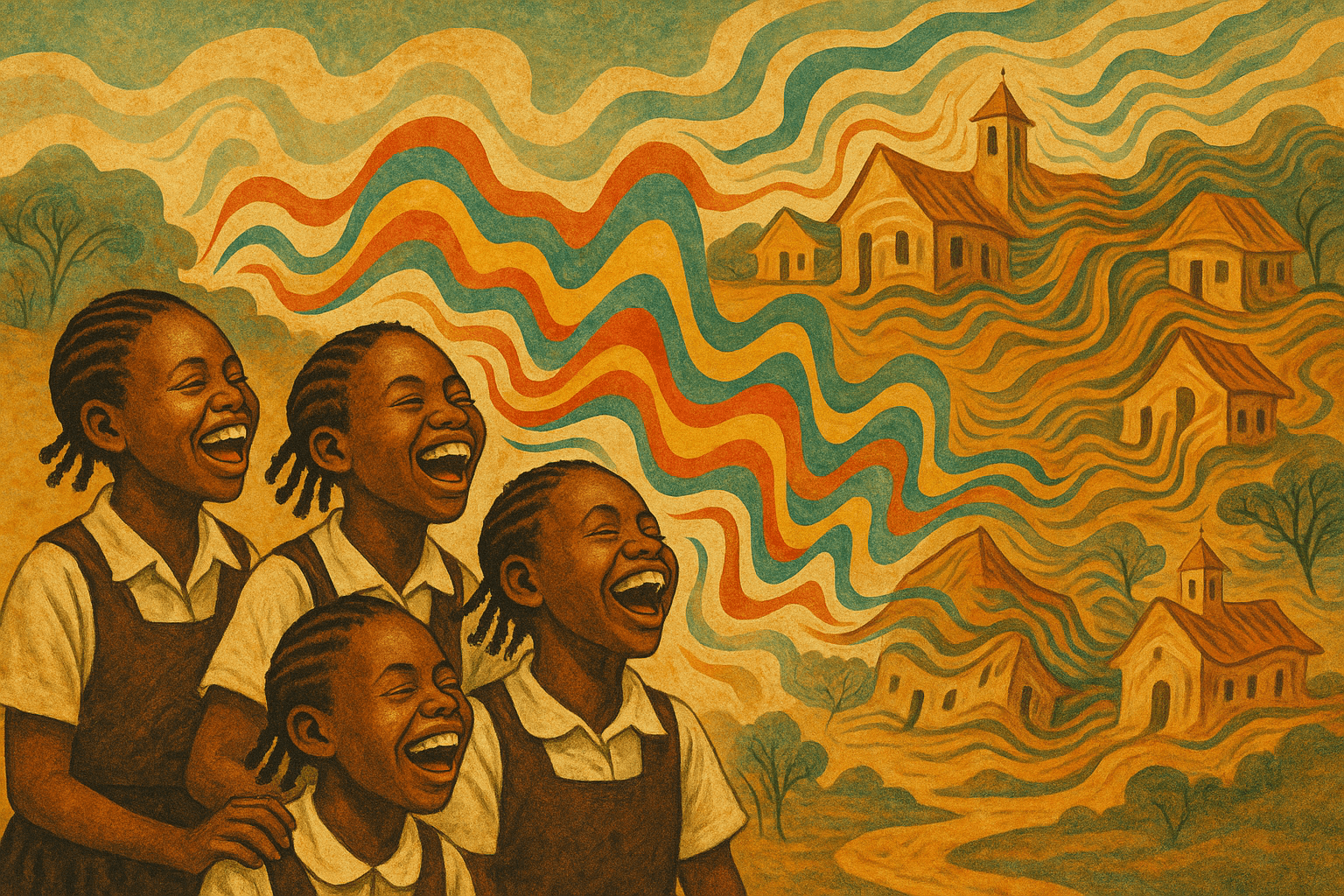
It Starts with a Giggle
The story begins on January 30, 1962, at a mission-run girls’ boarding school in the village of Kashasha. The day was likely ordinary until one girl told a joke to her friends. A few students began to laugh. This is a common enough scene in any school, but this laughter was different. It didn’t stop. It grew, becoming uncontrollable, morphing from cheerful giggles into painful, incapacitating fits.
The afflicted girls laughed for hours, even days. But this was no joyful experience. The laughter was accompanied by a host of other distressing symptoms:
- Crying spells
- Fainting
- Rashes
- Pain
- Restlessness and random running
The “illness” spread like wildfire through the student body. Within weeks, 95 of the school’s 159 pupils, all between the ages of 12 and 18, were affected. The school became unmanageable. With no medical explanation and no way to restore order, the administrators made a decision that would have dramatic consequences: on March 18, 1962, they closed the school and sent the students home.
The Laughter Spreads
Instead of quarantining the problem, sending the girls home ignited a regional outbreak. As the students returned to their villages, they carried the strange affliction with them. One of the most significant secondary outbreaks occurred in the village of Nshamba, home to several of the Kashasha schoolgirls. Soon, another 217 people in the village, mostly young people and adult women, were experiencing the same uncontrollable fits of laughter and crying.
The epidemic rippled outwards. As schools in the affected area took in students from the now-closed Kashasha school, they too became centers of contagion. The laughter leaped from community to community, forcing more schools to shutter their doors. By the end of the phenomenon, which lasted somewhere between 6 and 18 months, an estimated 1,000 people had been affected and a total of 14 schools had been temporarily closed, disrupting the education of thousands of children.
Throughout the crisis, medical professionals were stumped. They tested for toxins in food and environmental exposures, but all tests came back negative. The victims showed no signs of a conventional physical illness. So, what was going on?
A Diagnosis of the Mind: Mass Psychogenic Illness
Modern analysis points to a fascinating and unsettling diagnosis: Mass Psychogenic Illness (MPI), sometimes known as mass sociogenic illness or, more archaically, mass hysteria. MPI is the rapid spread of illness symptoms through a cohesive social group, where there is no identifiable organic cause. The physical symptoms are very real—the pain, the rashes, the fainting—but their origin is psychological, not physiological.
MPI typically occurs in populations under immense stress. The symptoms manifest physically as a shared coping mechanism or an outlet for anxiety that cannot be expressed in other ways. The Tanganyika epidemic is now considered a textbook case. The laughter and crying were not the disease itself, but rather the physical expression of deep-seated social and psychological strain.
The Stress of a New Nation
To understand the “why”, we have to look at the historical context. Tanganyika was in the midst of a monumental transition. The country had just gained its independence from British colonial rule on December 9, 1961, just weeks before the outbreak began. This was a time of great hope, but also profound uncertainty and stress.
The students at the Kashasha boarding school were at the epicenter of these societal pressures. They were part of a generation being pushed to succeed in a new educational system, one that promised upward mobility but also imposed rigid, unfamiliar rules. These students carried the high expectations of their families and their fledgling nation on their shoulders. Living in a strict boarding school, far from their traditional support systems, they were in a classic high-stress environment.
In this tense atmosphere, the initial joke and resulting laughter may have acted as a trigger—a release valve for pent-up anxiety. When one person’s coping mechanism spiraled out of control, it became a socially contagious behavior. Seeing their peers succumb to these fits likely validated and amplified the stress felt by others, causing the symptoms to spread through a process of social contagion. The afflicted individuals weren’t “faking it”; their bodies were genuinely responding to an overwhelming psychological burden.
History’s Strange Lesson
Like a fire running out of fuel, the Tanganyika Laughter Epidemic eventually dissipated. It had no single end date but gradually faded from communities as social dynamics shifted and the phenomenon lost its momentum. The Kashasha school attempted to reopen in May but was forced to close again in June. It finally succeeded in reopening, for good, in July 1962.
The event serves as a powerful reminder that history is more than a timeline of wars, treaties, and rulers. It is the story of human beings, shaped by the pressures of their time. The Laughter Epidemic of 1962 is not just a bizarre historical footnote; it’s a fascinating case study in the complex relationship between the mind, the body, and society. It shows us how, under the right conditions of stress and uncertainty, even an expression of joy like laughter can become a vehicle for a community’s shared anxiety.