A Toast to Tradition: The Enduring Legacy of the Reinheitsgebot
Imagine your local tavern in the early 16th century. You order a stein of beer, but what’s really in it? Alongside the familiar taste of grain, you might detect hints of soot for color, chalk as a filler, or even more sinister additives like hallucinogenic henbane or psychoactive nightshade, thrown in by unscrupulous brewers looking to cut costs or give their brew an extra “kick.” This was the chaotic reality of brewing before a landmark decree set a standard that would echo for half a millennium. On April 23, 1516, in the Bavarian city of Ingolstadt, two dukes named Wilhelm IV and Ludwig X enacted a law that would become the most famous food regulation in history: the Reinheitsgebot, or the German Beer Purity Law.
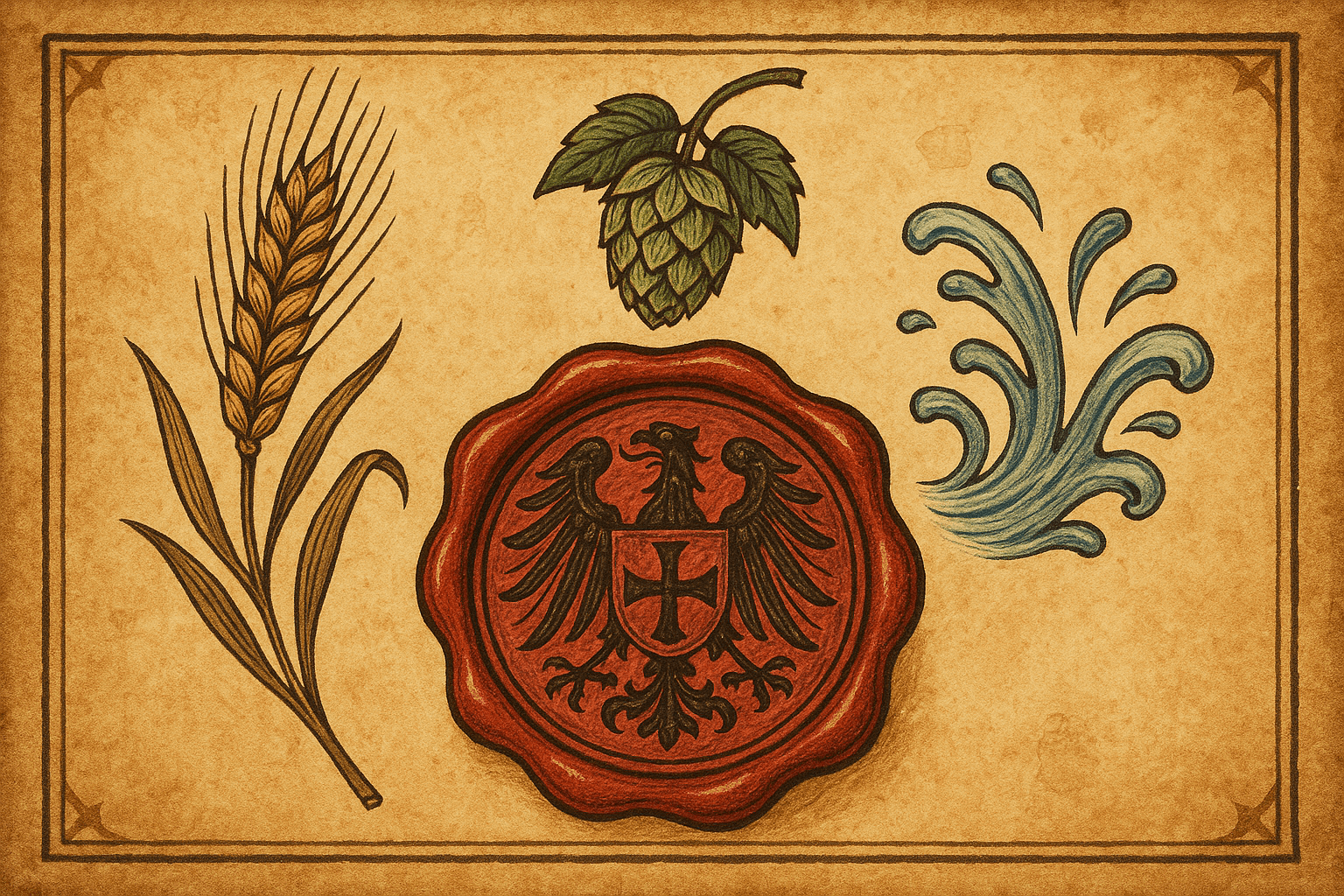
At its heart, the decree was strikingly simple. It stated that the only ingredients that could be used to produce beer were water, barley, and hops. For over 500 years, this simple rule has shaped German brewing, cementing its reputation for quality and becoming a powerful marketing tool. But the story of the Reinheitsgebot is far more complex than a mere quest for purity; it’s a tale of economic control, consumer protection, and the accidental definition of a national identity.
More Than Purity: A Law Born of Pragmatism
While we celebrate the Reinheitsgebot today as a noble pursuit of quality, its original architects had several, far more practical, concerns in mind. The law was a brilliant piece of 16th-century public policy designed to solve three pressing issues:
- Consumer Protection: The primary and most famous goal was to protect drinkers. By banning the rogue’s gallery of questionable and often dangerous additives, the law ensured a safer, more consistent product. It eliminated the guesswork and risk, guaranteeing that when a Bavarian citizen paid for beer, they got beer—not a potentially poisonous concoction.
- Price Control: The original 1516 text didn’t just legislate ingredients; it also fixed the price of beer. The law stipulated that a Maß (a measure of just over one liter) could not be sold for more than one Pfennig in the winter and two in the summer. This prevented brewers from price-gouging the public for what was then a fundamental part of the daily diet.
- Resource Management: Perhaps the most overlooked motivation was bread. By mandating that brewers use only barley, the dukes reserved more valuable grains like wheat and rye for bakers. This was a crucial economic move to prevent competition between brewers and bakers, keeping the price of bread—the staple food of the era—stable and affordable for the populace. It was, in essence, a brilliant act of grain resource allocation.
The Invisible Ingredient: What About Yeast?
Astute readers will notice a key ingredient missing from the original trio: yeast. Without yeast, there is no fermentation, and without fermentation, there is no beer. So how could the law omit it?
The simple answer is that in 1516, no one knew what yeast was. While brewers had mastered the art of fermentation, they didn’t understand the science. They knew that adding the sludgy sediment from a previous batch of beer would kickstart the next one, but they considered this mysterious process a gift from God, a magical transformation rather than a biological reaction. The role of microorganisms was a secret that would remain unlocked until Louis Pasteur’s groundbreaking work in the 19th century. Yeast was seen not as an ingredient to be added, but as a product of the brewing process itself. The Reinheitsgebot was eventually updated to officially include yeast, but its initial absence is a fascinating glimpse into the state of scientific knowledge at the time.
From Bavarian Decree to German Law
For centuries, the Reinheitsgebot was strictly a Bavarian affair. Other German states and cities had their own, often similar, brewing regulations. It wasn’t until the unification of Germany in the late 19th century that the Bavarian law began its march toward national dominance.
When the German Empire was formed in 1871, the proud and independent Bavarians were hesitant to join. As a condition of their entry, they insisted that their beloved Purity Law be adopted by the entire nation. The process was gradual, but in 1906, the Reinheitsgebot was officially incorporated into German federal law. This move unified the country’s brewing standards, cementing the “water, barley, hops” philosophy as the cornerstone of German beer identity. What started in a single duchy was now the law of the land, creating a national standard revered at home and admired abroad.
A Modern Marketing Tool and a Source of Debate
In the 20th century, the Reinheitsgebot transformed from a domestic law into a global marketing phenomenon. The phrase “Brewed according to the German Purity Law” became a seal of quality, a promise of natural ingredients and uncompromising tradition. It helped German beer stand out in a crowded international market, representing authenticity in an age of increasing industrialization.
However, this revered status was not without its challenges. In 1987, the European Court of Justice ruled that the Reinheitsgebot constituted an unfair trade barrier. Germany could no longer legally ban the import and sale of foreign beers that contained other “impure” ingredients like corn, rice, or spices. The protective walls of the Purity Law came tumbling down.
Today, the law has evolved into the Vorläufiges Biergesetz (Provisional Beer Law), which still governs what German brewers can produce for their domestic market. Yet, the 1987 ruling sparked a fierce debate that continues today. Traditionalists argue that the law is a vital guardian of German quality and culture. On the other hand, a new generation of craft brewers sees the strict adherence to the old rules as a creative straitjacket, preventing them from experimenting with fruit, spices, and other ingredients that define many popular global beer styles. Can a German brewer make a world-class Belgian Witbier with orange peel and coriander and still call it “Bier”? The question cuts to the heart of the Reinheitsgebot’s modern identity.
A 500-Year Legacy
The Reinheitsgebot is more than just an old law; it’s a living piece of history. It began as a pragmatic solution to the problems of 16th-century life—protecting consumers, feeding the population, and controlling the economy. Over 500 years, it evolved into a symbol of a nation’s craftsmanship, a badge of honor, and one of the most successful marketing slogans of all time. So the next time you enjoy a German lager, raise your glass to Duke Wilhelm IV and his Purity Law—a simple decree that forever changed the world of beer.