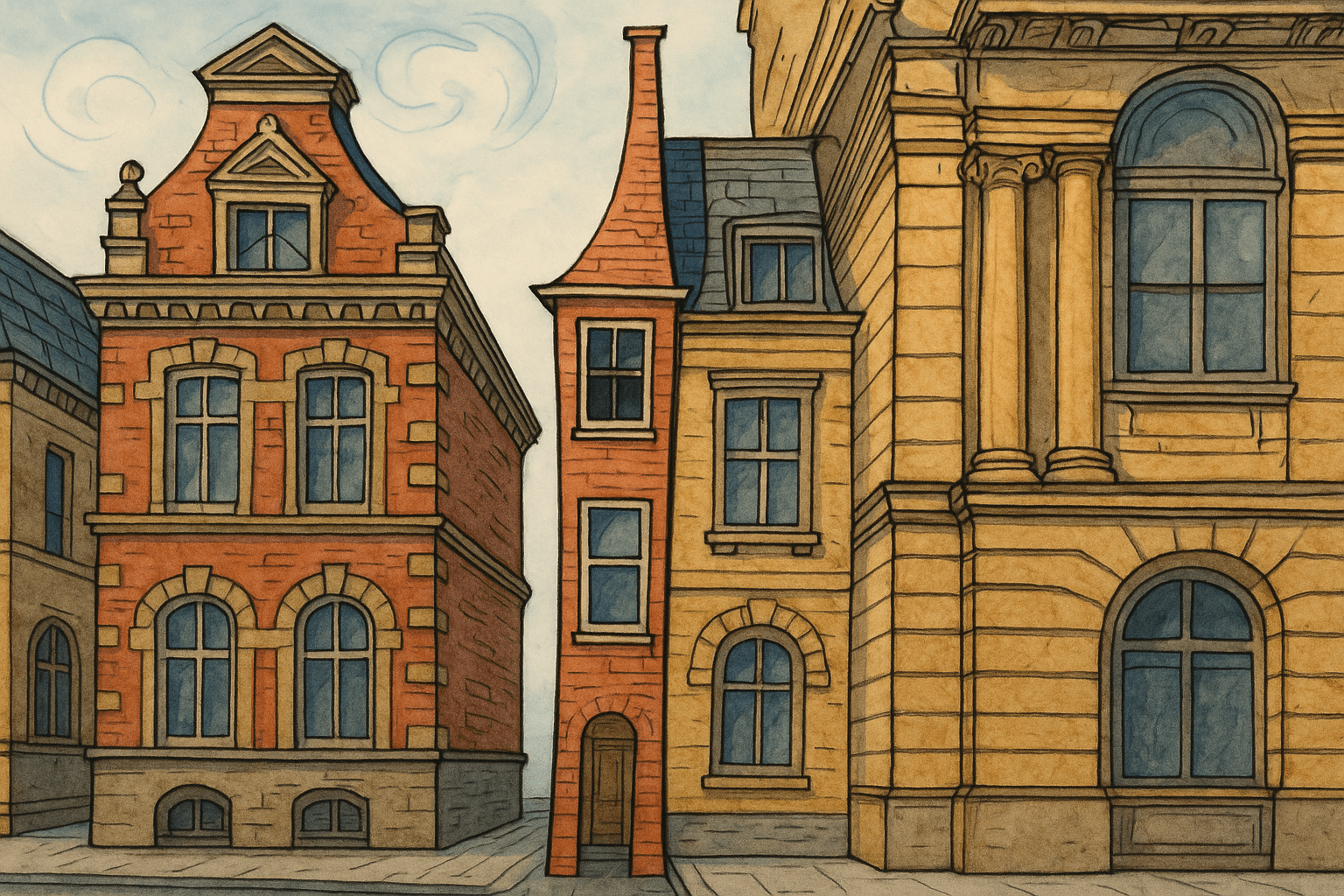
The old adage claims that “good fences make good neighbors.” But what happens when the fence isn’t enough? What happens when a grudge is so deep, a dispute so bitter, that the only way to get the last word is to build it, brick by brick, right in your adversary’s line of sight? Welcome to the fascinating, and often petty, world of spite houses—buildings constructed for the sole purpose of antagonism.
These architectural oddities are more than just quirky structures; they are monuments to human conflict. They stand as physical, often permanent, records of family feuds, battles with city hall, and neighborly disputes that spiraled spectacularly out of control. They are grudges given floor plans, and their stories reveal a side of history that is deeply, and often hilariously, human.
What Exactly is a Spite House?
A spite house is a building constructed or modified to irritate neighbors or any party with intersecting property lines. The motivation is not utility or comfort, but pure, unadulterated spite. The methods of architectural annoyance are surprisingly varied:
- Blocking Light and Air: The most common form of spite house is built to intentionally block a neighbor’s windows, sunlight, or scenic view. This is often achieved by building an unnaturally tall or narrow wall directly in front of the offending neighbor’s property.
- Exploiting Loopholes: Many spite houses exist because of a legal loophole. A person might be left with a sliver of land after a property dispute and, discovering there’s no law against building on it, will construct the most awkward and inconvenient house possible.
- General Annoyance: Sometimes, the goal is simply to create an eyesore. Think garish colors, bizarre shapes, or a structure so out of place it devalues the entire neighborhood, much to the builder’s satisfaction and everyone else’s dismay.
While the reasons differ, the outcome is the same: a building that serves as a permanent middle finger to an opponent.
The Skinny House of Boston: A Soldier’s Revenge
Perhaps the most famous spite house in the United States is the “Skinny House” at 44 Hull Street in Boston. Its story is a classic tale of sibling rivalry. Legend has it that in the 19th century, two brothers inherited a plot of land from their father. While one was away serving in the Civil War, the other brother built a large, grand home for himself, occupying the vast majority of their shared inheritance. He left only a tiny, seemingly unusable sliver of land for his soldier brother, assuming he’d never be able to build on it.
He assumed wrong. When the soldier returned, he was furious. To get his revenge and ruin his greedy brother’s view and sunlight, he built a house on the sliver of land. The resulting structure is just 10.4 feet wide at its broadest point and tapers to a mere 6.2 feet in the back. The soldier effectively walled off his brother’s home, blocking his light and view forever. Today, the Skinny House is a cherished—and fully occupied—Boston landmark, a testament to a family feud that literally shaped the city’s landscape.
The Alameda Spite House: When Your Neighbor is the City
Not all spite is directed at a person; sometimes, the target is the government. In the early 20th century, the city of Alameda, California, decided to build a street, seizing a large portion of Charles Froling’s land through eminent domain. Froling had planned to build his dream house on the plot, but the city and a neighboring developer took what they wanted, leaving him with a long, narrow strip of land deemed useless for construction.
In a magnificent act of defiance, Froling consulted an architect and built a house on that exact strip. The resulting building, completed in 1908, is 10 feet wide, 54 feet long, and 20 feet high. Its side wall sits cheek-to-jowl with the neighboring house, and its front door opens onto a street that exists only because his land was taken. The house is a beautiful example of Victorian architecture, but its impossible dimensions make it a stark and constant reminder to the city of the man who refused to be pushed aside.
The Old Spite House of Alexandria: Solving a Loitering Problem
In Alexandria, Virginia, stands another of America’s narrowest homes, born not from a property dispute but from sheer annoyance. In 1830, John Hollensbury owned the house next to a noisy, disruptive alleyway. He grew tired of the constant clatter of horse-drawn wagons and the loiterers who used the narrow passage as a hangout spot.
His solution was simple and elegant. He built a house *in* the alley. Measuring just 7 feet wide and 25 feet deep, the tiny two-story brick building completely blocked access. The walls of the two adjacent houses serve as the side walls for the tiny home, and scratch marks from wagon wheels are still visible on the interior walls. What began as a tool to end a public nuisance is now a beloved private residence and a historical point of interest. It’s a perfect example of how one man’s frustration can become a city’s treasure.
An International Grudge: The Beirut Lighthouse
The phenomenon of the spite house is not unique to America. In Beirut, Lebanon, a building known locally as “Al-Ba’sa” (The Grudge) serves as one of the most striking examples of spite architecture in the world. The story goes that two brothers inherited adjacent plots of land. One brother’s plot was prime real estate with a valuable, uninterrupted view of the Mediterranean Sea.
The other brother’s plot sat directly in front of it. In an act of pure spite, supposedly after a falling out, he built the thinnest habitable building imaginable. In some places, it is only two feet deep. While it contains rooms, it is barely functional as a home. Its true function is to serve as a wall, completely obliterating his brother’s sea view and torpedoing the value of his property. Though it has been used as a brothel and a refuge for war refugees, its primary identity remains: it is a wall masquerading as a house, a silent, slender monument to a bitter family feud.
An Architecture of Animosity
Spite houses are more than just historical curiosities. They are powerful reminders that our physical environment is often a direct reflection of our social relationships. They prove that human emotions—pride, anger, stubbornness, and a thirst for revenge—can be forces of construction just as powerful as ambition or necessity. These narrow, awkward, and defiant buildings stand as enduring memorials, not to great leaders or noble ideas, but to the simple, potent fact that sometimes, nothing satisfies like having the last word.