The Contenders: A Tale of Three Kingdoms
To understand this tumultuous period, we must first meet the players. Each kingdom possessed a unique character, geography, and destiny that shaped its role on this grand historical stage.
Goguryeo (고구려): The Northern Powerhouse
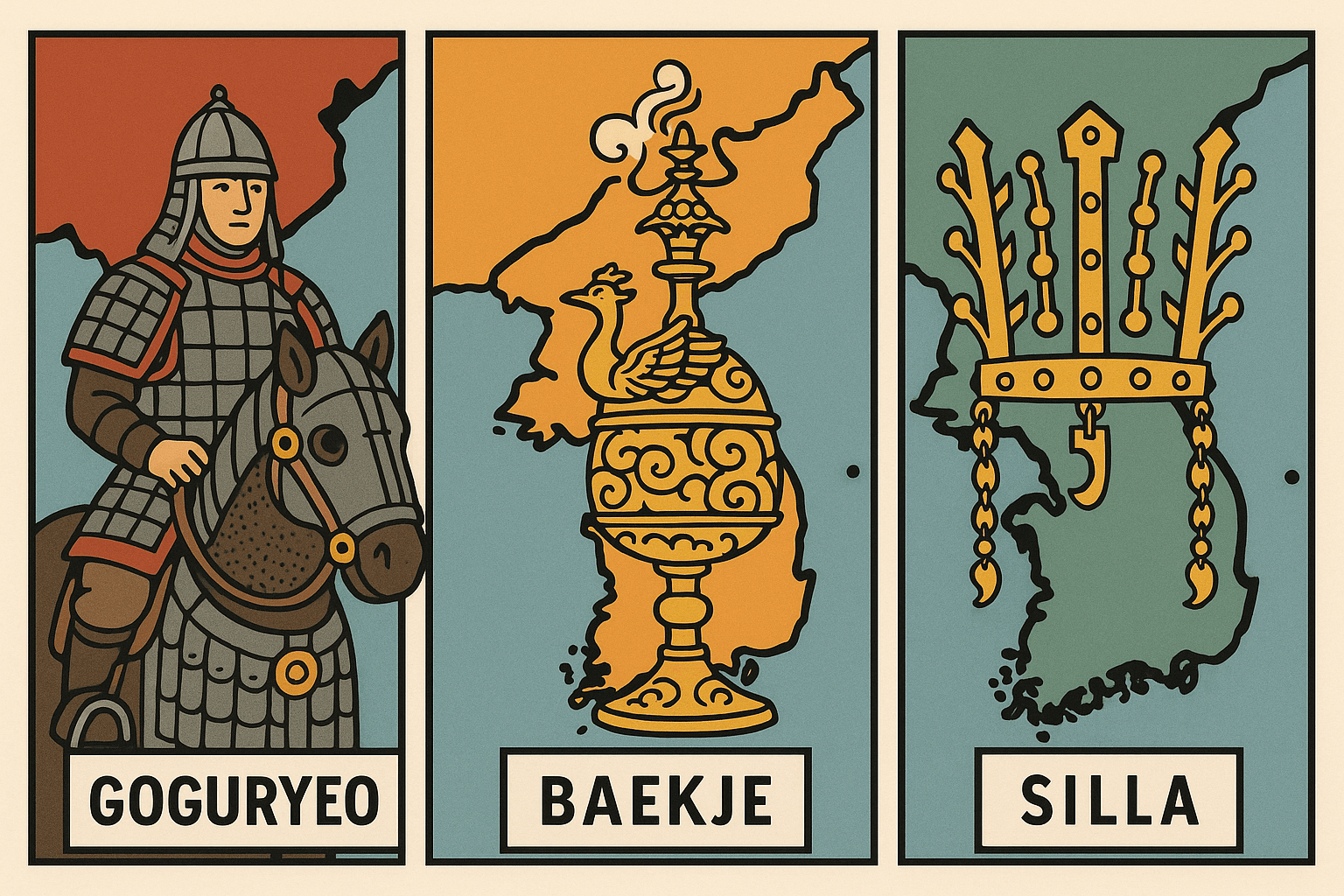
Occupying the vast northern territories of the peninsula and stretching deep into modern-day Manchuria, Goguryeo was the warrior kingdom. Born from the harsh, mountainous terrain, its people were renowned for their martial prowess and expansionist drive. Under domineering rulers like King Gwanggaeto the Great, who reigned in the late 4th and early 5th centuries, Goguryeo vastly expanded its territory, subjugating neighboring tribes and becoming a formidable regional power. Its military might was legendary, famously repelling massive invasions from Chinese dynasties like the Sui and Tang. This legacy of strength and resistance is immortalized in the stunningly vivid murals found within the Complex of Goguryeo Tombs, a UNESCO World Heritage site.
Baekje (백제): The Maritime Connoisseur
In the fertile plains of southwestern Korea, the kingdom of Baekje flourished. While it possessed a capable military, Baekje’s true genius lay in diplomacy, trade, and culture. As a major maritime power, its ships navigated the East Asian seas, establishing strong connections with China and, most significantly, Japan. Baekje was a cultural conduit, playing a pivotal role in transmitting crucial elements like Buddhism, Chinese writing, and advanced artistic techniques to the burgeoning Yamato state in Japan. The kingdom was known for its refined aesthetics and exquisite craftsmanship, exemplified by masterpieces like the Gilt-Bronze Incense Burner of Baekje, a breathtakingly intricate work of art.
Silla (신라): The Cunning Survivor
Tucked away in the southeastern corner of the peninsula, Silla was initially the smallest and weakest of the three. Its geographic isolation made it the last to adopt foreign ideas like Buddhism and Chinese governance models. However, what Silla lacked in initial power, it more than made up for in strategic cunning and social organization. Its unique “bone-rank” system (golpum) was a rigid hereditary caste system that dictated all aspects of social life, from the jobs one could hold to the clothes one could wear. Silla also cultivated an elite youth corps known as the Hwarang, or “Flowering Knights”, who were trained in military arts, philosophy, and ethics, becoming instrumental in the kingdom’s later military successes.
It’s also worth noting the Gaya Confederacy, a league of city-states in the southern central region known for its advanced ironworking. For much of the period, Gaya was a significant fourth power, but it was ultimately absorbed by the ever-expanding Silla in the 6th century.
An Era of Endless War and Shifting Alliances
The 700-year history of the Three Kingdoms was a dizzying dance of war and alliance. The balance of power was constantly in flux. For a long time, the primary axis of conflict involved Baekje and Silla forming a shaky alliance to resist the expansionist pressure of the powerful Goguryeo to the north.
A pivotal moment came in the mid-6th century. Baekje and Silla successfully joined forces to seize the crucial Han River valley from Goguryeo. The Han River basin was the peninsula’s strategic and economic heartland. But in a shocking act of betrayal that would define relations for the next century, Silla turned on its ally, drove Baekje out, and claimed the entire territory for itself. This gave Silla direct access to the Yellow Sea and a trade route to China, while fueling a deep and bitter enmity with a vengeful Baekje.
This complex chessboard was further complicated by the giant lurking next door: China. Goguryeo spent centuries locked in conflict with various Chinese dynasties. Its successful defense against a Sui invasion force of over one million soldiers is one of the most celebrated military victories in Korean history and directly contributed to the Sui Dynasty’s collapse.
More Than Just Warfare: A Crucible of Culture
While defined by conflict, this era was also one of profound cultural and technological development. The single most transformative force was the arrival of Buddhism in the 4th century. Initially met with resistance from native shamanistic beliefs, Buddhism was eventually embraced by the royalty of all three kingdoms.
- It offered a universal belief system that could transcend tribal divisions.
- It provided a framework for state protection and royal authority.
- It inspired the creation of magnificent temples, serene statues, and intricate pagodas, such as the Hwangnyongsa (Silla) and Mireuksa (Baekje) temples.
Art and innovation flourished. Silla’s capital, Gyeongju, yielded stunning golden crowns of unbelievable delicacy from its royal tombs. Baekje’s elegant Buddhist statues influenced Japanese sculpture for generations. And in Silla, the Cheomseongdae observatory was built—one of the world’s oldest surviving astronomical observatories, a testament to the kingdom’s scientific advancement.
The Unification: Silla’s Ultimate Victory
By the 7th century, the stage was set for the final act. Silla, having grown in power and confidence, forged the most consequential alliance in Korean history: a pact with the powerful Tang Dynasty of China. Their shared goal was the destruction of Silla’s rivals.
The Silla-Tang alliance was brutally effective.
- In 660 CE, their combined forces attacked the isolated and internally fractured Baekje. The capital fell, and the kingdom was extinguished.
- They then turned their full attention to the mighty Goguryeo. After years of exhausting warfare against China and internal strife, the northern powerhouse finally fell in 668 CE.
The Three Kingdoms period was over. But the Tang Dynasty had no intention of leaving. They established protectorates on the peninsula, planning to absorb the territory into their empire. In a final, audacious move, Silla broke with its powerful ally and waged a decade-long war against the Tang. By 676 CE, Silla had successfully expelled the Chinese forces from most of the peninsula, establishing the first unified state in Korean history: Unified Silla.
The legacy of the Three Kingdoms is not simply the story of Silla’s victory. It is the story of how three distinct rivals, through centuries of competition, laid the cultural, political, and social bedrock of Korea. The martial spirit of Goguryeo, the artistic sophistication of Baekje, and the strategic endurance of Silla would all become threads woven into the rich and complex tapestry of modern Korean identity.