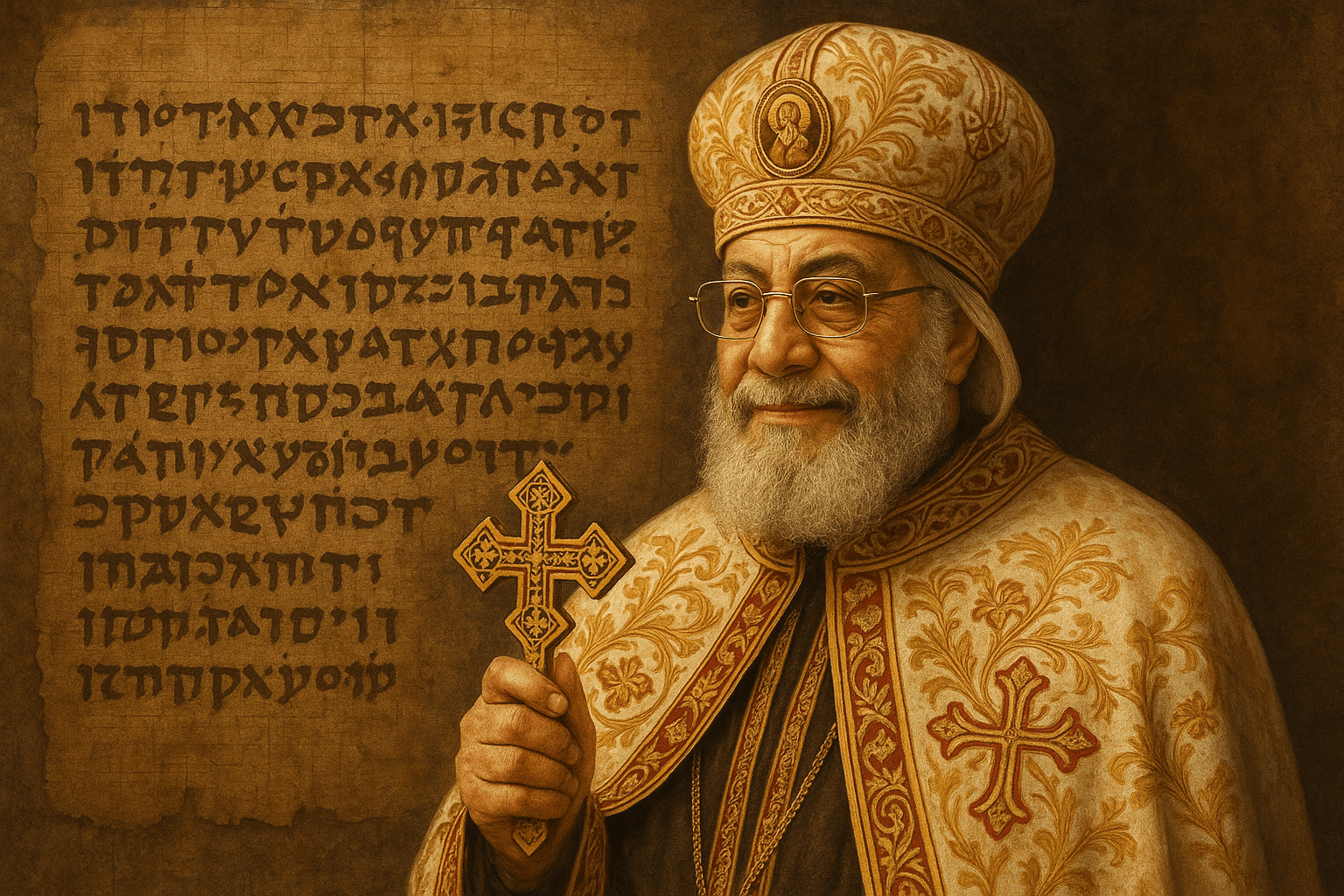
When the word “Pope” is mentioned, the mind almost universally conjures images of Rome, St. Peter’s Basilica, and the leader of the world’s 1.3 billion Roman Catholics. Yet, nestled in the ancient land of Egypt, another pope presides over one of Christianity’s oldest communities—the Pope of Alexandria. His title, “Pope of Alexandria and Patriarch of All Africa on the Holy See of St. Mark the Evangelist”, carries a history as ancient, as dramatic, and as pivotal to the formation of Christian doctrine as that of any See, including Rome itself.
The Lion in the Land of the Pharaohs: The Markan Legacy
The story of the Coptic Papacy begins not with a fisherman like St. Peter, but with an author: St. Mark the Evangelist. Tradition holds that Mark, the writer of the second Gospel, arrived in the bustling, multicultural metropolis of Alexandria around 42 AD. At the time, Alexandria was the intellectual capital of the Mediterranean world, home to the great library and a vibrant mix of Greek philosophy, Roman governance, and ancient Egyptian traditions.
In this dynamic environment, Mark began to preach the new Christian faith. His first convert was a shoemaker named Anianus, who would succeed him to become the second Patriarch of Alexandria. This established an episcopal line that the Coptic Orthodox Church traces, unbroken, to the present day. St. Mark is thus not just a distant figure but the foundational pillar of their church. His apostolic symbol, the Lion of St. Mark, remains a powerful emblem for the See of Alexandria. His ministry in Egypt ended in martyrdom in 68 AD, but the seed he planted had taken root in fertile, albeit challenging, soil.
An Intellectual and Theological Powerhouse
The intellectual climate of Alexandria profoundly shaped its church. Long before the papal title became exclusively associated with Rome, the Bishop of Alexandria was affectionately called “Pope” (from the Greek Pappas, meaning “Father”). The Catechetical School of Alexandria, a kind of early Christian university, became the premier center for theological study in the world. Scholars like Clement of Alexandria and the brilliant, if controversial, Origen pioneered biblical interpretation and the synthesis of Christian faith with Greek philosophy.
This academic rigor made the Popes of Alexandria leading voices in every major theological debate of the early Church. They were not just local bishops; they were titans who shaped the very definition of what it meant to be an orthodox Christian. Their influence reached its zenith in the great Ecumenical Councils of the 4th and 5th centuries.
Defining Orthodoxy: From Nicaea to Chalcedon
The Coptic Papacy’s role as a defender of faith was cemented at two critical councils that would define Christianity forever—and ultimately, lead to its first great schism.
The Council of Nicaea (325 AD)
The first major council was called by Emperor Constantine to address the Arian heresy, which taught that Jesus Christ was a created being and not co-eternal with God the Father. The fiercest opponent of this view was Pope Alexander I of Alexandria, who brought along his brilliant and fiery young deacon, Athanasius. Together, they championed the position that Christ was “of the same substance” (homoousios) as the Father. Their view prevailed, forming the core of the Nicene Creed, which is still recited by most Christians today.
When Athanasius later became Pope Athanasius I, he spent his 45-year tenure defending this Nicene orthodoxy, earning the title Athanasius Contra Mundum (“Athanasius Against the World”) for his tireless struggle against Arian emperors and bishops. He solidified Alexandria’s reputation as the “Pillar of Orthodoxy.”
The Council of Chalcedon (451 AD)
If Nicaea was Alexandria’s triumph, Chalcedon was its tragedy. The debate had shifted to a finer point of Christology: how exactly were the divine and human natures of Jesus related? The Council of Chalcedon, supported by Rome and Constantinople, declared that Christ exists in two natures—one divine, one human—united in a single person.
The Alexandrian contingent, led by Pope Dioscorus I, held a different view. They argued for “one incarnate nature of the God-Logos” (the Word), a formula championed by their revered predecessor, Pope Cyril I. Their position, known as Miaphysitism (from the Greek for “one nature”), emphasizes the perfect, seamless union of divinity and humanity in Christ, without separation or confusion. Their opponents, however, unfairly branded this as Monophysitism, the heretical belief that Christ’s humanity was completely absorbed by his divinity, a view the Coptic Church has always rejected.
The Council condemned and deposed Pope Dioscorus. This was a political and theological breaking point. The vast majority of Christians in Egypt and much of Syria rejected the Chalcedonian definition, viewing it as a betrayal of the faith of their fathers, Cyril and Athanasius. They remained loyal to Pope Dioscorus and his successors, cleaving the Church. This event marks the birth of the distinct Coptic Orthodox Church as part of the Oriental Orthodox communion, separate from the Eastern Orthodox and Roman Catholic Churches.
Survival and Perseverance Under New Rulers
Following Chalcedon, the Coptic Church faced persecution from the Byzantine Empire, which tried to impose Chalcedonian patriarchs on an unwilling populace. The Arab conquest of Egypt in 641 AD was, for many Copts, a release from this Byzantine oppression. Under Islamic rule, Christians became dhimmis, or a protected minority. They had religious freedom in exchange for a special tax (the jizya) and acceptance of a lower social status.
For over a millennium, the Coptic Pope was more than a spiritual leader; he was the head of the Coptic nation (millet). He was the community’s chief representative to the caliphs, sultans, and governors, responsible for negotiating its rights and ensuring its survival through periods of both remarkable tolerance and brutal persecution.
The Modern Papacy: A Shepherd for a Global Flock
In the modern era, the Coptic Papacy has overseen a remarkable revival. Though the papal seat officially moved from Alexandria to Cairo in the 11th century to be closer to the center of Egyptian governance, the ancient title remains. Twentieth-century leaders like Pope Cyril VI (1959-1971), a man revered as a saint for his profound prayer life and numerous miracles, and Pope Shenouda III (1971-2012), a charismatic teacher who led the church for over 40 years, became towering figures of national importance.
Pope Shenouda, in particular, guided the church through immense social change and oversaw a global expansion of the Coptic diaspora, establishing hundreds of new churches across North America, Europe, and Australia. Today, the current pontiff, Pope Tawadros II, continues this legacy. He shepherds a community of an estimated 10-15 million in Egypt and several million more abroad, navigating the challenges of sectarianism, modernization, and serving a flock that is now truly global.
From an evangelist’s mission in a Roman metropolis to the defender of orthodoxy, from the leader of a subject people to the head of a worldwide faith, the Coptic Papacy of Alexandria stands as a testament to profound faith and incredible resilience. It is a living link to the earliest days of Christianity, a voice from the age of the councils that continues to echo in the 21st century.