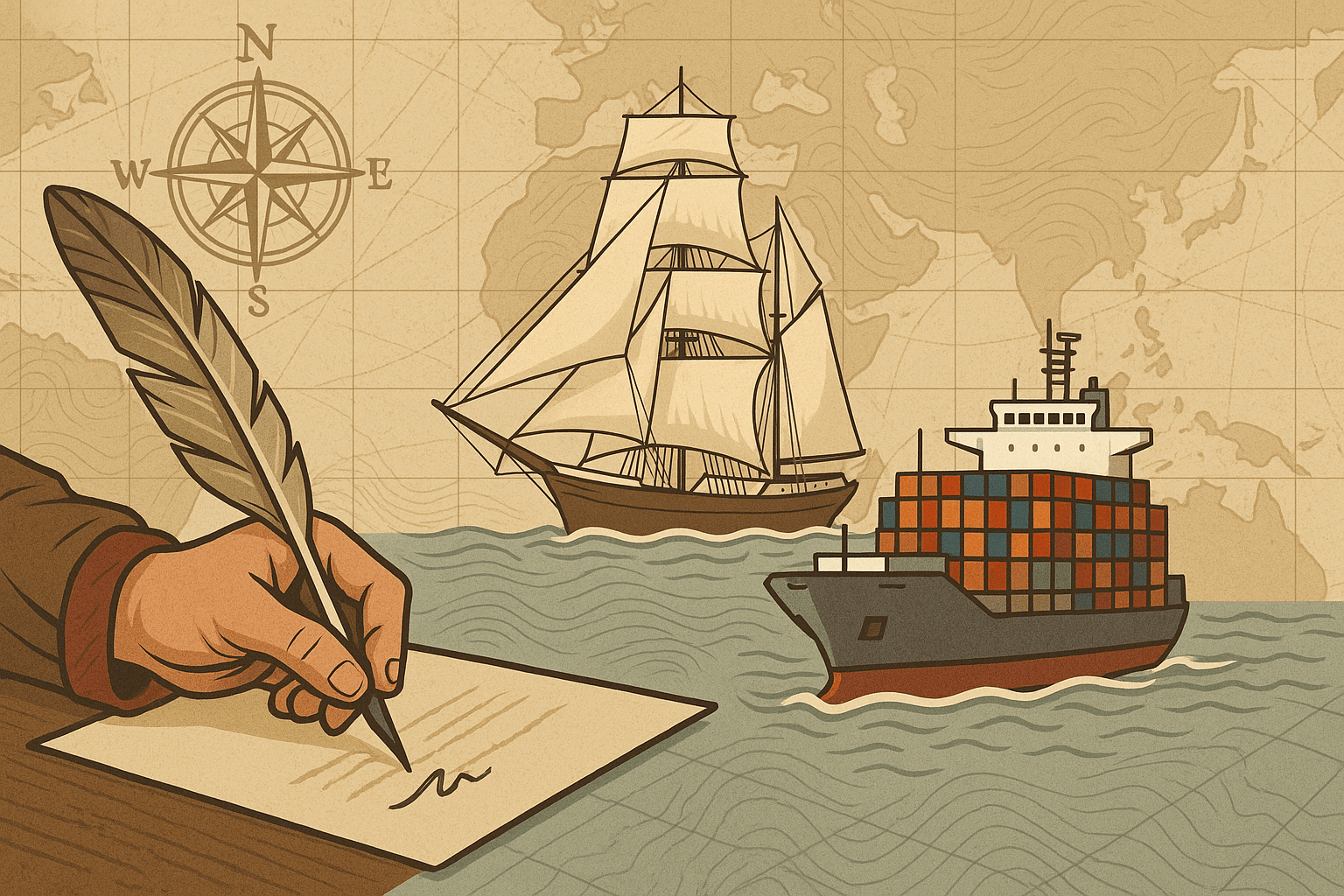
Imagine you’re a Florentine merchant in the 14th century. You’ve just sent a precious cargo of silk and spices on a ship bound for London. The journey will take weeks, fraught with the perils of pirates, storms, and dishonest sailors. How do you prove the goods are yours when they arrive? What if you want to sell the cargo to another merchant while the ship is still battling the waves of the Atlantic? For centuries, these questions posed a fundamental barrier to the growth of global trade. The elegant solution that emerged was not a new type of ship or a faster route, but a deceptively simple piece of paper: the Bill of Lading.
This single document would evolve to become a cornerstone of international commerce, ingeniously combining three crucial functions into one: a receipt for goods shipped, a contract for their transportation, and a document of title representing legal ownership. Its history is the story of how trust was built, risk was managed, and capital was unlocked, paving the way for the globalized world we know today.
The Seeds of an Idea: From Ship’s Log to Shipper’s Receipt
The origins of the bill of lading are found in the bustling ports of the Mediterranean during the late Middle Ages. Maritime republics like Venice and Genoa dominated trade, and with this boom in commerce came the need for better record-keeping. Initially, a ship’s clerk or master would maintain a private log or “book of lading.” This register detailed all the cargo loaded onto the vessel, noting the merchant (the shipper), the nature of the goods, and the intended recipient (the consignee).
This was purely an internal record for the carrier. However, merchants soon began demanding a copy of the entry pertaining to their specific cargo as proof that the captain had received it. This copy, signed by the master of the ship, was the earliest form of a bill of lading. At this stage, it was little more than a receipt. It confirmed that the goods were on board, but its utility ended there. It was a vital first step, but the document’s true power was yet to be realized.
A Receipt Becomes a Contract
As trade routes lengthened during the Renaissance and the Age of Discovery, the simple receipt began to accumulate more detail. Shippers and carriers needed to clarify their agreement to avoid disputes at the end of a long and uncertain voyage. The “receipt” started to include the terms of the carriage agreement.
Phrases that are still familiar today began to appear, such as the goods being “received in good order and condition.” It would specify the port of destination, the agreed-upon freight charges, and the party responsible for paying them. By codifying these terms, the bill of lading transformed from a simple acknowledgment of goods into evidence of the contract of carriage between the merchant and the shipping line. To mitigate the risk of a single document being lost at sea, the practice of issuing bills in a set of three identical parts became common—one for the shipper, one for the ship’s master, and a third sent by separate, often faster, means to the consignee at the destination.
The Game Changer: The Document of Title
The most revolutionary evolution in the bill of lading’s history occurred in the 17th and 18th centuries, driven by the sophisticated commercial markets of England and the Netherlands. This was the leap that turned the document into a negotiable document of title.
What does this mean? It meant that physical possession of the bill of lading became legally equivalent to possessing the goods themselves. The document became a proxy for the cargo. This was a monumental innovation. Now, the Florentine merchant didn’t have to wait for his silk to arrive in London to do business. While the ship was still at sea, he could sell the cargo simply by endorsing the bill of lading and delivering it to a new buyer. The new buyer could, in turn, sell it to another. Ownership of tons of silk, tossing on a distant sea, could change hands multiple times in a London coffee house through the simple exchange of a piece of paper.
This “negotiability” unlocked vast amounts of capital that were previously frozen during transit. A merchant could now secure a loan from a bank using the bill of lading as collateral. This ability to trade goods in-transit fueled the growth of commodity markets and finance, lubricating the wheels of the burgeoning British Empire and the global economy. The legal principle was cemented in English common law in the landmark 1794 case of Lickbarrow v. Mason, which formally recognized that the transfer of a bill of lading could transfer ownership of the goods to a good-faith purchaser.
Standardization in the Industrial Age
The Industrial Revolution brought steamships and a tidal wave of manufactured goods, but it also brought legal chaos. Each shipping line developed its own bill of lading, often filled with “exception clauses” that exonerated them from nearly all liability for lost or damaged cargo. The power imbalance was stark, and shippers demanded protection.
This led to a push for international standardization. The United States passed the Harter Act in 1893, one of the first major laws to impose certain non-negotiable duties upon carriers. This effort went global with the adoption of the Hague Rules in 1924, an international convention that created a uniform legal framework for bills of lading. For the first time, there was a widely accepted international standard governing the rights and responsibilities of both the carrier and the cargo owner. These rules, later updated as the Hague-Visby and Rotterdam Rules, still form the legal bedrock of maritime shipping today.
The Bill of Lading in the Digital Age
For all its historical importance, the paper bill of lading is an analog instrument in a digital world. In an age of container ships carrying goods worth hundreds of millions of dollars, the supply chain can move faster than the courier carrying the paper document. A lost or delayed bill of lading can result in massive costs and port congestion as cargo sits idle, unable to be legally claimed.
The obvious solution is the Electronic Bill of Lading (eBL). However, the transition has been slow. The primary challenge is replicating the unique function of a “document of title” digitally. How do you create a digital file that cannot be copied, ensuring there is only one true “original” that can be transferred? Technologies like blockchain are emerging as a powerful solution, offering a secure, transparent, and decentralized ledger that can create a unique digital token representing the bill of lading. This token can be transferred instantly and securely, promising to finally bring the document that enabled global trade into the 21st century.
From a medieval clerk’s logbook to a potential blockchain token, the bill of lading has been a quiet but powerful engine of history. It solved the fundamental problem of trust over distance, allowing ownership to travel as fast as commerce demanded, and in doing so, it created the framework for the world’s interconnected economy.