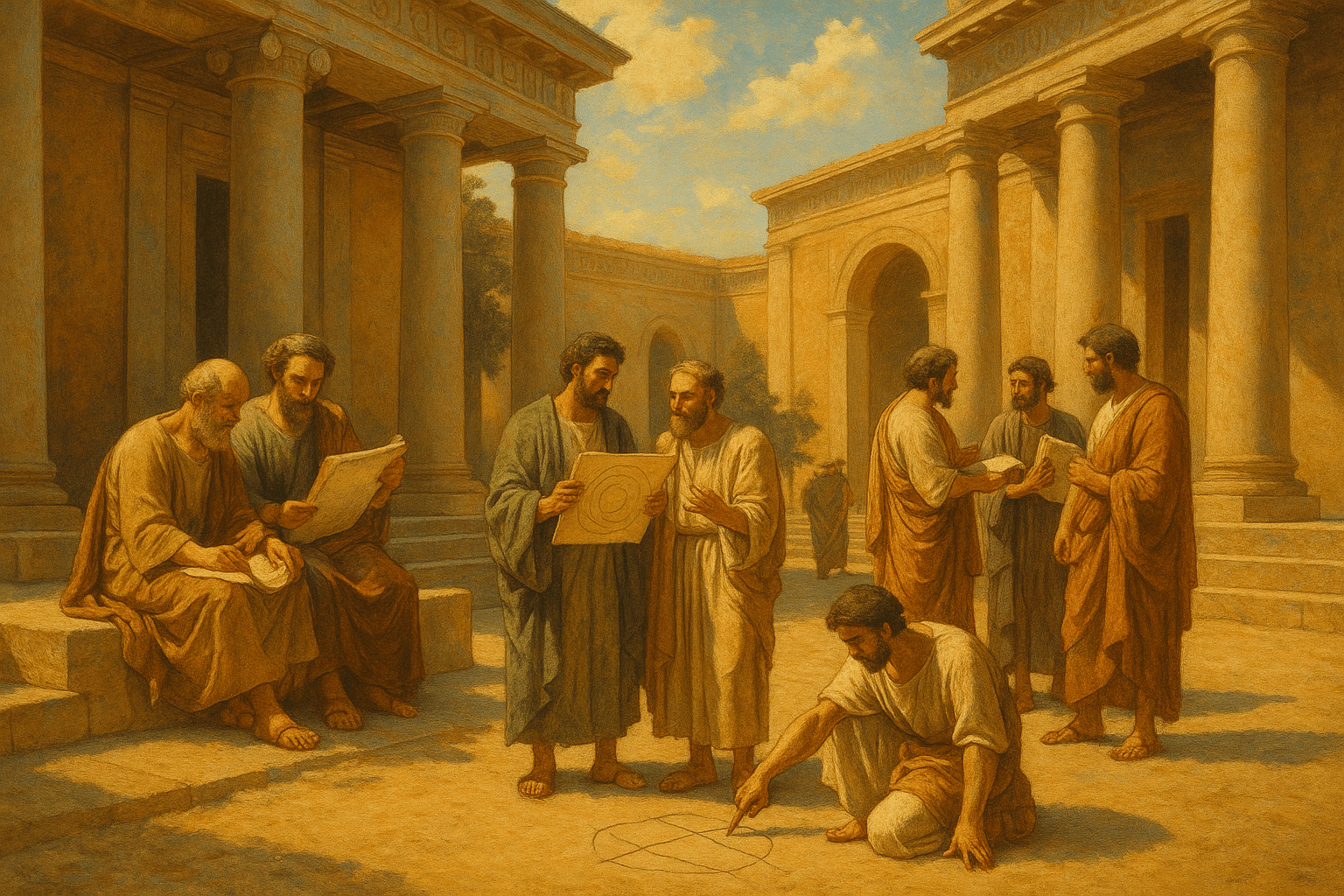
Established in the early 3rd century BCE by the Greek Ptolemaic dynasty that ruled Egypt, the Musaeum (or Mouseion) was far more than a library. Its name, meaning “Shrine of the Muses,” hints at its purpose. It was a place where knowledge was not just stored, but actively created, debated, and expanded upon under the patronage of the gods of creativity and intellect.
More Than a Library: A Temple to the Muses
Imagine being one of the greatest minds of your generation and receiving an invitation from the king of Egypt. You are offered a position not as a tutor or a courtier, but as a full-time scholar at the Musaeum. Your life would be transformed. The Ptolemies provided their chosen intellectuals with:
- A generous state-funded salary (stipend) for life.
- Tax-exempt status.
- Free housing in a communal complex.
- Free meals in a grand shared dining hall.
This was revolutionary. For the first time in history, a large, diverse group of scholars was freed from the daily grind of earning a living. They didn’t need to teach students (though some did) or seek out wealthy patrons. Their only job was to think, research, experiment, and debate. The Musaeum wasn’t a university; it was a government-funded research institute. Its residents were not just librarians and philosophers, but mathematicians, astronomers, engineers, geographers, physicians, and poets, all living and working together in a vibrant, interdisciplinary community.
A Universe of Knowledge Under One Roof
The concentration of brilliant minds, backed by the unparalleled resources of the Library, created an intellectual supernova. The discoveries and inventions that emerged from the Musaeum shaped the course of Western science and scholarship for nearly two millennia.
Mathematics and Measurement
The Musaeum was home to Euclid, whose book The Elements became the foundational text for geometry until the 19th century. He didn’t just collect geometric facts; he organized them into a single, logical deductive system, creating the very framework of mathematical proof.
Later, the head of the Library, Eratosthenes of Cyrene, performed one of the most elegant experiments in history. Hearing that on the summer solstice, the sun cast no shadow at noon in the southern city of Syene, he measured the shadow cast by a stick in Alexandria at the same time. Using the angle of the shadow and the distance between the two cities, he calculated the circumference of the Earth with an accuracy of over 90%. It was a stunning demonstration of the power of observation and mathematics, proving our planet was a sphere and measuring its size 1,700 years before Columbus sailed the ocean blue.
Astronomy and Engineering
While Eratosthenes was measuring the Earth, his contemporary Aristarchus of Samos was looking at the heavens. He was the first person known to propose a heliocentric model of the solar system, placing the Sun, not the Earth, at its center. While his idea was largely rejected in favor of the geocentric models of Aristotle and Ptolemy (the astronomer, not the king), it stands as a breathtaking leap of imagination.
The tradition of mechanical genius continued with figures like Hero of Alexandria, who worked centuries later but in the same tradition. He documented countless mechanical devices and created the aeolipile, a simple steam-powered turbine, demonstrating the principles of rocketry and steam power long before the Industrial Revolution.
Anatomy and the Human Body
Perhaps the most radical work at the Musaeum occurred in medicine. In a stark break with Greek tradition, which held a powerful taboo against desecrating the human body, physicians like Herophilus and Erasistratus performed the first systematic dissections of human corpses. Their detailed studies of the nervous system, distinguishing between sensory and motor nerves, and their descriptions of the brain, heart valves, and eyes were unparalleled in antiquity. For the first time, medicine was being placed on a firm footing of empirical anatomical knowledge.
The Ptolemaic Strategy for Supremacy
Why did the Ptolemies invest so much treasure in this intellectual enterprise? It was a brilliant act of political strategy. As Greek-Macedonian rulers of Egypt, they needed to legitimize their reign and establish their new capital, Alexandria, as the center of the Hellenistic world. What better way to do that than by cornering the market on knowledge?
By attracting the world’s leading scholars, they were engaging in a form of cultural imperialism. All intellectual roads led to Alexandria. The Musaeum became a symbol of Ptolemaic power and prestige, proving that they, not the old city-states like Athens, were the true inheritors of Alexander the Great’s legacy. The aggressive acquisition of scrolls for the Library—sometimes even seizing books from ships docking in the harbor to be copied—was part of this grand strategy. The goal was to possess not only the greatest minds but also the sum of all knowledge itself.
The End of an Era and an Enduring Idea
The Musaeum’s golden age couldn’t last forever. As the Ptolemaic dynasty weakened from internal strife, funding became precarious. The famously brutish king Ptolemy VIII Physcon purged the Musaeum of scholars he deemed disloyal, scattering its intellectual community. Later, under Roman rule, Alexandria remained an important center of learning, but the unique state-sponsored “think tank” model of the early Musaeum faded.
While the buildings themselves are long gone, the idea behind the Musaeum is immortal. It was a testament to the belief that knowledge is a worthy pursuit in its own right, and that providing brilliant people with the freedom and resources to think can change the world. From the great universities of the Middle Ages to the advanced research institutes and government think tanks of today, the legacy of this “Shrine of the Muses” on the Nile continues to shape our quest for understanding the universe.