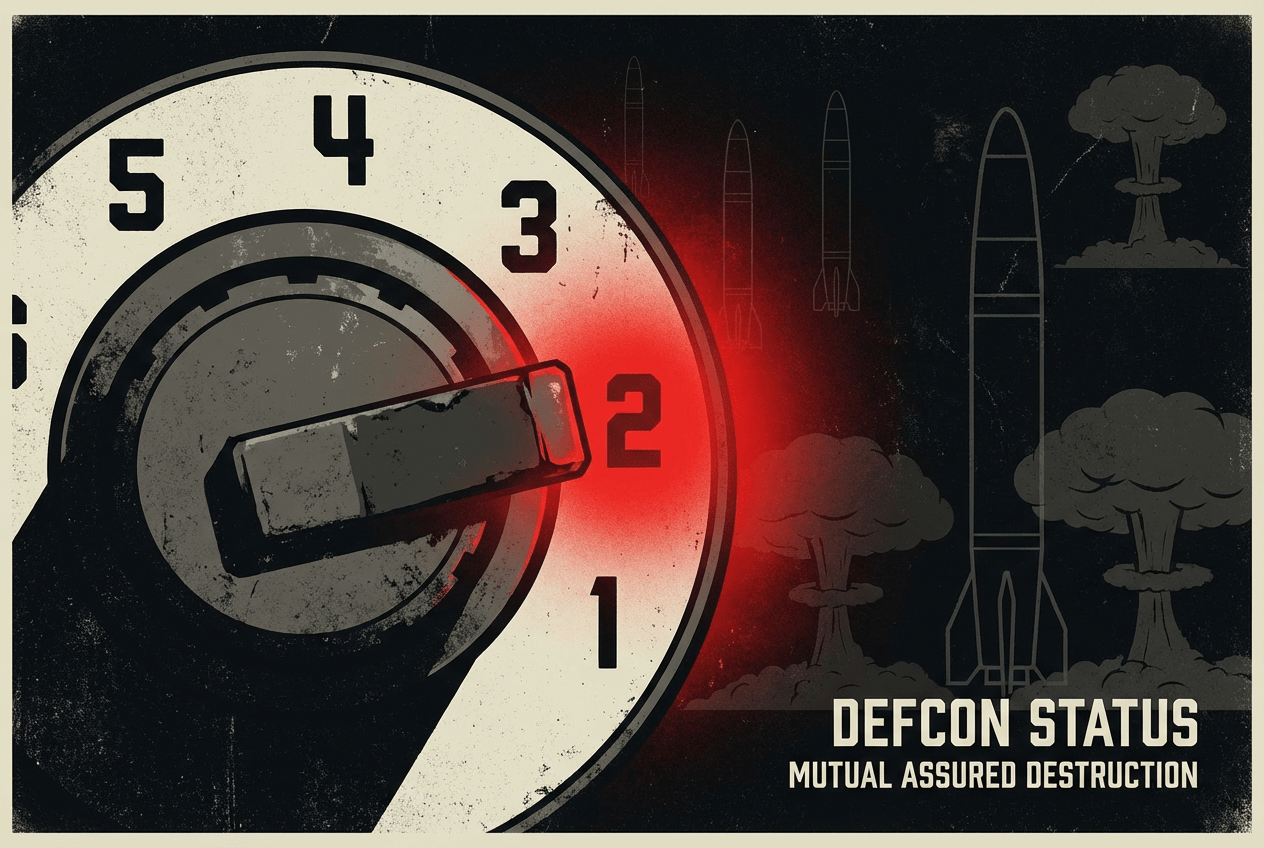
“Mr. President, we’re at DEFCON 1!” It’s a line you’ve heard in countless thrillers, from WarGames to Independence Day. The scene is always the same: tense faces in a command center, flashing red lights, and the implication that the world is about to end. It’s a fantastic piece of movie shorthand for a crisis. It’s also completely wrong.
In reality, DEFCON 1 doesn’t mean a crisis is brewing; it means nuclear war is already happening. The DEFCON (Defense Readiness Condition) scale is a real system, but its history is far more secretive and its application far more terrifying than Hollywood lets on. It isn’t a prop; it’s a carefully calibrated ladder of escalation, a silent, coded language for the most dangerous moments in modern history. Let’s unravel the secret history of the system designed to manage the unimaginable.
What is the DEFCON Scale, Anyway?
First, let’s clear up the pop culture confusion. The DEFCON scale runs from 5 down to 1, where 1 is the most severe. Think of it not as a volume knob going up, but as a countdown to doomsday.
Established by the Joint Chiefs of Staff in 1959, the scale provides a standardized way for the U.S. military to graduate its readiness for war. Each level,
which has a corresponding exercise term, dictates specific security measures and response times across the armed forces.
- DEFCON 5 (Exercise Term: FADE OUT): This is the lowest state of readiness, normal peacetime conditions. It’s where the U.S. military sits on any given day when the world is relatively calm.
- DEFCON 4 (Exercise Term: DOUBLE TAKE): This level requires increased intelligence gathering and heightened security measures. It’s a subtle uptick, a sign that leaders are paying close attention to a developing situation.
- DEFCON 3 (Exercise Term: ROUND HOUSE): This represents a significant increase in readiness. The U.S. Air Force, for example, must be ready to mobilize in just 15 minutes. This is a serious step, moving forces into a state of preparedness for potential conflict.
- DEFCON 2 (Exercise Term: FAST PACE): This is the last step before all-out war. At this level, the armed forces are ready to deploy and fight in under six hours. This condition is reserved for the most severe national security threats.
- DEFCON 1 (Exercise Term: COCKED PISTOL): Nuclear war is imminent or has already begun. There are no known instances of the U.S. ever reaching this stage. For all our sakes, let’s hope it stays that way.
Crucially, different military commands can exist at different DEFCON levels. For instance, U.S. forces in Europe could be at DEFCON 3 while forces in the Pacific remain at DEFCON 5. This flexibility allows for a tailored, regional response without placing the entire global military on a war footing.
A System Forged in the Fires of the Cold War
The DEFCON system wasn’t born in a vacuum. It was a direct response to the new and terrifying reality of the Cold War: nuclear annihilation. In the 1950s, as both the United States and the Soviet Union built up their nuclear arsenals, the need for a unified system of alert became paramount.
Before 1959, different branches of the military and various commands had their own alert systems, leading to a confusing and potentially dangerous patchwork of readiness states. In a crisis where every second counted, ambiguity was the enemy. The Joint Chiefs of Staff created the DEFCON scale to ensure that from the Pentagon to a far-flung bomber base, everyone was speaking the same language. An order to go to “DEFCON 3” would carry the same weight and trigger the same protocols everywhere, streamlining the nation’s response to a Soviet threat.
Shrouded in Secrecy
Here is where reality diverges most sharply from fiction. Unlike in the movies, the U.S. government almost never publicly announces the current DEFCON level. This secrecy is a strategic imperative. Suddenly declaring a move to DEFCON 3 could be seen as an act of provocation by an adversary, potentially escalating a crisis the measure was meant to manage. It could also cause widespread public panic.
Instead, changes in the DEFCON level are communicated through classified channels. Our knowledge of the few times the alert status has been raised comes not from press conferences, but from declassified documents, memoirs, and historical analysis conducted long after the fact. The DEFCON scale serves as a quiet signal to an adversary, a non-verbal warning that says, “We see what you’re doing, and we are prepared.”
The Times the World Held Its Breath
While the DEFCON level may have shifted for regional crises and military operations, there are a handful of moments when the entire world stood on a knife’s edge. These were the times the system was tested under the greatest possible pressure.
The Cuban Missile Crisis (October 1962)
This is it—the closest the world has ever come to nuclear Armageddon. As the U.S. discovered Soviet nuclear missile sites under construction in Cuba, the Kennedy administration scrambled to respond. On October 24, 1962, as the U.S. enacted a naval “quarantine” of the island, a chilling order was given: U.S. Strategic Air Command (SAC), which controlled the nuclear bomber fleet and ICBMs, was raised to DEFCON 2. This is the only confirmed instance of a force-wide DEFCON 2 in history.
The reality of DEFCON 2 was terrifying. Nuclear-armed B-52 bombers were placed on airborne alert, flying continuous routes to the edges of Soviet airspace, ready to proceed to their targets on a moment’s notice. The crews of missile silos began the final countdown procedures, their fingers quite literally on the keys. The rest of the U.S. military was at DEFCON 3. For thirteen days, the world held its breath as a single miscalculation could have triggered an exchange leading to hundreds of millions of deaths. The eventual stand-down was one of history’s greatest sighs of relief.
The Yom Kippur War (October 1973)
A decade later, the superpowers were again at loggerheads. During the 1973 war between Israel and a coalition of Arab states led by Egypt and Syria, the U.S. backed Israel while the Soviet Union supported the Arab coalition. As the tide of the war turned against Egypt, Soviet leader Leonid Brezhnev sent a stark message to President Nixon, threatening to unilaterally send Soviet troops to the region.
Fearing a direct superpower confrontation, Nixon and his security team responded with a powerful, unmistakable signal. On October 25, 1973, U.S. forces worldwide were placed on DEFCON 3. B-52s were readied, and carriers were moved into position. The message was clear: if the Soviets intervened, they would face American forces. The gamble worked. The Soviets detected the change in military posture and backed down, proposing a joint U.N. peacekeeping force instead. The crisis de-escalated.
September 11, 2001
In the chaotic hours after the terrorist attacks on September 11, 2001, Secretary of Defense Donald Rumsfeld ordered the U.S. military to DEFCON 3. Unlike the Cold War standoffs, the threat wasn’t a rival superpower but a shadowy, non-state actor. The alert was a defensive measure, preparing the military for any potential follow-on attacks and putting the nation on a war footing. It also served as a signal to the rest of the world that the U.S. military was on high alert and ready to respond to any further aggression.
The DEFCON scale is more than just a historical curiosity or a movie trope. It is a sobering relic of the Cold War that remains a vital, if hidden, part of our modern security apparatus. It’s a testament to a time when humanity engineered the means of its own destruction and, in turn, had to engineer a system to keep it leashed. The history of its use is a history of bullets dodged—a quiet, coded story we are lucky to read as history, and not as a lived catastrophe.