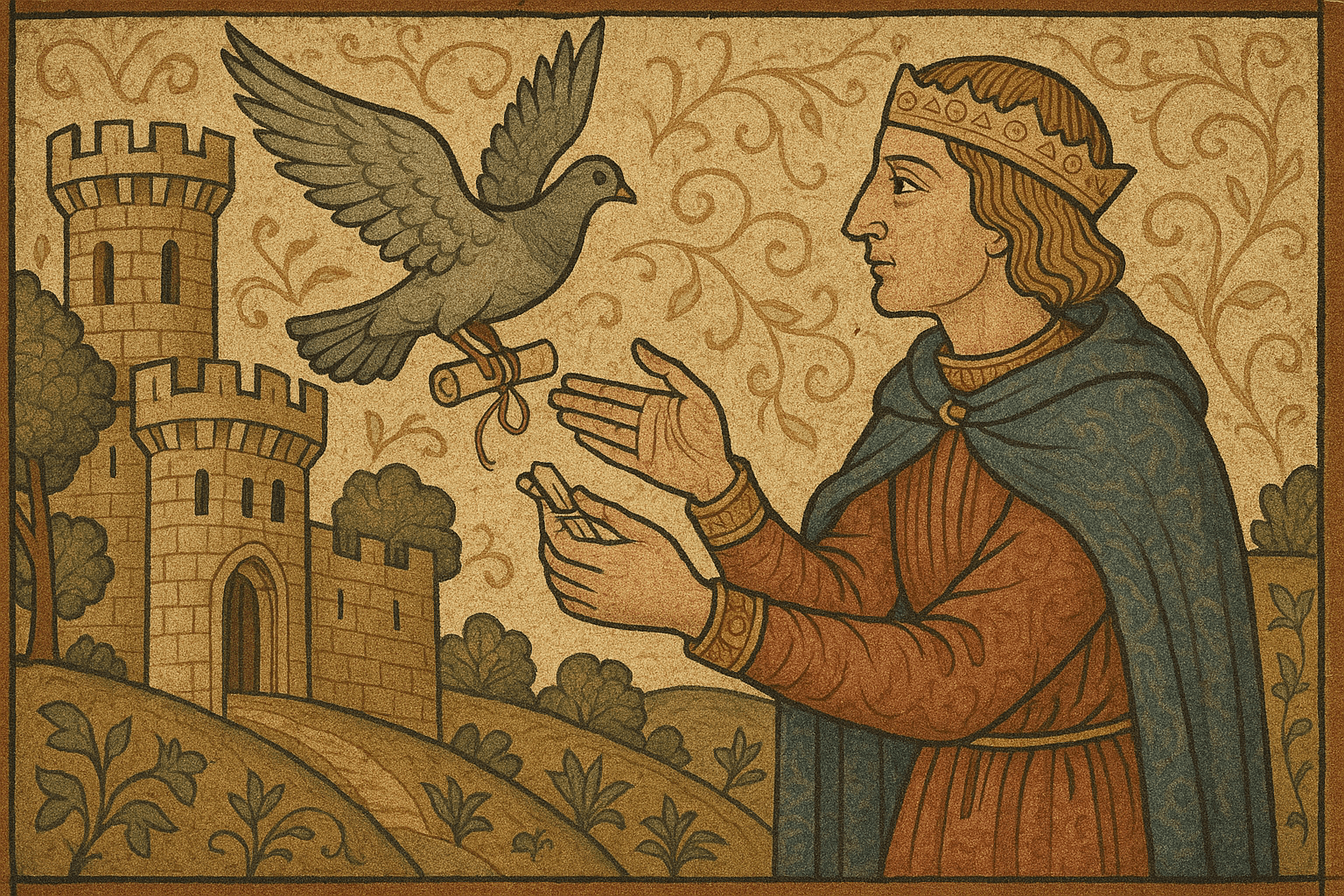
While we often associate messenger pigeons with the harrowing trenches of World War I, their golden age as an instrument of statecraft occurred centuries earlier. Sophisticated, organized, and astonishingly fast, the pigeon post systems of the medieval period, particularly in the Islamic world, represent a forgotten marvel of logistics and ingenuity.
From Ancient Omens to Imperial Messengers
Humans have long been fascinated by the homing pigeon’s uncanny ability to find its way back to its nest. The Romans, masters of infrastructure, used them to send a variety of messages, with Julius Caesar famously using pigeons to communicate with his forces during the conquest of Gaul. But these were often ad-hoc applications. It was in the medieval era that the pigeon post was institutionalized, transforming from a curiosity into a vital organ of the state.
The Golden Age: Pigeon Post in the Islamic Caliphates
Nowhere was the pigeon post more developed than in the great caliphates of the Middle East. Under the Abbasids in Baghdad and later the Fatimids and Mamluks in Cairo, the system reached its zenith. This was not a casual affair; it was a formal and funded part of the state postal service, known as the barīd.
An Instrument of State Control
The barīd was the central nervous system of the caliphate, a multi-faceted network that included horse-mounted couriers, foot messengers, and its swiftest component: the pigeon post. It was used to:
- Deliver administrative decrees to provincial governors.
- Receive intelligence on troop movements and potential rebellions.
- Report on the collection of taxes and the prices of commodities.
- Announce the birth of an heir or the death of a rival.
This rapid flow of information gave the central government an enormous advantage, allowing it to project power and react to events across vast territories with unprecedented speed. A message from Cairo to Damascus, a journey that could take a horse relay over a week, might be delivered by pigeon in less than a day.
Masters of Avian Logistics
The success of this system relied on a sophisticated infrastructure. A chain of specially constructed pigeon lofts, or towers (burj), was established along key routes. Each tower was staffed by a keeper who cared for the birds and managed the incoming and outgoing messages. Detailed registers were kept, cataloging the lineage and origins of each pigeon to ensure the purity of prized bloodlines. Certain birds were famous, known for their speed and reliability, and were valued more than a prized Arabian horse.
The great Zengid ruler Nur al-Din, and later his successor Saladin, were masters of the pigeon post. During their campaigns against the Crusader states, they used a constant stream of winged messengers to coordinate their armies, receive reports from spies, and stay informed of every development. When Crusaders besieged a Muslim-held city, pigeons were often the only hope for the defenders, carrying desperate pleas for reinforcement over the heads of the enemy army.
The Spread to Medieval Europe
European lords and merchants were introduced to the potential of the pigeon post largely through their contact—and conflict—with the East during the Crusades. They witnessed firsthand how Saladin’s forces used birds to maintain communication and were quick to see the military value. However, the European implementation was different, reflecting its more fragmented political landscape.
Castles, Merchants, and Feudal Networks
Unlike the centralized, state-run systems of the caliphates, pigeon post in Europe was mostly a private and localized affair. Feudal lords established lofts in their castles to communicate with allies or with their other holdings. During a siege, a pigeon released from a castle tower was far more likely to get past enemy lines than a human messenger on foot or horseback. The Normans, who ruled Sicily and became a crossroads of Christian and Islamic culture, were among the first to adopt the practice in Europe, establishing their own royal pigeon post.
Merchants and early bankers also saw the value. Genoese and Venetian traders used pigeons to send news of market prices or the safe arrival of a ship, giving them a crucial edge over their competitors. A message arriving hours or days ahead of a rival could mean the difference between immense profit and financial ruin.
The Nuts and Bolts of Medieval Airmail
How did this medieval technology actually work? It was a simple concept executed with meticulous care.
The One-Way Miracle
A carrier pigeon’s ability is not to deliver a message to any random location, but to return to its home loft, where it was raised and knows its mate and young to be. This is a one-way system. To send a message from Point A to Point B, you needed a bird that was born and raised at Point B. The pigeon would be carried (in a cage, by horse or cart) to Point A, and when released with a message, it would instinctively fly “home” to Point B. For a two-way conversation, you needed two sets of pigeons, one homed at each location.
Securing the Message
The message itself had to be lightweight. It was written on a tiny piece of thin paper, or sometimes even silk, then rolled tightly and inserted into a small, light capsule or tube. This was then fastened to the pigeon’s leg. Sometimes, coded messages were used in case the bird was captured by the enemy—an early form of avian cryptography.
The Perils of the Sky
The journey was far from guaranteed. A messenger pigeon faced numerous threats, including:
- Predators, especially hawks and falcons, which could be trained to intercept pigeons.
- Adverse weather like storms or strong winds that could disorient or exhaust the bird.
- Enemy archers who would try to shoot the pigeons down, knowing they carried vital intelligence.
The Twilight of the Flying Couriers
By the end of the Middle Ages, the grand, state-funded pigeon post systems had largely collapsed with the empires that built them. While private use continued, the rise of more organized, overland postal services, though slower, offered greater reliability for non-urgent mail. For centuries, the pigeon post remained a niche tool for financiers, stockbrokers, and the military.
It was a technology ahead of its time, a biological solution to the problem of distance. The next time you see a pigeon in a city square, take a moment to remember its ancestors. They were not mere birds, but the vital airmail of the medieval world—the silent, winged messengers who carried the secrets of kings and caliphs on their journey home.