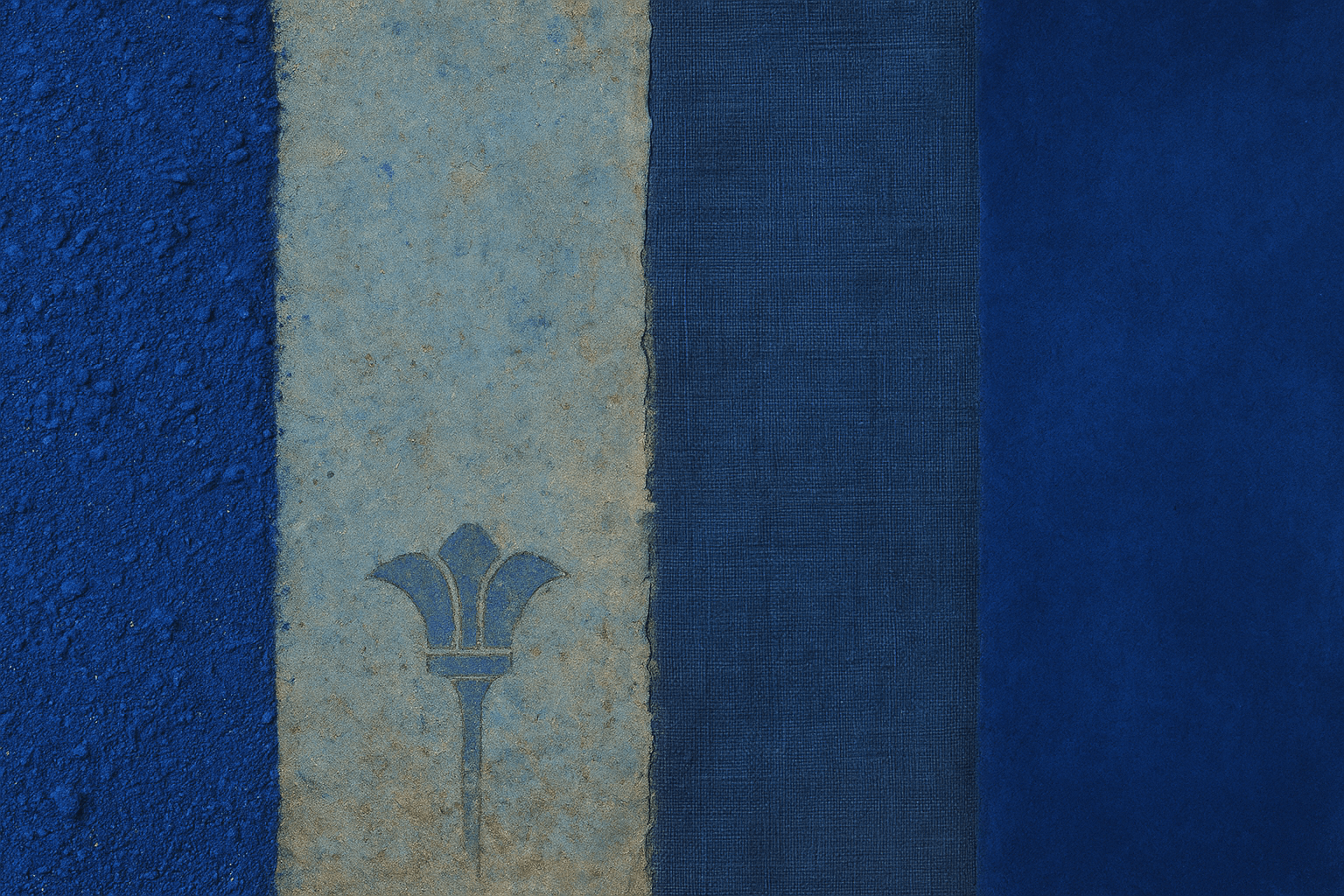
The First Synthetic Color: Egyptian Blue
Our story begins over 5,000 years ago in ancient Egypt. The Egyptians were enchanted by Lapis Lazuli, a deep blue metamorphic rock mined in the distant mountains of Afghanistan. The arduous journey along ancient trade routes made it fantastically expensive—a luxury reserved for royalty and divine artifacts. Ever the innovators, the Egyptians were not content to rely on a stone more precious than gold. They set out to create their own blue.
Through remarkable chemical prowess, they developed the world’s first-ever synthetic pigment: Egyptian Blue. The recipe was a feat of high-tech ancient engineering. They mixed ground limestone or sand (a source of calcium and silica) with a copper-containing mineral (like malachite) and a flux such as natron. This mixture was then heated in a kiln to a precise, blistering temperature between 800 and 900°C (1470-1650°F). The result was a vibrant, stable blue crystal (calcium copper silicate) that could be crushed into a pigment.
This was a revolution. Suddenly, the color of the divine, of the heavens, and of the life-giving Nile was accessible. It adorned the walls of pharaohs’ tombs, brought painted sarcophagi to life, and was even used to create beautiful faience beads and figurines. For nearly 3,000 years, Egyptian Blue was the standard blue of the ancient world, but as the Roman Empire crumbled, the complex knowledge required to create it was lost, and the color vanished for over a thousand years.
The Age of Ultramarine: More Precious Than Gold
With Egyptian Blue lost to time, the medieval and Renaissance world turned back to the original source: Lapis Lazuli. But now, master artisans developed a complex process to refine it into a pigment of unparalleled brilliance called Ultramarine. The name itself, from the Latin ultramarinus, means “beyond the sea”, a direct reference to its exotic, far-flung origins.
Creating Ultramarine was an incredibly laborious task. The Lapis Lazuli stone had to be ground into a fine powder, carefully avoiding the specks of fool’s gold (pyrite) and calcite that were often mixed in. This dust was then kneaded into a dough of melted wax, pine resin, and oils. After several days, the dough was kneaded again in a bath of lye. The finest, purest blue particles would fall away from the impurities and sink to the bottom, leaving a pigment so pure and radiant it seemed to glow.
This painstaking process made Ultramarine even more expensive than the raw stone it came from—its price often matched, and sometimes exceeded, that of pure gold. Its use in art was therefore strictly controlled by patronage. Artists reserved Ultramarine for the most sacred subjects, most famously the robes of the Virgin Mary, where its celestial hue signified her purity, divinity, and status as Queen of Heaven. To gaze upon the Ultramarine in a painting by Giotto or Titian was to witness a statement of both profound faith and immense wealth.
The Search for an Affordable Alternative
For artists not working on a Sforza-level budget, Ultramarine was simply out of reach. This created a market for cheaper, if inferior, alternatives.
- Smalt: This pigment was essentially ground-up cobalt-colored glass (potash glass). While it offered a shade of blue, it was a poor substitute. Smalt had a coarse, granular texture, lacked the vibrancy of Ultramarine, and was known to fade into a dull gray over time.
- Indigo: A deep blue dye extracted from plants, Indigo had been used for centuries to color textiles. It was far cheaper than mineral pigments, but it was fundamentally a dye, not a pigment. When used in painting, it was notorious for its transparency and for fading rapidly when exposed to light, making it a frustrating and impermanent choice for artists.
For centuries, the world of color was divided: the breathtaking, bank-breaking blue of Ultramarine for the rich, and the disappointing compromises of Smalt and Indigo for everyone else.
An Accidental Revolution: Prussian Blue
The next great leap forward in the history of blue came not from a deliberate quest, but from a lucky accident. In Berlin, around 1706, a paint and dye maker named Johann Jacob Diesbach was attempting to create a batch of cochineal red pigment. One of his materials, potash, was supplied by an alchemist named Johann Konrad Dippel. Unbeknownst to Diesbach, this particular batch of potash had been contaminated with animal blood during Dippel’s experiments to create an “elixir of life.”
When Diesbach mixed the contaminated potash with his other ingredients (including iron sulfate), a strange chemical reaction occurred. The iron from the potash reacted with the other compounds, and instead of the expected deep red, Diesbach was left with a startlingly deep, powerful, and stable blue. He had accidentally created the first modern synthetic pigment: iron ferrocyanide, which would become known as Berliner Blau or Prussian Blue.
The impact was immediate and profound. Prussian Blue was affordable, easy to produce, and intensely pigmented. It spread across Europe, transforming the artist’s palette. It was used by artists like Watteau and Canaletto. A century later, it would famously cross the globe to Japan, where it fueled the “blue revolution” in ukiyo-e woodblock prints, becoming the signature color in Katsushika Hokusai’s iconic The Great Wave off Kanagawa.
The Blue Rush of the 19th Century and Beyond
The discovery of Prussian Blue opened the floodgates of chemical innovation. In 1802, French chemist Louis Jacques Thénard developed Cobalt Blue, a pure, stable, and semi-opaque blue that was a perfect, less expensive mimic of Ultramarine’s hue. It was adored by the Impressionists like Monet and Renoir, who used its brilliance to capture the fleeting light of sky and water.
Then, in 1826, a competition in France to create a synthetic version of Ultramarine was won, resulting in “French Ultramarine.” Finally, the legendary color of the Renaissance masters was available to any artist who desired it.
From the lost magic of the Egyptians to the accidental discovery in a Berlin lab, the history of the color blue is a microcosm of human achievement. It’s a story that demonstrates our relentless desire to capture the world around us, to understand the materials it is made of, and to create beauty in the face of scarcity. And the quest hasn’t ended—as recently as 2009, a new, vibrant blue pigment (YInMn Blue) was discovered by accident, proving that our long and difficult relationship with this magnificent color is still being written.